
Issue Summary
The federal government is experiencing profound transition and faces both challenges and opportunities to improve performance and efficiency, ensure accountability, and position the nation for the future. At the end of FY 2024, the federal government employed 2.3 million federal civilian employees who delivered a wide range of services, such as providing healthcare to veterans, overseeing food and drug safety, enforcing laws, and securing infrastructure.
Since January 2025, the President has directed federal agencies to reduce the size of their workforce and restrict hiring. In response, agencies have taken various steps (some of which have been paused by litigation or congressional action). These include offering incentives for employees to voluntarily resign or retire, terminating employees in probationary or trial periods, implementing reductions in force, and restricting hiring for most federal positions.
In 2025, there were a total of 378,000 departures from the federal civilian workforce. This has resulted in a net decline in staff of over 11% at 22 major federal agencies that make up 95% of the civil service. While such declines varied across agencies—from about 1% at the Department of Homeland Security to over 45% at the Department of Education—most agencies had declines greater than 10% (after taking into account the 127,000 hires made during this time period).
Total Civilian Workforce at 22 Federal Agencies, December 2024 to January 2026
Image
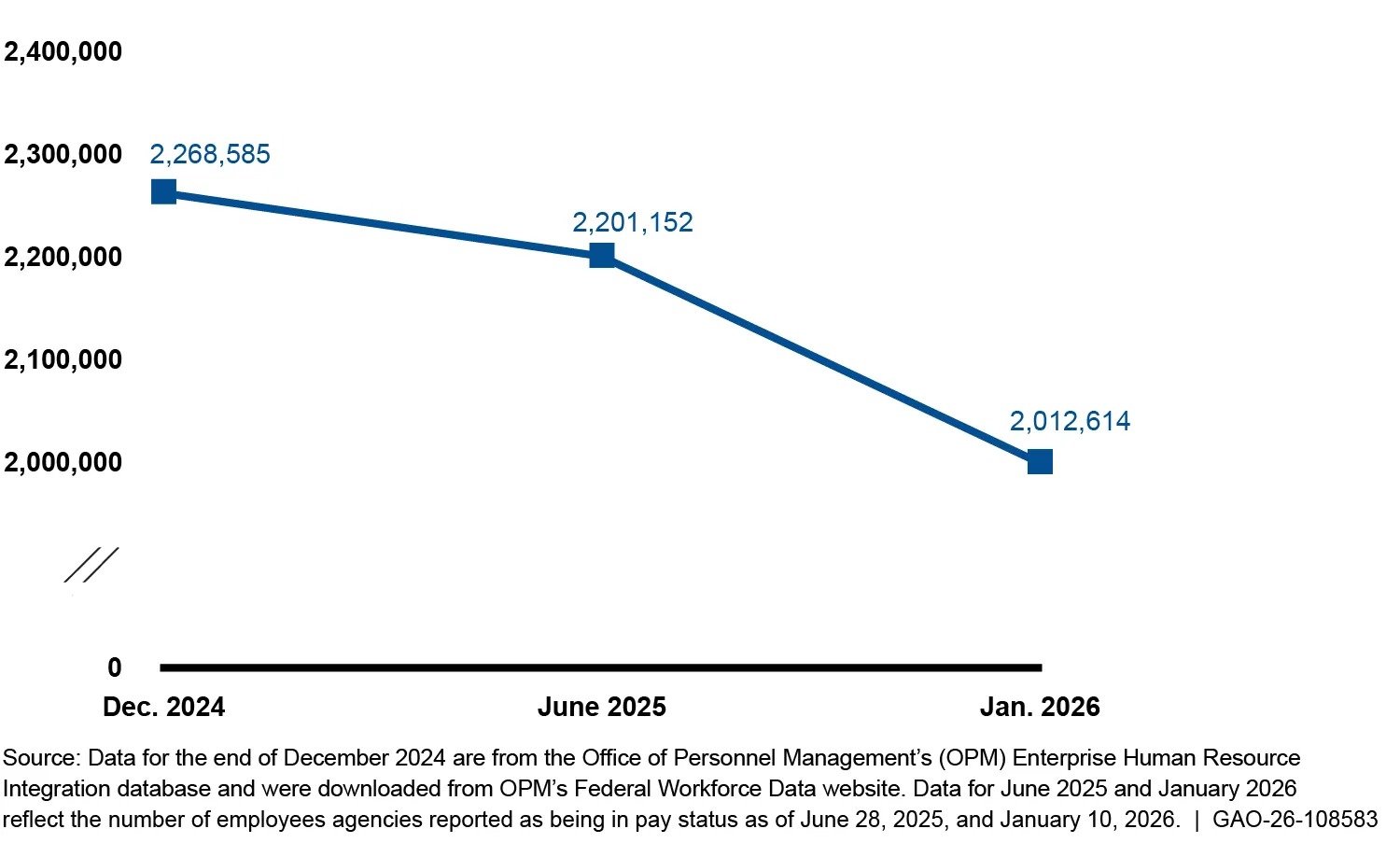
As a result of these workforce changes, agencies may need to take potentially costly steps to address staffing and skills gaps, such as using overtime, hiring contractors, investing in new technology, and reducing services to the public. Many agencies are also undergoing significant reorganizations. These changes could further exacerbate long-standing challenges in managing the federal workforce—an issue that’s been on the High-Risk List since 2001. Such challenges include maintaining mission-critical knowledge and skills, recruiting and retaining talent, and streamlining the hiring process.
Leading practices in workforce management can help overcome some of these challenges.
For example:
- Agency reform and reorganization. Restructuring the federal government is a major endeavor that can include refocusing agency missions, identifying and eliminating inefficiencies, and examining the impact of proposed changes on employees, stakeholders, and customers. To achieve productive change, agencies must consider leading practices, allocate sufficient resources, and consider workforce needs during and after reforms.
- Workforce planning. Federal agencies must develop long-term strategies for acquiring, developing, and retaining staff. For example, agencies should involve HR professionals and key stakeholders in strategic and workforce planning efforts. They should also monitor and evaluate progress toward human capital goals, maintain an inventory of employee skills and competencies, and have a process to address any skills gaps. As part of this effort, agencies should also develop succession plans to ensure there is a pipeline of qualified staff ready to move into open positions. Strategic workforce planning should happen before staff realignments or downsizing, so that changed staff levels don’t inadvertently produce skills gaps or other adverse effects.
- Classification and pay. Almost since the General Schedule (GS) job classification system was established in 1949, questions have been raised about its ability to keep pace with the evolving nature of government work. The federal government should examine ways to make the GS system's design and implementation more consistent with the attributes of a modern, effective classification system.
- Performance management. Managing employee performance has been a long-standing government-wide issue and the subject of numerous reforms since the beginning of the modern civil service. Without effective performance management, agencies risk not only losing the skills of top talent, they also risk missing the opportunity to effectively address increasingly complex and evolving mission challenges. Leading practices that may contribute to improved performance management include strengthening organizational culture, improving employee engagement and morale, and helping agencies hold employees accountable for poor performance and misconduct.
- Recruitment and hiring. Agencies should implement strategies to attract top candidates, identify the most qualified candidates, and ensure that the process of hiring and bringing them on board is as streamlined as possible. To do this effectively, agencies should develop customized approaches to recruit for specialized and hard-to-fill positions, and leverage hiring flexibilities—such as incentives and shared hiring opportunities with other agencies.
- Training. Effectively training federal employees involves developing a strategic approach that establishes training priorities and leverages investment in training to achieve specific agency results. This approach should include leaders who communicate the importance of training and encourage employees to participate in training activities. Agencies should also identify specific training initiatives that improve individual and agency performance and ensure that these are delivered effectively. Finally, quantitative and qualitative performance data should be used to assess how training efforts contribute to improved results.
Recent Reports
GAO Contacts
Image