
Human Capital: A Guide for Developing and Assessing Strategic Training and Development Efforts in the Federal Government
Fast Facts
Federal agencies train employees to carry out their missions in a rapidly changing world. But how do agencies know if their training programs are effective?
Our updated human capital guide can help agencies and oversight bodies assess whether training programs are aligned with priorities, efficiently implemented, and improving staff performance.
To develop the guide, we consulted with government officials, the private sector, academia, and nonprofit organizations. This guide updates our earlier work and covers new topics—including online learning and advancements in technology.

A woman sitting at a desk with a laptop in front of her while another woman stands next to her also looking at the laptop.
Highlights
What GAO Found
Training and development programs help federal agencies achieve their mission and goals by improving individual and, ultimately, organizational performance. This report is a guide that federal agencies can use to ensure their training and development investments are targeted strategically. In recent years, training and development have shifted from primarily classroom-based instruction to more integrated, blended learning approaches that reflect changes in the workplace and advances in technology. In addition, there is a greater focus on aligning learning to agency mission needs and outcomes, with coaching and mentoring playing an important support role in development.
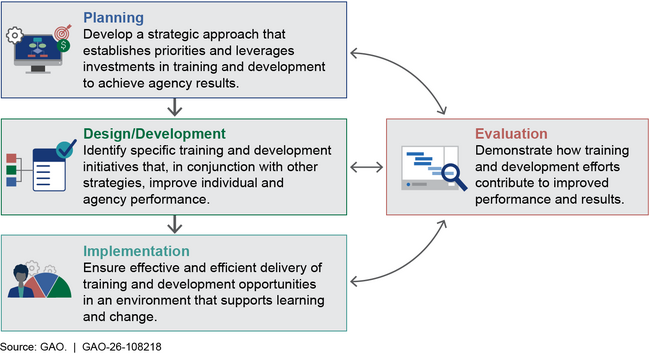
The training and development process can loosely be segmented into four broad, interrelated components: (1) planning, (2) design and development, (3) implementation, and (4) evaluation. As shown in the figure, these components form an integrated cycle. Decisions made in early stages influence later outcomes, while evaluation results should feed continuously into future planning and design. Effective agencies treat evaluation as an ongoing activity rather than a discrete, end-of-process step.
Four Components of the Training and Development Process
GAO also identified nine core characteristics that make a training and development process effective and strategically focused on achieving results, such as improved customer service or public safety. These characteristics include ensuring stakeholder involvement throughout the process and effectively allocating resources to maximize training investments. Additionally, new technology advancements, including digital learning and artificial intelligence, are further shaping how training is designed, delivered, and evaluated.
Why GAO Did This Study
Federal agencies operate in an increasingly complex environment characterized by evolving missions, fiscal constraints, technological change, and shifting workforce demographics. In this context, the ability of agencies to achieve results depends significantly on the skills, competencies, and adaptability of their employees.
In March 2004, GAO issued a guide for assessing strategic training and development efforts across the federal government. GAO has updated this guide to provide a current framework to help agencies, among other things, evaluate their training and development programs—specifically, to assess whether these programs are aligned with mission priorities, efficiently implemented, and demonstrably contributing to improved performance. This guide also provides a common structure for oversight bodies to assess agency practices consistently and systematically.
GAO consulted with 24 knowledgeable government officials and subject matter specialists in the private sector, academia, and nonprofit organizations. To validate and update the key practices in our 2004 report, GAO reviewed relevant literature on strategic training and development. GAO used this literature to help identify practices that have emerged over the past 20 years and to help identify the subject matter specialists. These specialists validated the practices described in the 2004 report and identified new or modified practices.
For more information, contact Dawn Locke at locked@gao.gov or Zina Merritt at MerrittZ@gao.gov.