
Nuclear Waste Cleanup: DOE Shortages in Mission-Critical Positions Have Continued to Increase
Fast Facts
The Department of Energy's Office of Environmental Management's federal staff oversee nuclear cleanup work across the U.S. In 2024, we reported that the office was understaffed, with a 17% vacancy rate—and that workforce challenges had caused delays, cost overruns, and accidents.
At the end of FY 2025, it had even fewer staff, with vacancy rate of 45%. Almost half of its vacancies were in mission-critical positions, such as nuclear safety specialists. Many in the remaining workforce are or will soon be eligible for retirement.
We maintain that the office should implement the recommendations from our 2024 report as it's rebuilding its workforce.
Overview of DOE's Carlsbad Field Office
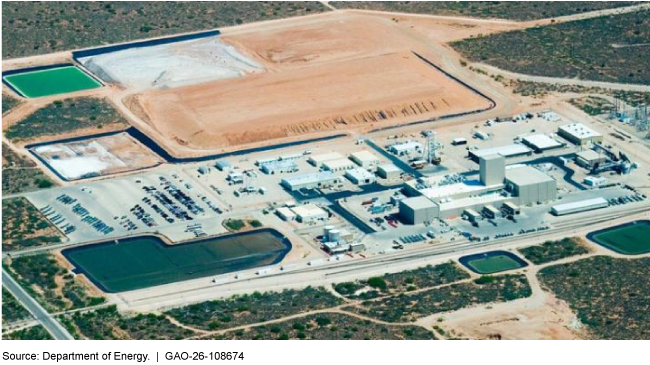
An overview photograph of DOE's Office of Environmental Management's site in New Mexico called the Carlsbad Field Office.
Highlights
What GAO Found
The Department of Energy’s (DOE) Office of Environmental Management (EM) has become further understaffed since GAO reported on EM’s workforce challenges in July 2024. From fiscal year (FY) 2023 through FY 2025, total staff decreased by 33 percent, from 1,272 to 856. This created an overall vacancy rate of 45 percent as of the end of FY 2025, based on a staffing need of 1,515 full-time employees that EM identified in FY 2023.
This understaffing includes shortages in mission-critical occupations that are integral to carrying out EM’s mission, which includes addressing contaminated buildings, soil, and groundwater, and treating radioactive waste.
Federal Staff in Selected Mission-Critical Occupations at the Department of Energy’s Office of Environmental Management (EM), End of Fiscal Year (FY) 2025
|
Occupational group |
Onboard staff |
Separations in 2025 |
Vacancies |
Vacancy rate (based on FY23 need) |
Retirement eligibility rate by 2030 |
|---|---|---|---|---|---|
|
General Engineering |
174 |
69 |
179 |
51% |
31% (54) |
|
Nuclear Engineering |
19 |
14 |
23 |
55% |
42% (8) |
|
General Physical Science |
117 |
55 |
51 |
30% |
35% (41) |
Source: GAO analysis of Department of Energy and EM information. | GAO-26-108674
EM experienced high attrition in FY 2025. Most staff left through the Deferred Resignation Program (DRP), and attrition will likely remain high, according to EM data. Of the 409 staff who left EM in FY 2025, 76 percent (312) separated through the DRP. Almost half (180) were in mission-critical occupations.
EM’s remaining workforce is aging. EM’s data indicate that, as of the end of FY 2025, 35 percent of EM’s remaining staff, and 30 percent in mission-critical occupations, will be eligible for retirement by 2030.
According to officials, EM plans to hire about 174 new staff in FY 2026, based on its FY 2026 budget, to help offset staffing gaps. As of March 2026, officials said EM is reassessing staffing needs and did not plan to change work scopes to match any potential changes in workforce numbers while considering reorganization. A reduction in identified staffing needs would eliminate some vacant positions, according to officials.
In July 2024, GAO reported that EM’s levels of understaffing and workforce management challenges had caused schedule delays, cost overruns, and workplace accidents. These events all affected EM’s mission to clean up nuclear waste, according to DOE assessments. GAO concluded that without efforts to address workforce challenges, severe staffing shortages threatened EM’s ability to meet its mission.
Why GAO Did This Study
EM relies on federal staff to oversee its nuclear waste cleanup, which is the result of decades of nuclear weapons production and research at locations across the country. Since January 2025, several executive orders, memoranda, and related programs have affected EM’s workforce.
GAO was asked to provide updated information on the EM workforce data that it had reported in July 2024 in GAO-24-106479.
This report describes EM’s workforce capacity including the composition and attrition rates as of the end of FY 2025. GAO reviewed agency documents, analyzed EM’s human capital data for fiscal years 2023 through 2025, and interviewed EM officials.
Recommendations
In its July 2024 report, GAO made 10 recommendations to DOE to improve EM’s workforce management, including that EM develop a forward-looking workforce plan and develop a strategy for a multigenerational pipeline.
DOE agreed with all of the recommendations, which remained open as of March 2026. GAO maintains that all of these recommendations warrant action.