Issue Summary
The federal government spends hundreds of billions of dollars each year on contracts, which consume a large portion of the federal budget. In FY 2025 alone, the federal government spent about $793 billion on contracts for a wide variety of goods and services—from cybersecurity software to consulting services to aircraft carriers—that are critical to the success of agency missions.
Which Agencies Were Responsible for the Most Contract Dollars?
Image
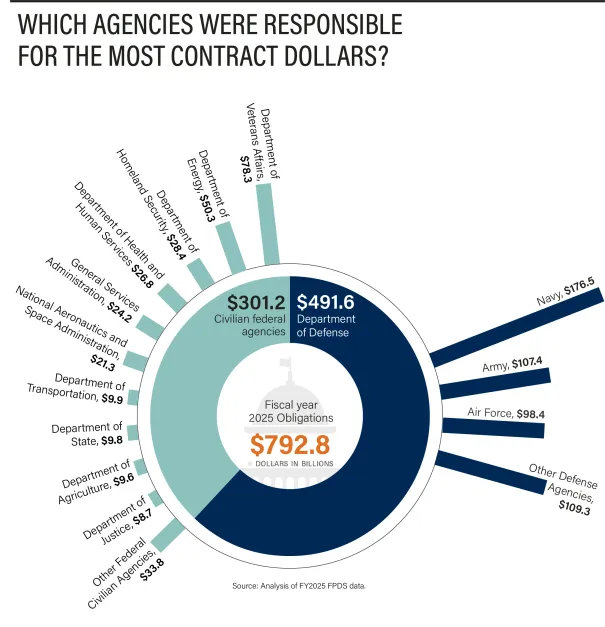
Unlike a contract between a homeowner and a plumber, a federal contract is complex, sometimes worth billions of dollars, and subject to numerous laws and regulations that govern how agencies award and manage these contracts. The stakes are high. Federal contracting practices have implications not only for how efficiently agencies are spending taxpayer dollars but also the extent to which the U.S. is able to acquire cutting-edge technologies, maintain a healthy industrial base, and address national security objectives. Further, when agencies face contracting-related challenges, the consequences can be far-reaching: the military may not have the latest technologies, disaster relief may not reach the public fast enough, and the discovery of life-saving drugs and medical breakthroughs may be slowed.
There are a number of ways federal agencies can improve how they contract for goods and services.
For instance:
- Obtaining better prices. Federal agencies are responsible for negotiating the best deal for the government when contracting for goods and services.
- The government’s category management initiative helps federal agencies use contracts to buy like a single enterprise to leverage the government’s buying power and save money. But not all agencies are effectively using these contracts. For example, the Department of Veterans Affairs (VA) has not established category-specific savings goals related to use of these contracts and needs more training to ensure officials have the necessary information. For instance, the VA spends hundreds of millions of dollars annually to buy and maintain high-tech medical equipment like MRI machines. It can use agency-wide contracts to do so, which reduces red tape and helps the VA get the best available price. But some officials didn’t use these contracts when buying maintenance because of poor guidance and resources.
- Competition for government contracts saves money and improves performance. For instance, the Department of Energy receives multiple offers for most of its large contracts. But some industry representatives have questioned the fairness of the award process, and such perceptions of unfairness may deter competition.
- Timely awarding of contracts. Delivering contracted goods and services at the speed of relevance is critical for maintaining national security and responding to national emergencies.
- Contracting during an emergency can be challenging. For example, the Federal Emergency Management Agency (FEMA), the Army Corps of Engineers, states, localities, and Tribes can award contracts in advance of a disaster to support quick response and recovery actions. However, without defined roles and responsibilities—especially for how to coordinate and share information—this has resulted in confusion among FEMA’s offices.
- Expedited contract awards without adequate planning can inadvertently lead to wasted contract dollars. For example, the Army and U.S. Immigration and Customs Enforcement quickly awarded a $1.3 billion facility contract for immigration detention in Texas. The contract requires ICE to pay the full cost of meals and operational services for 5,000 people—even when the facility's population is far lower. This has resulted in millions of dollars of waste.
- Improving oversight. The government is responsible for overseeing contractors and monitoring their performance and compliance with the terms and conditions of contracts.
- To confirm their employees' eligibility to work in the U.S., most federal contractors must use the E-Verify program. OMB expects agencies to ensure that their contractors comply, but not all agency officials are aware of this expectation. Also, the Department of Homeland Security used to give agencies a quarterly list of contractors enrolled in and using E-Verify—but discontinued this report last year due to data accuracy issues. Without clear expectations and useful data, agencies may not be checking their contractors' compliance with this requirement.
- The VA increasingly relies on contractors for a wide range of services. But if contractors perform certain functions—e.g., providing legal advice or supporting budget prep—without additional oversight, they could pose risks to government decision-making and accountability. OMB has issued guidance to help agencies determine which contracted services need this oversight but VA has yet to fully implement this guidance.
- Building a resilient industrial base and supply chain. A healthy defense industrial base, including small businesses and non-traditional contractors, is critical to maintaining U.S. national security objectives.
- More than 200,000 companies provide supplies, parts, and manufacturing for DOD's weapon systems. Risks to this defense industrial base include materials shortages, reliance on foreign suppliers, and more. Various DOD offices and the military services monitor such risks and work to mitigate them. However, DOD doesn't have a robust strategy to mitigate risks or track progress.
- The Defense Production Act authorizes the President to invest in industrial production—and more—to ensure the availability of needed goods and services. From 2018 to 2024, agencies made $3.2 billion in industrial investments under this act. For example, agencies invested in ramping up production of personal protective equipment like gloves and masks during the COVID-19 pandemic. Agencies across the federal government are using this authority, but they have not collected or shared lessons learned.
- Improving transparency. Collecting better data on federal contracts would increase visibility into certain contracting scenarios and improve oversight.
- Several federal agencies share responsibility for leading wildfire response and recovery. These agencies often work with private sector contractors to obtain life-saving goods and services quickly. They tend to prioritize speed when ordering, but one agency had officials—who weren’t contracting officers—approve individual orders that exceeded their ordering limit.
- DOD sometimes awards funds via an "other transaction agreement." OTAs allow for more flexibility than traditional contracts do, enabling DOD to partner with contractors it hasn't worked with before. DOD can award OTAs to an individual organization (like a contractor) or to a consortium, which is a group of organizations focused on a specific technology area (like cybersecurity). DOD has been awarding OTAs through consortia more frequently but it hasn't systematically tracked data on which consortia—and therefore which technology areas—receive these funding awards.
- Enhancing contracting outcomes. The government buys a huge range of products and services, from military aircraft to common office supplies. A review of how 7 leading companies manage procurement found that successful companies link performance metrics to broader strategic goals, work with those using the products and services to develop these metrics, and use outcome-oriented metrics (like timeliness and quality). However, some federal agencies didn't consistently use the second and third practices—which could help improve government contracting.
Recent Reports
GAO Contacts
Image

Image