
Disaster Contracting: Actions Needed to Encourage Advance Contract Use and Improve Information Sharing and Oversight
Fast Facts
The Federal Emergency Management Agency, the Army Corps of Engineers, states, localities, and Tribes can award contracts in advance of a disaster to support quick response and recovery actions. For instance, having contracts for debris removal in place before a disaster can help communities quickly start cleaning up after a disaster occurs.
However, we found confusion among FEMA's offices about roles and responsibilities for encouraging state, local, and tribal governments to award advance contracts. This could result in these governments not being fully prepared for future disasters.
Our 6 recommendations address this issue and more.
Debris from Hurricane Helene in North Carolina in March 2025
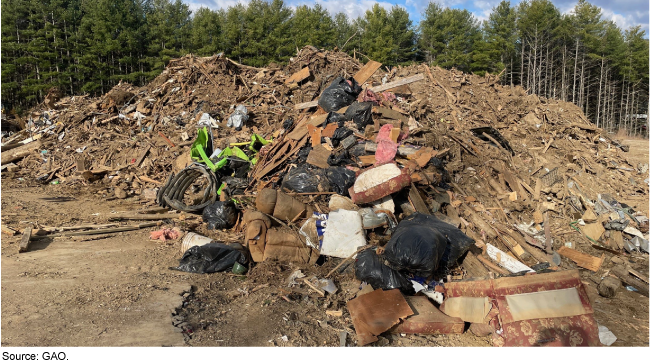
A pile of debris and mud surrounded by several trees.
Highlights
What GAO Found
When communities are hit by a major disaster—such as a flood, hurricane, or wildfire—a key first step is removing large quantities of debris so that they can begin to recover. The Federal Emergency Management Agency (FEMA), a component within the Department of Homeland Security (DHS), and the U.S. Army Corps of Engineers can help them respond quickly by awarding contracts before disasters strike. Tribes, states, and localities may also award their own advance contracts for debris removal. GAO found that six of 16 selected governments had awarded advance contracts for debris removal and identified benefits of having them, such as speed of debris removal.
GAO also found confusion among FEMA’s procurement training group and its regional offices about roles and responsibilities for encouraging governments to award advance debris removal contracts. Clarifying roles and responsibilities would improve information sharing to encourage advance contract use.
Uncleared Fire Debris in Pacific Palisades, California (May 2025)
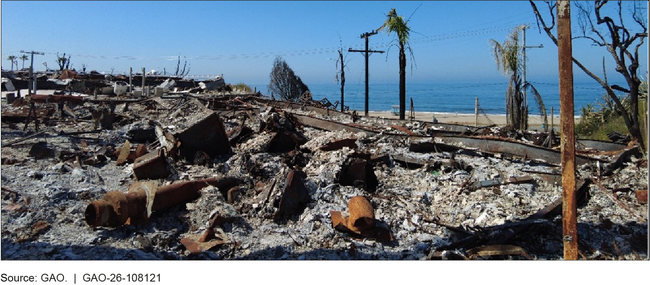
GAO found that the Army Corps’s processes for reporting debris removal data to those affected by the Los Angeles wildfires (January 2025) and Hurricane Helene in North Carolina (September 2024) differed. In Los Angeles, the Army Corps publicly shared an online interactive map with real-time debris removal data within about 6 weeks after the wildfires began. In contrast, it did not share county-specific infographics for those in North Carolina affected by the hurricane until 4 months after the disaster. Because the Army Corps has not completed an analysis of the reasons for the differences in data sharing, it may miss opportunities to improve its approach to providing timely and consistent data, including real-time debris removal data, during future disasters.
FEMA put controls in place to mitigate the risks of fraud, waste, and abuse in its debris removal program. For example, it requires that grant applicants ensure that debris removal quantities are accurate to avoid incurring unnecessary costs. But, FEMA is not well positioned to obtain and evaluate information about new or evolving fraud, waste, and abuse risks in its debris removal program because its efforts do not align with fraud risk management leading practices. Conducting regular risk assessments and developing a process to address risks would help FEMA more strategically manage risks across its entire debris removal program.
Why GAO Did This Study
FEMA and the Army Corps spend billions of dollars annually to respond to major disasters. Using advance contracts can help quickly start the recovery because contractors may be able to start work soon after a disaster.
The Disaster Contract Improvement Act includes a provision for GAO to review several areas related to debris removal. This report, among other objectives, examines (1) selected governments’ perspectives on the use of advance contracts for debris removal, and the extent to which FEMA encouraged the use of advance contracts; and the extent to which (2) the Army Corps developed processes for reporting advance contract debris removal efforts during the responses to two disasters, and (3) FEMA mitigated risks in its debris removal program.
To conduct this review, GAO reviewed FEMA and Army Corps policies, data, and other documents and conducted site visits to observe ongoing debris removal in Los Angeles and North Carolina. GAO also interviewed FEMA and Army Corps officials, and officials from 16 governments, selected based on obligation amounts and geographic variation, among other factors.
Recommendations
GAO is making six recommendations, including that FEMA defines roles and responsibilities in encouraging advance contract use, that the Army Corps analyzes differences in information sharing in its recent disaster responses, and that FEMA develops a process to identify and address risks of fraud, waste, and abuse. DHS and the Army concurred with our recommendations.
Recommendations for Executive Action
| Agency Affected | Recommendation | Status |
|---|---|---|
| Federal Emergency Management Agency | The FEMA Administrator should define the Procurement Disaster Assistance Team's and Regional Offices' roles and responsibilities in encouraging state, local, and tribal governments to award advance contracts for debris removal, including how they should coordinate and share information. (Recommendation 1) |
When we confirm what actions the agency has taken in response to this recommendation, we will provide updated information.
|
| Federal Emergency Management Agency | The FEMA Administrator should ensure that the Procurement Disaster Assistance Team updates its training materials to include quality information, such as other governments' success stories using advance contracts. (Recommendation 2) |
When we confirm what actions the agency has taken in response to this recommendation, we will provide updated information.
|
| Corps of Engineers | The Assistant Secretary of the Army for Civil Works should ensure that the Chief of Engineers and the Commanding General of the U.S. Army Corps of Engineers conduct an analysis of the information sharing practices for debris removal missions, including the differences between the Hurricane Helene and Los Angeles wildfires, and identify any lessons learned for responding to future disasters. (Recommendation 3) |
When we confirm what actions the agency has taken in response to this recommendation, we will provide updated information.
|
| Federal Emergency Management Agency | The FEMA Administrator should take steps, such as providing training on how to use checklists, to ensure Consolidated Resource Center officials are aware of cost eligibility policy requirements for reviewing grants involving noncompetitive and time-and-material contracts. (Recommendation 4) |
When we confirm what actions the agency has taken in response to this recommendation, we will provide updated information.
|
| Federal Emergency Management Agency | The FEMA Administrator should conduct regular assessments to identify risks of fraud, waste, and abuse in FEMA's debris removal program. (Recommendation 5) |
When we confirm what actions the agency has taken in response to this recommendation, we will provide updated information.
|
| Federal Emergency Management Agency | The FEMA Administrator should ensure that the PA program develops a process for addressing fraud, waste, and abuse risks identified in regular risk assessments of its debris removal program, including evaluating and revising its controls for these risks and, if necessary, instituting additional controls. (Recommendation 6) |
When we confirm what actions the agency has taken in response to this recommendation, we will provide updated information.
|