
After Disaster Strikes, the Mountains of Debris Left Behind Are the Next Crisis
Long after the storm passes, the water recedes, or the fire goes out, communities impacted by natural disasters must deal with another crisis—mountains of debris. This debris must be cleared before rebuilding can begin. For example, in the year following Hurricane Helene, more than 9 million cubic yards of debris was removed from North Carolina alone. That’s enough rubble to fill nearly seven and a half Empire State Buildings.
Today’s WatchBlog post looks at our new report on how some communities are taking proactive steps to plan for this cleanup and why other communities struggle to do so.
Depiction of the Volume of Debris Removed in North Carolina by the U.S. Army Corps of Engineers After Hurricane Helene (2024)
Image

The calm comes before the storm. The cleanup comes after.
Natural disasters can cost billions to recover from. For example, the Federal Emergency Management Agency (FEMA) provided $3 billion to survivors of Hurricanes Helene and Milton, the Los Angeles wildfires, and the Texas floods in 2025. In 2024 alone, there were 27 disasters that each left more than $1 billion in damage.
Uncleared Fire Debris in Pacific Palisades, California (May 2025)
Image
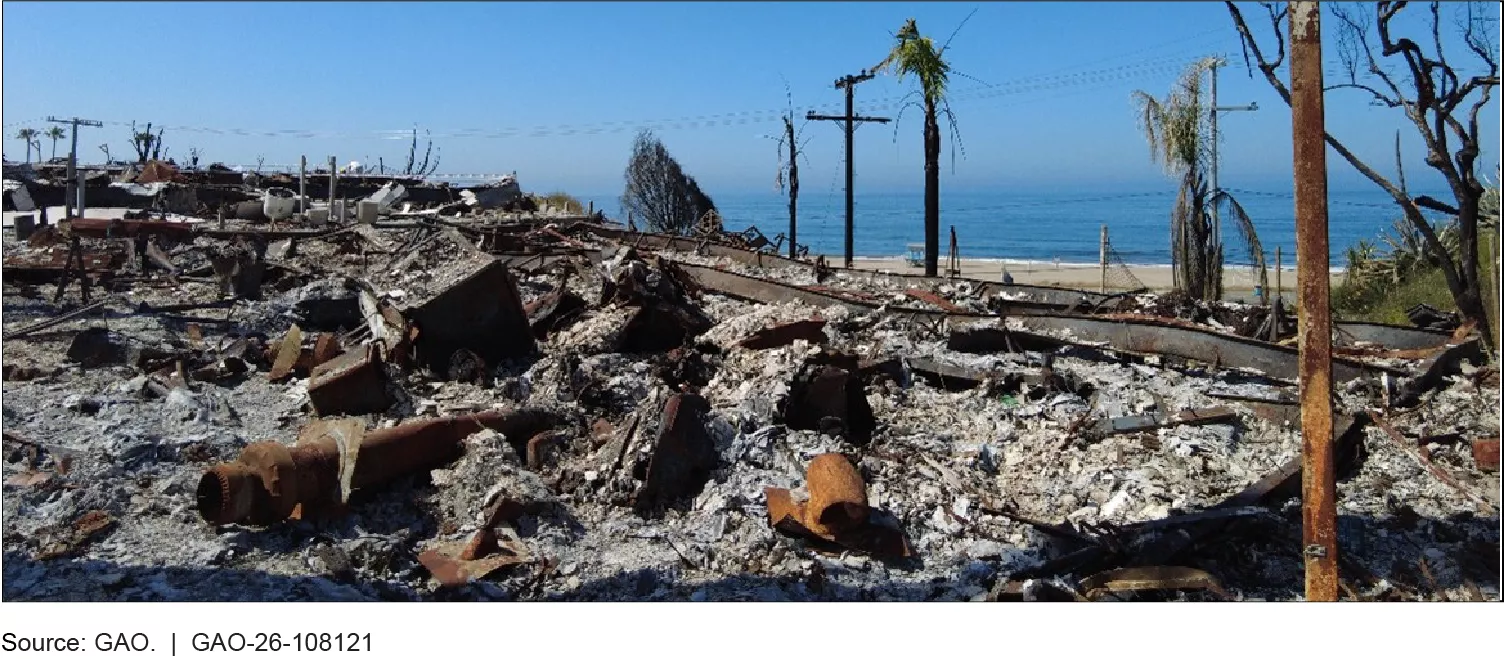
Every disaster is different. And each community has its own needs and challenges after a disaster. But we found that some communities were able to recover more quickly because of advanced planning. This included having contracts in place for cleanup before the disaster even struck. What does this look like?
Some state and local governments set up debris removal contracts before disasters so that cleanup can begin as soon as possible. Having these contracts in place means that communities aren’t grappling with finding a contractor and getting a good deal when they are also addressing other urgent needs.
Why some communities have contracts in place. We spoke to officials from governments that awarded contracts in advance. They said that the greatest benefit is the speed at which debris removal begins. For example, in one community this work began within 48 hours after a major disaster. Officials also told us that having a contract already in place can reduce costs and ensure that contracts meet FEMA reimbursement requirements.
Why some communities don’t have contracts in place. We also spoke to officials who did not award contracts in advance of disasters. Some said that they lacked the experienced personnel and financial resources needed to award advanced contracts. They were also concerned that minimum fees would be required regardless of whether they used the service in the future. Other officials said that cleanup in different geographies—mountainous versus coastal, for example—can require different equipment. For this reason, they did not want to award contracts before knowing where contractors would need to work.
The federal role in helping communities clean up after disaster
FEMA is responsible for helping with recovery after disasters. In our report, we looked at two key ways FEMA does this—
- First, by helping state and local governments prepare for cleanup needs
- Second, by providing them grants to help with cleanup costs
Helping local governments prepare. Part of FEMA’s role is to educate state and local governments on the use and benefits of having contracts in place in advance for disasters. FEMA also provides training meant to encourage this advanced planning. But when we looked at this training, we found it did not include information on how to overcome some of the challenges local officials told us about. And the training did not provide guidance on how to successfully set up contracts in advance. In our new report, we made recommendations for how FEMA could improve these and other efforts related to disaster clean up contracting.
Helping through grants. FEMA also helps state and local governments by awarding an average of $20.5 billion in public assistance grants each year. This can help offset state and local governments’ debris removal costs.
But it is critical that FEMA officials understand and apply eligibility requirements to avoid fraud risks in this program. We recommended that FEMA take steps to ensure the program has a robust fraud risk management system.
To learn more about disaster debris removal contracting and the federal government’s role in this process, read our full report.
- GAO’s fact-based, nonpartisan information helps Congress and federal agencies improve government. The WatchBlog lets us contextualize GAO’s work a little more for the public. Check out more of our posts at GAO.gov/blog.
- Got a question or comment? Email us at blog@gao.gov.
GAO Contacts
Image


Related Products

GAO's mission is to provide Congress with fact-based, nonpartisan information that can help improve federal government performance and ensure accountability for the benefit of the American people. GAO launched its WatchBlog in January, 2014, as part of its continuing effort to reach its audiences—Congress and the American people—where they are currently looking for information.
The blog format allows GAO to provide a little more context about its work than it can offer on its other social media platforms. Posts will tie GAO work to current events and the news; show how GAO’s work is affecting agencies or legislation; highlight reports, testimonies, and issue areas where GAO does work; and provide information about GAO itself, among other things.
Please send any feedback on GAO's WatchBlog to blog@gao.gov.