After A Disaster, Survivors May Get Hit Again By Scammers
After disaster strikes, there’s often a lot of confusion on the ground. As communities try to recover quickly, residents and businesses can find themselves scrambling to get assistance that covers the cost of materials and labor needed to rebuild.
This combination of confusion and the influx of financial assistance is an attractive target for scammers. And the result may be that some people fall victim twice—both to the disaster and to the scams that come after it.
Today’s WatchBlog post looks at our new report about disaster assistance scams including their methods, prevalence, and how to avoid them.
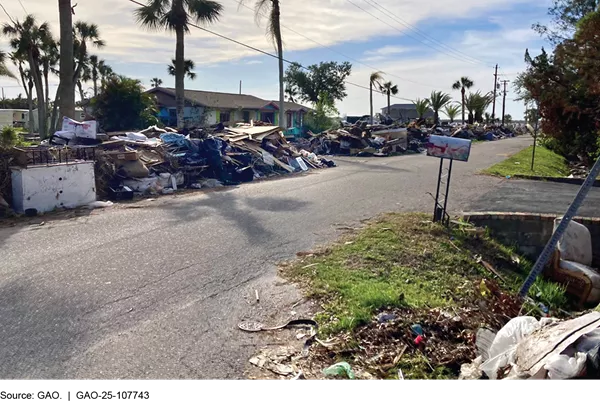
Florida Community Damaged from Hurricanes Helene and Milton in 2024
Image
What makes disaster survivors attractive targets for scams?
After a disaster, survivors are particularly vulnerable to scams. Hurricanes, tornados, fires, or flooding may leave communities without electricity, internet, and other utilities. This can limit people’s ability to get good information about what’s going on. At the same time, there’s often an influx of funding from insurance and the federal government, which distributes billions of dollars in relief funds quickly after disasters.
For scammers, this is the perfect storm—a concentration of potential victims desperate for help.
The prevalence of disaster scams is not known, and scams are likely under reported. A Census Bureau survey from 2024 found that as many as 77% of survivors experienced a possible scam within a month of the disaster.
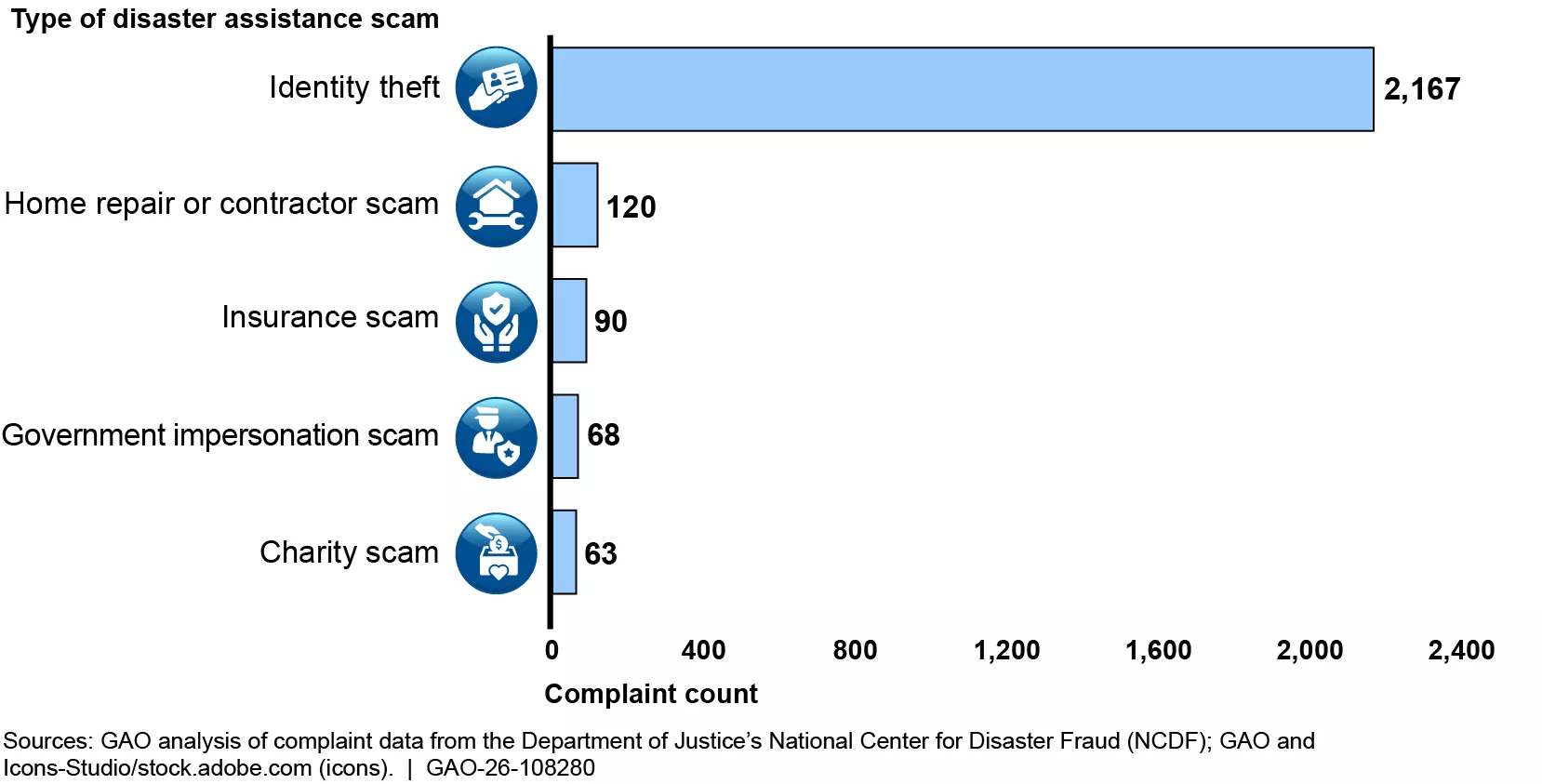
Scammers generally succeed by manipulating or deceiving victims, playing on their emotions to exploit vulnerabilities. A lot of disaster-related scams start with an offer to help. Here are some common scams that occur after disasters:
- Identity theft. Scammers steal names, addresses, and Social Security numbers. Then they apply for disaster assistance meant for survivors.
- Insurance scams. Scammers pretend to be insurance companies calling to get information from survivors. But really, they are stealing personal information and often funds too.
- Home repair or contractor scams. The scammers pretend to offer services for repair work, often asking for a deposit up front or money for materials prior to any work being started. In the end, no repair work is done, or the work is inferior or incomplete.
- Government impersonation scams. Scammers pretend to be local law enforcement or government officials from, for example FEMA, in an attempt to extort money or steal personal information.
- Mortgage scams. Scammers may offer homeowners assistance by falsely claiming to negotiate or delay their mortgage payments with the promise to prevent foreclosure through an upfront fee.
- Rental scams. These include fake listings for temporary housing that are actually either not really available or do not exist. Money is exchanged before the survivor realizes the listing is fake.
- Fake charities. The scammers pretend to collect donations to help survivors but then keep some or all the funds.
Types of Reported Disaster Assistance Scams, 2023 to 2024
Image
Technology is making these scams more realistic. Text messages, social media, and artificial intelligence (AI) have helped increase the frequency of scams and made them harder to detect. Scammers can more easily set up fake IDs and websites that make their scams seem legitimate. Learn more about how this technology is being used in scams by reading our other report about them or by listening to our April 2025 podcast below.
Technology also makes it harder to catch scammers. Payment apps and online transactions allow money to move more quickly. Scammers have benefited from this technology, which has made tracing and recovering lost money more difficult. We looked at payment scams and financial technologies in 2024. Learn more in our full report.
What is being done to go after scammers and protect consumers?
Federal and state law enforcement, as well as FEMA, have gone after scammers who target disaster survivors. Scamming disaster survivors can result in criminal or civil convictions, prison sentences, fines, and bans from relevant industries. Prosecuting scammers is important. But federal and state law enforcement also want to prevent scams. When someone reports a scam, that information is analyzed along with other reports to look for trends. This can help law enforcement investigate crimes. It also helps them to provide the public with information about common and emerging scams.
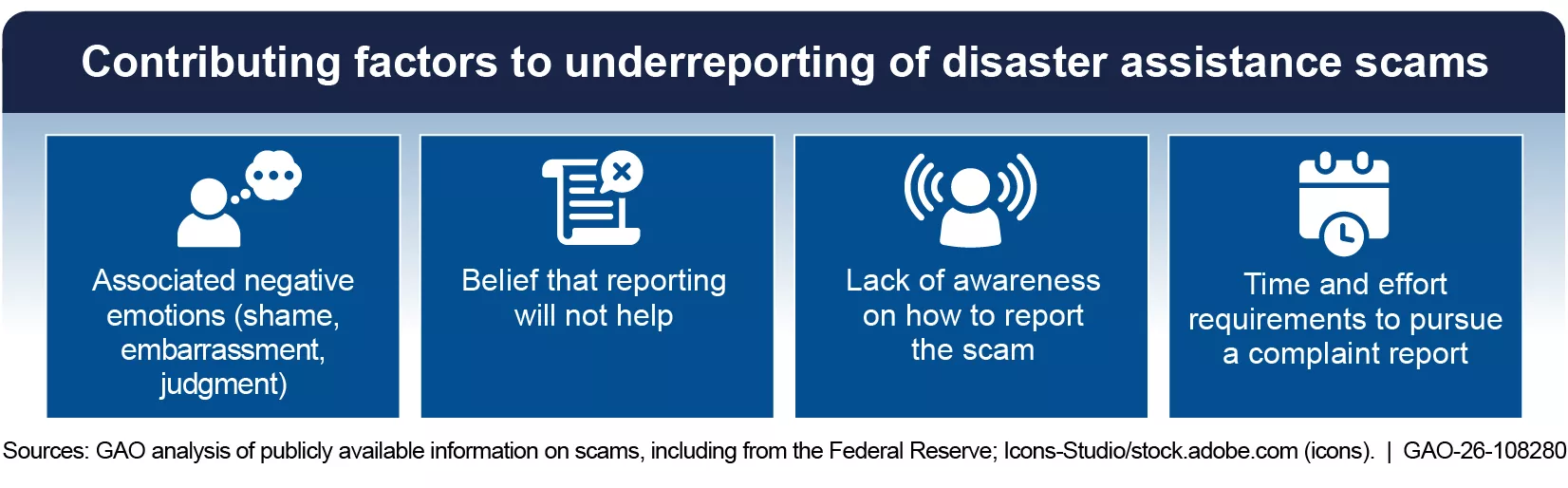
If you are scammed, it’s very important to report it. But sadly, many don’t. And law enforcement said this lack of reporting is a major hindrance to its efforts.
Image
Need for a government-wide strategy. As scams increase in number and sophistication, so increases the need for a government-wide strategy for preventing them. In March, the president issued an executive order directing the creation of an action plan that would lead to a government-wide strategy. As the government enacts these orders, we hope they will incorporate our recommended actions from 2025, that would ensure such a strategy is effective.
What can you do to protect yourself?
Educate yourself. That is the best way to arm yourself against scams. Our report includes a list of common scams as well as their potential red flags (things to look out for).
There are also other great sources of information for you. There are many federal and state-run websites that detail common scams. For example,
FEMA’s website has a “rumor page” that informs the public about misinformation circulating online and via text messages after a disaster.
- The Consumer Financial Protection Bureau’s website has resources about all kinds of scams, as well as information on how to get help if you are a victim.
If you enjoyed this blog, we hope you’ll check out our full report to learn more.
- GAO’s fact-based, nonpartisan information helps Congress and federal agencies improve government. The WatchBlog lets us contextualize GAO’s work a little more for the public. Check out more of our posts at GAO.gov/blog.
- Got a comment, question? Email us at blog@gao.gov.
GAO Contacts
Image