
Border Security: DHS Needs to Better Plan for and Oversee Future Facilities for Short-term Custody
Fast Facts
U.S. Customs and Border Protection can use temporary soft-sided facilities when it needs more capacity to process and hold people apprehended at the southwest border.
Between 2019-2024, CBP spent over $4 billion on contracts for meals, guards, and services at these facilities. As of March 2025, CBP isn’t using these facilities but likely will use them again. It hasn’t assessed lessons learned about staffing, operations, or costs.
The Department of Homeland Security received funding for permanent processing centers in 2022 and began building the first one in 2024 without complete cost information.
We recommended addressing these issues, and more.
Aerial View of a CBP Temporary Soft-Sided Processing and Holding Facility in San Diego, CA
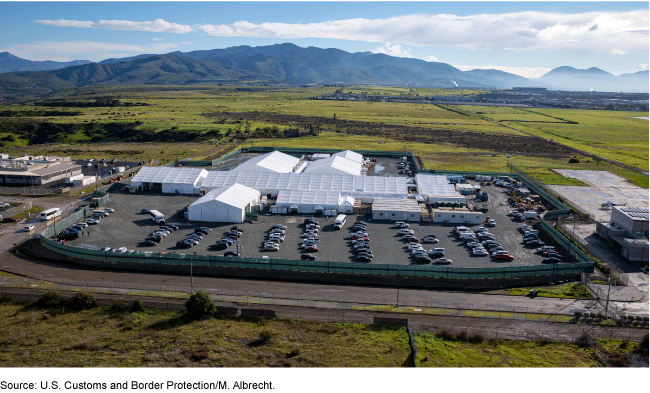
A large building with a lot of cars parked in front of it.
Highlights
What GAO Found
Between 2019 and 2024, U.S. Customs and Border Protection (CBP)—a component of the Department of Homeland Security (DHS)—experienced a significant increase in the number of individuals apprehended by U.S. Border Patrol along the southwest border. To address this issue, CBP used temporary soft-sided facilities—steel-framed tent-like structures—to provide additional capacity for processing and holding people in its custody.
Because they are temporary, the number of facilities can change due to trends in the number of people apprehended. In September 2024, CBP had seven soft-sided facilities with different capacities—from 983 to 2,500. In March 2025, CBP ceased operating these facilities due to a significant drop in apprehensions.
Aerial and Interior Views of Soft-Sided Facilities Used by U.S. Customs and Border Protection
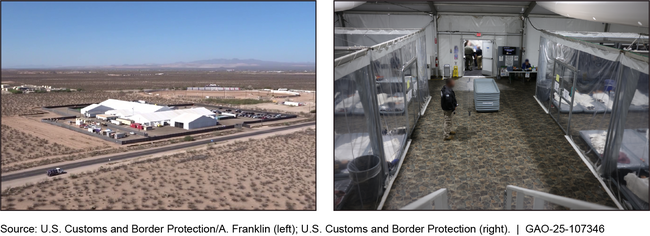
CBP obligated over $4 billion total from 2019 through 2024 for soft-sided facilities and related services. But CBP engaged in limited acquisition planning to inform its investments in these facilities. For example, CBP did not take steps to accurately determine the number of contractor staff it needed to operate those facilities. As a result, some locations had either too few or too many staff. While CBP is not currently operating soft-sides facilities, it is likely to do so in the future if there are future surges in apprehensions, according to officials. Thus, CBP has an opportunity to identify and document lessons learned to better inform future investment decisions for these facilities.
In fiscal year 2022, Congress appropriated $330 million to DHS to develop and construct Joint Processing Centers. DHS plans to build and operate up to five of these facilities along the southwest border, which GAO estimates could cost roughly $7 billion. While DHS engaged in some initial planning to acquire Joint Processing Centers, officials did not complete key acquisition planning and oversight steps that leading practices suggest are key to inform large-dollar investments. For example, DHS began construction on the Laredo, Texas Joint Processing Center in October 2024 without reliable and complete operations and cost information. Further, it has not fully documented requirements and criteria for determining its Joint Processing Center locations. Documenting its process for identifying future Joint Processing Center locations and completing a life-cycle cost estimate would ensure that DHS is managing billions of dollars of mission critical services efficiently and effectively.
Why GAO Did This Study
CBP relied on contracts to operate and maintain soft-sided facilities (SSF). These facilities provide support and services when additional processing and holding capacity is needed for individuals apprehended along the southwest border. DHS also received funding to construct Joint Processing Centers (JPC)—permanent facilities that DHS expects will be more cost-effective than SSFs in the future.
GAO was asked to review CBP's and DHS's use and oversight of SSFs and JPCs. This report examines, among other things, (1) how CBP used contracts to support its SSF needs, and (2) the extent to which CBP and DHS engaged in planning efforts for SSF and JPC related acquisitions.
GAO analyzed contracting data on SSF contract obligations for fiscal years 2019-2024, and reviewed DHS budget plans, acquisition policies, and cost estimates for SSFs and JPCs. GAO also visited four selected SSF locations in Yuma and Tucson, AZ, El Paso, TX, and San Diego, CA based in part on apprehension and cost data; reviewed a nongeneralizable sample of eight of 69 contracts for SSFs and JPC construction contract documents; and interviewed DHS and CBP officials.
Recommendations
GAO is making six recommendations, including that CBP identifies and documents lessons learned from its SSF acquisitions; and that DHS documents its process for identifying future JPC locations and completes a life-cycle cost estimate for the Laredo JPC. DHS concurred with the recommendations.
Recommendations for Executive Action
| Agency Affected | Recommendation | Status |
|---|---|---|
| United States Customs and Border Protection | The CBP Commissioner should identify and document lessons learned from CBP's recent SSF planning and management experiences, such as how to determine SSF staffing requirements, operational statuses, and costs that leading practices and DHS policy would typically suggest for large investments, to inform future SSF efforts. (Recommendation 1) |
CBP agreed with this recommendation. According to CBP officials, they have developed Analysis of Alternatives, and Decision Point templates to support future SSF planning and guide informed decision making. CBP officials also said that Border Patrol has identified and documented lessons learned related to staffing and operational statuses, and that its Office of Facilities and Asset Management has collected lessons learned related to costs. CBP officials are in the process of finalizing a Planning, Execution, and Management of Southwest Border Facilities Policy, intended to address identifying and documenting lessons learned from recent soft-sided facilities planning and management efforts. As of July 2026, the draft of the Planning, Execution, and Management of Southwest Border Facilities Policy is under review from Border Patrol leadership and will eventually go to the CBP Commissioner for final approval and signature.
|
| Department of Homeland Security | The Secretary of Homeland Security should ensure that, as DHS plans for future JPCs, the Under Secretary for Management manages them in accordance with leading practices for large investments by conducting key planning and oversight activities. This could include a life-cycle cost estimate, operational requirements document, risk management plan, and other analyses, to ensure informed and efficient decision-making. (Recommendation 2) |
DHS agreed with this recommendation. In November 2025, DHS updated its Management Directive 102-01 and directed the department to conduct key planning and oversight activities for major acquisitions, including life-cycle cost estimates, operational requirements documents, risk management plans, and other analyses. In July 2026, DHS finalized Instruction 102-01-001, Acquisition Management Implementation for Major Systems and Infrastructure Acquisition, which provides guidance for how to manage and oversee large real property investments. According to DHS officials, the decision to manage future JPCs under this Instruction would be based on an assessment of risk and costs, but that at this time, no additional JPCs are being planned.
|
| Department of Homeland Security | The Secretary of Homeland Security should ensure that the Under Secretary for Management documents the department's process for identifying potential JPC locations and how it will define, weight, and apply selection criteria to ensure the optimal locations to meet mission needs are identified. (Recommendation 3) |
DHS agreed with this recommendation. In April 2026, DHS issued a memo titled " Framework for Selecting New Joint Processing Centers" that outlines a process for identifying potential JPC locations. The memo provides guidance on how DHS will define, weight, and apply decision making criteria using key factors, such as the availability of contract staff, infrastructure readiness and airport access.
|
| Department of Homeland Security | The Secretary of Homeland Security should ensure that the Under Secretary for Management completes a life-cycle cost estimate for the Laredo JPC that includes all costs for building and operating the facility, including operational costs identified in the upcoming concept of operations plan. (Recommendation 4) |
DHS agreed with this recommendation. Officials told us the budget for building and operating the Laredo JPC was included in CBP's Fiscal Year 2027 President's Budget. DHS also provided an estimate of costs to operate the JPC for the next 5 years, which it said it used to support its budget request. However, this is not equivalent to a life-cycle cost estimate, which includes all costs for the entire lifecycle of the facility, including prior costs.
|
| United States Customs and Border Protection | The CBP Commissioner should ensure that the CBP Head of the Contracting Activity takes action, such as providing additional training or guidance, to ensure awareness of the roles and responsibilities of technical monitors assisting CORs in providing contract monitoring and surveillance, including their appointment process; necessary training, skills, and qualifications; and guidance for communicating with CORs. (Recommendation 5) |
CBP agreed with this recommendation. In July 2026, CBP reported it issued supplemental guidance and is finalizing training and awareness materials for technical monitors. CBP also plans to hold a contract administration training by fall 2026 covering Contracting Officer Representative and technical monitor roles, responsibilities, and certification requirements.
|
| United States Customs and Border Protection | The CBP Commissioner should ensure that the CBP Head of the Contracting Activity takes action, such as providing additional training and guidance, to ensure officials responsible for contract oversight prepare and implement contract administration plans in accordance with DHS and CBP guidance. (Recommendation 6) |
CBP agreed with this recommendation. In July 2026, CBP officials said that an Acquisition Alert on contract administration is undergoing final review and there will be a training session by fall 2026. Additionally, CBP officials said they are working on a revised and streamlined Contract Acquisition Plan.
|