
Southwest Border: CBP Should Improve Oversight of Medical Care for Individuals in Custody
Fast Facts
The death of a child in U.S. Customs and Border Protection's custody in 2023 raised concerns about how the agency provides medical care to people in its custody.
We found that CBP hasn't consistently followed its policies and guidance for medical care. For example, medically high-risk people didn't always receive medical assessments, as required.
In addition, there were gaps in CBP's oversight of its medical services contracts. For instance, CBP didn't have metrics to measure performance and didn’t use properly certified staff or train them on how to monitor contractors at its facilities.
Our recommendations address these and other issues.
Individuals in U.S. Customs and Border Protection Custody Waiting for a Medical Assessment
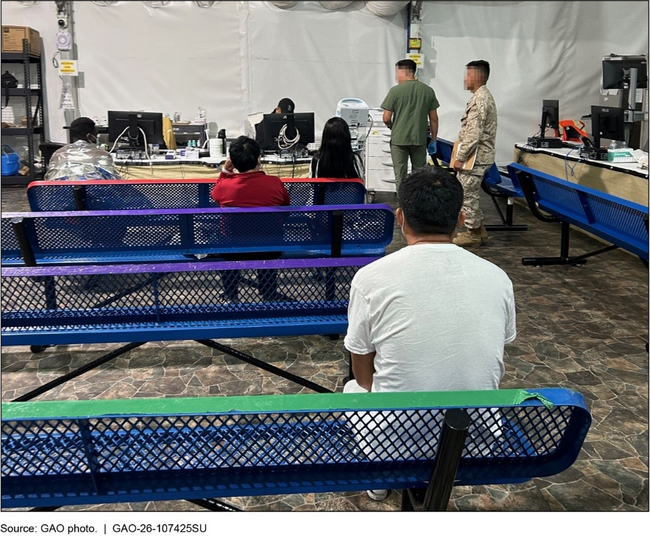
Individuals in CBP custody sitting on benches waiting to see a contracted medical provider.
Highlights
What GAO Found
U.S. Customs and Border Protection (CBP), through its components U.S. Border Patrol and Office of Field Operations, detains individuals who unlawfully enter the U.S. at short-term holding facilities. CBP personnel process individuals and determine the next course of action, such as transferring them from custody or removing them from the country. For the past decade, CBP has used contracted medical personnel at facilities along the southwest border to provide health screenings and treatment of basic medical conditions to individuals in custody.
Contracted Medical Personnel Area at U.S. Customs and Border Protection Facility

GAO found that CBP developed policies and guidance for providing medical care to individuals in custody but has not consistently implemented them. For example, CBP requires some populations, such as children, pregnant individuals, and adults who indicated they might have an illness or injury, to receive a basic physical exam known as a medical assessment. Although CBP introduced new guidance and improved the percentage of individuals who received medical assessments, GAO found that some individuals still did not receive assessments, as required. For example, 57 percent of adults with a potential illness or injury and 20 percent of pregnant individuals did not receive medical assessments from August 2023 to August 2024, as required. Without an oversight mechanism to ensure that people in custody receive the required medical assessments, CBP may not be aware of medical needs and cannot ensure it takes the appropriate next steps for any necessary medical care.
GAO also found that CBP and contracted medical personnel did not consistently implement additional care requirements for individuals in custody who had serious injuries or illnesses (i.e., those who were medically high-risk). For example, from August 2023 to August 2024, contracted medical personnel did not conduct medical monitoring checks required for medically high-risk adults and children approximately 40 percent of the time. In July 2025, CBP developed new tools to inform its oversight efforts, but did not explain how it will use them to systematically assess whether medically high-risk individuals received their medical monitoring checks on time. Developing and implementing a mechanism to monitor this requirement and others would help CBP better ensure these individuals receive required care, and personnel are monitoring their conditions.
CBP did not consistently provide medical records and prescriptions—referred to as medical summary forms—as required, to individuals with medical issues leaving CBP custody. By not providing the medical summary forms, CBP can create challenges with continuity of care. GAO also found CBP’s oversight reports did not include data from facilities that do not have contracted medical personnel. These facilities send individuals to local hospitals or urgent care facilities for medical care, including medical assessments. Without these data, CBP cannot ensure all individuals in custody received required medical assessments to decrease the risk of adverse medical outcomes.
Moreover, GAO’s analysis showed that CBP did not consistently manage or oversee its medical services contracts. For example:
- CBP did not clearly specify minimum staffing levels it requires of the contractor in the medical services contract. As such, CBP cannot ensure it has sufficient contracted medical personnel to meet its needs for providing medical care at its facilities; and
- CBP has not analyzed the costs and benefits of providing certain types of care through contracted medical personnel versus sending individuals to local hospitals. Performing a cost benefit analysis gives CBP the opportunity to identify potential cost savings.
GAO also identified gaps in CBP’s contract oversight, which could be remedied with a contract administration plan. For example, GAO found that CBP officials with contract oversight duties did not visit CBP facilities to directly observe performance under the medical services contracts until 2024. While CBP received reports from the contractor, it did not have metrics to measure contractor performance. Without a plan that includes roles and responsiblities and performance metrics, CBP is missing opportunities to obtain a more complete and quantifiable understanding of contractor performance.
CBP did not always submit contractor past performance evaluations as required. Ensuring that CBP complies with the requirements to submit these evaluations annually and at the end of the performance period would allow CBP to use more current information in its ratings. Such compliance would also better position officials to make informed decisions when awarding future medical services contracts.
U.S. Customs and Border Protection (CBP) Submission of Contractor Past Performance Evaluations for the Medical Services Contracts as of August 2025

GAO found that CBP met many of its medical quality management program requirements in overseeing the quality of care that contracted medical personnel provide. However, CBP does not have guidance that includes clear responsibilities for the Office of the Chief Medical Officer and did not track corrective actions taken after some medical events. Doing so would help CBP ensure the safety and quality of all medical services provided to individuals in CBP custody.
Why GAO Did This Study
From fiscal years 2021 through 2024, CBP encountered about 2 million individuals along the southwest border each year, resulting at times in overcrowding in its facilities. In May 2023, the death of an 8-year-old girl in CBP custody raised concerns about CBP's provision of medical care.
This report focuses on the southwest border and examines the extent to which CBP has (1) developed and implemented policies for providing medical care for individuals in its custody and (2) managed its contracts for medical services and provided oversight of its contractor.
To conduct this audit, GAO reviewed CBP documentation, including medical care guidance and other documentation related to screening and assessing individuals for medical issues. GAO observed CBP and contractor implementation of policies, challenges, and management of medical care at 31 CBP facilities along the southwest border, selected among areas with higher encounters.
Additionally, GAO analyzed data for fiscal years 2021 through 2024 (the most recent available at the time of our review) to assess the extent to which CBP components implemented its medical policies, its guidance, and federal internal control standards. GAO reviewed CBP contract file documentation for the three medical services contracts in this same period. GAO compared documentation of monitoring and performance activities against contract requirements, agency policies, and procurement regulations.
GAO interviewed CBP officials in headquarters and field locations to gain their perspectives on its provision of medical care. GAO also interviewed contracting officials regarding their efforts and responsibilities in managing and overseeing the contractor.
Recommendations
GAO is making 14 recommendations to CBP, including to:
- Implement an oversight mechanism to ensure individuals get required medical assessments;
- Implement an oversight mechanism for required medical care related to medically high-risk individuals, such as medical monitoring checks;
- Develop and implement a mechanism to ensure that individuals with medical issues have their medical summary forms any time they leave CBP custody;
- Monitor whether individuals at facilities without contracted medical personnel receive medical assessments under CBP guidance;
- Specify the minimum staffing level needs for contracted medical personnel in any future medical services contracts;
- Analyze the costs and benefits of limiting the types of care that contracted medical personnel can provide versus sending individuals to local hospitals and document any resulting cost savings;
- Develop a contract administration plan for any future medical services contracts;
- Comply with the timing requirements in the Federal Acquisiton Regulation to ensure that contractor past performance evaluations for any future medical services contracts are submitted at least annually and also at the end of the period of performance; and
- Update existing guidance to include clear responsibilities and track corrective actions for sentinel events, among other medical quality management actions.
DHS concurred with thirteen recommendations. It did not concur with one recommendation to document the factors CBP personnel should consider when determining whether individuals are at-risk based on serious physical or mental injuries or illnesses for the purpose of expeditious processing under CBP’s standards. GAO maintains that DHS should do so to ensure consistent implementation of CBP’s expedited processing requirement.
Recommendations for Executive Action
| Agency Affected | Recommendation | Status |
|---|---|---|
| United States Customs and Border Protection | The CBP Commissioner should ensure that the Office of the Chief Medical Officer takes action, such as providing additional training or guidance, to ensure contracted medical personnel understand the difference between medical assessments and medical encounters, and reasons for the difference. (Recommendation 1) |
In January 2026, we found that CBP did not consistently implement its medical assessment policy and guidance. More specifically, CBP policy and guidance requires medical assessments- a basic physical exam and review of symptoms, vitals, and medical history- for certain individuals in custody. One reason that CBP did not consistently implement its medical assessment policy was that contracted medical personnel were sometimes performing medical encounters (evaluations to address acute medical concerns) instead of the required medical assessments. A senior CBP official stated that distinguishing between the two is important for medical processing and oversight purposes. More specifically, CBP officials use electronic medical records data on medical assessments and medical encounters to assess needs in CBP facilities. For example, a tender-age child with multiple medical assessments has likely been in custody for a longer period, whereas a child with multiple medical encounters is likely ill and could require greater medical attention. We recommended that CBP provide additional training or guidance to ensure contracted medical personnel understand the difference between medical assessments and medical encounters, and reasons for the difference. In response, at the conclusion of our audit, CBP sent a copy of its medical process guidance to its medical services contractor and discussed differences between medical assessments and medical encounters during a meeting with the contractor. Furthermore, they provided documentation that contracted medical personnel in the field (who are responsible for implementing the guidance) received additional training on the differences between medical assessments and medical encounters. As a result, CBP should be better positioned to monitor medical needs in CBP facilities and ensure that individuals in custody receive the medical care required by CBP policy and guidance.
|
| United States Customs and Border Protection | The CBP Commissioner should ensure that the Office of the Chief Medical Officer develops and implements an oversight mechanism to ensure individuals receive required medical assessments. (Recommendation 2) |
CBP concurred with this recommendation. In September 2025, CBP provided an overview of its compliance framework and examples of tools they used to ensure compliance with medical care requirements, including that individuals receive required medical assessments. However, these examples did not show consistent implementation of the compliance framework over a broader period or note corrective actions to address identified issues. In addition, in July 2026, CBP officials said they were unable to conduct their quarterly oversight site visits as part of their compliance framework during the first two quarters of fiscal year 2026 due to lapses in appropriations, an internal modernization and streamlining effort, and staff turnover. They stated they resumed the site visits in June 2026 and will provide documentation to address our recommendation in September 2026. We will continue to monitor CBP's actions to address this recommendation and evaluate them when complete.
|
| United States Customs and Border Protection | The CBP Commissioner should clearly document in policy or guidance the factors that CBP personnel should consider to determine an individual in custody is at-risk based on serious physical or mental injuries or illnesses for the purpose of expeditious processing under CBP's standards for short-term custody. (Recommendation 3) |
CBP did not concur with this recommendation. As of June 2026, CBP officials stated they do not plan to address this recommendation. In response to our report, DHS stated that it is not feasible to establish a comprehensive list of factors because CBP encounters individuals with a wide range of physical and mental health conditions. DHS also noted that CBP handles these determinations on a case-by-case basis, and prescribing specific factors could constrain the autonomy of field authorities and hinder operational flexibility. However, our recommendation does not specify that DHS document all the physical and mental health conditions CBP personnel may encounter among individuals in its custody. We maintain that documenting factors CBP officials should consider, even if such documentation cannot account for every potential situation in a complex operating environment, would help ensure personnel are consistently implementing CBP's expedited processing requirement.
|
| United States Customs and Border Protection | The CBP Commissioner should ensure that the Office of the Chief Medical Officer develops and implements an oversight mechanism for CBP and contracted medical personnel to ensure medically high-risk individuals in custody receive required medical care, including medical monitoring checks and red wristbands. (Recommendation 4) |
CBP concurred with this recommendation. In September 2025, CBP provided an overview of its compliance framework and examples of tools they used to ensure compliance with medical care requirements, including for medically high-risk individuals in custody. However, these examples did not show consistent implementation of the compliance framework over a broader period or note corrective actions to address identified issues. In addition, in July 2026, CBP officials said they were unable to conduct their quarterly oversight site visits as part of their compliance framework during the first two quarters of fiscal year 2026 due to lapses in appropriations, an internal modernization and streamlining effort, and staff turnover. They stated they resumed the site visits in June 2026 and will provide documentation to address our recommendation in September 2026. We will continue to monitor CBP's actions to address this recommendation and will evaluate them when complete.
|
| United States Customs and Border Protection | The CBP Commissioner should ensure that the Office of the Chief Medical Officer includes information in monitoring reports on individuals at facilities without contracted medical personnel to ensure they receive the medical care required under CBP guidance. (Recommendation 5) |
CBP concurred with this recommendation. In June 2026, CBP sent support documentation of ongoing communication with operational components and monitoring reports. In July 2026, we requested additional documentation to show CBP is systematically monitoring whether individuals at facilities without contracted medical personnel receive medical care required under CBP guidance. We will continue to monitor CBP's actions to address this recommendation and will evaluate them when complete.
|
| United States Customs and Border Protection | The CBP Commissioner should develop and implement a mechanism to ensure that individuals who had medical issues identified or addressed while in CBP custody have their medical summary forms any time they leave custody. (Recommendation 6) |
CBP concurred with this recommendation. On September 2025, CBP provided documentation of a January 2025 memorandum about the use of the CBP medical summary form. To fully address this recommendation, CBP will need to confirm the operational components distributed the memorandum. Additionally, CBP will need to confirm medical summary forms are provided for individuals who come back into CBP custody as part of changes to the removal process. We will continue to monitor CBP's actions to address this recommendation and will evaluate them when complete.
|
| United States Customs and Border Protection | The CBP Commissioner should ensure that the Office of the Chief Medical Officer and the Office of Acquisition specify in any future medical services contracts, including bridge contracts, the minimum staffing level that CBP needs from the contractor. (Recommendation 7) |
CBP concurred with this recommendation. In July 2026, CBP officials said they developed a contracting mechanism to specify the minimum staffing level needed for all future CBP medical service contract awards and will provide documentation of these efforts in September 2026. We will continue to monitor CBP's actions to address this recommendation and will evaluate them when complete.
|
| United States Customs and Border Protection | The CBP Commissioner should ensure that the Office of the Chief Medical Officer and the Office of Acquisition establish a performance target in any future medical services contracts, including bridge contracts, Recommendations for Executive Action Page 65 GAO-26-107425 CBP Medical Care for Individuals in Custody to measure whether the medical services contractor is meeting minimum staffing levels. (Recommendation 8) |
CBP concurred with this recommendation. In July 2026, CBP officials said they developed a contracting mechanism to specify the minimum acceptable quality level requirements for medical staffing as a basis for measuring the performance work objectives for all future CBP medical service contract awards. They said they will provide documentation of these efforts in September 2026. We will continue to monitor CBP's actions to address this recommendation and will evaluate them when complete.
|
| United States Customs and Border Protection | The CBP Commissioner should ensure that the Office of the Chief Medical Officer performs a cost-benefit analysis of the medical services contract's scope of practice and staffing levels to compare the costs of providing nonemergency care through contracted medical personnel at CBP facilities to the costs of providing that care at a hospital or other local health system location and documents any resulting cost savings. (Recommendation 9) |
CBP concurred with this recommendation. In July 2026, CBP officials said they began developing a cost-benefit model to compare the costs for the scope of practice and staffing levels for nonemergency care through contracted medical personnel at CBP facilities to the costs of providing care at a hospital or other local health system locations. However, due to lapses in appropriations, loss of key resources, and changes to the scope of practice requirements, CBP officials estimated the model would not be complete until March 2027. We will continue to monitor CBP's actions to address this recommendation and will evaluate them when complete.
|
| United States Customs and Border Protection | The CBP Commissioner should ensure that the Office of Acquisition conducts a lessons learned analysis on how it administered its medical services contracts, to include identifying and analyzing risk areas and applying corrective actions. (Recommendation 10) |
CBP concurred with this recommendation. In July 2026, CBP officials provided summaries of topics discussed during meetings about lessons learned regarding the medical services contract, such as the administration and oversight of the contract. They stated they plan to hold another meeting in November 2026 to evaluate steps taken since their prior meetings, including their contract administration activities and implementation of corrective actions. CBP anticipates finalizing a lessons learned plan by January 2027, which we will evaluate to assess the extent to which it addresses this recommendation.
|
| United States Customs and Border Protection | The CBP Commissioner should ensure that the Office of Acquisition, in coordination with the Office of the Chief Medical Officer, develops a contract administration plan for any future medical services contracts, including bridge contracts, to include roles and responsibilities and performance metrics. (Recommendation 11) |
In April 2026, CBP developed and issued a Contract Administration Plan (CAP) for the newly awarded medical services contracts. As of July 2026, CBP had updated and revised its Acquisition Alert 2021-05, "Streamlined Contract Administration Plan," updated by CBP's Procurement Directorate, which was in final coordination and review. CBP anticipates completing its final actions for this recommendation by January 2027. We will continue to monitor CBP's actions to address this recommendation and will evaluate them when complete.
|
| United States Customs and Border Protection | The CBP Commissioner should ensure that task order monitors or their equivalents supporting any future medical services contracts, including bridge contracts, are certified at the same level as the primary contracting officer's representatives and appointed by the contracting officer. (Recommendation 12) |
CBP concurred with this recommendation. In December 2025, CBP issued supplement guidance requiring technical monitors to be formally designated through appointment letters and certified to the same standards as contracting officer's representatives. To fully address this recommendation, CBP will need to provide appointment letters for any task order monitors or technical monitors assigned to the CBP medical services contract(s) or verify they these monitors no longer assist in contract oversight.
|
| United States Customs and Border Protection | The CBP Commissioner should ensure that the Office of Acquisition complies with the timing requirements to submit contractor past performance evaluations for any future medical services contracts at least annually and also at the end of the period of performance, consistent with the Federal Acquisition Regulation. (Recommendation 13) |
In November 2025, CBP issued an updated Contractor Performance Assessment Reporting System workflow guide that provides detailed visual graphics of the review and approval process, including established timelines and responsibilities for each participant involved in the Contractor Performance Assessment Reporting System evaluation process. In June 2026, CBP held an information session emphasizing the importance of promptly resolving Contractor Performance Assessment Reporting System performance issues, offer remedies and resolutions, and address common mistakes and best practices. In July 2025, CBP hosted a Contractor Performance Assessment Reporting System training session emphasizing the importance of timely and accurate evaluations. CBP also provided the appointment letters for the contracting officer's representatives. To fully address this recommendation, CBP needs to provide documentation showing the task order monitors or their equivalents supporting any future medical services contracts, including bridge contracts, have been certified at the same level as the primary contracting officer's representatives and appointed by the contracting officer, or verify the technical monitors have been replaced and are no longer being used for any medical services contract. We will continue to monitor CBP's actions to address this recommendation and will evaluate them when complete.
|
| United States Customs and Border Protection | The CBP Commissioner should ensure that the Office of the Chief Medical Officer updates existing guidance that includes clear responsibilities for the Office of the Chief Medical Officer Medical Quality Division, including responsibilities to fully document action plans and track corrective actions for the quality assurance and sentinel event review elements of the MQM program. (Recommendation 14) |
CBP concurred with this recommendation. In July 2026, CBP officials they faced delays in completing guidance updates that address the recommendation due to lapses in appropriations, an internal modernization and streamlining effort, and staff turnover. They said they aim to complete the updates by September 2026. We will continue to monitor CBP's actions to address this recommendation and will evaluate them when complete.
|