
Tribal Water Infrastructure: Opportunities Exist to Improve Federal Assistance
Fast Facts
Access to safe water is critical for public health. The Indian Health Service and other agencies fund the construction of water infrastructure for Tribes—such as water and wastewater pipes and tanks.
Once the infrastructure is built, Tribes are responsible for operating and maintaining it. But they can struggle with the costs of routine operation and maintenance, which can lead to these systems deteriorating and failing early. This can hurt tribal health and increase costs to the federal government from repairing or replacing this infrastructure.
We made recommendations to Congress and federal agencies that could help address such issues.
Maintenance of a Tribal Water Tank
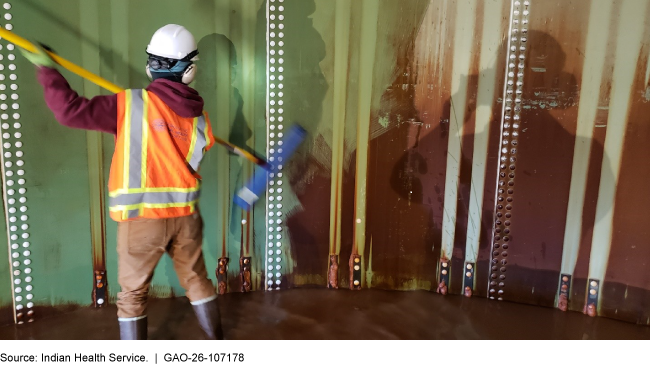
A person inside of a large water storage tank using a broom to clean the walls.
Highlights
What GAO Found
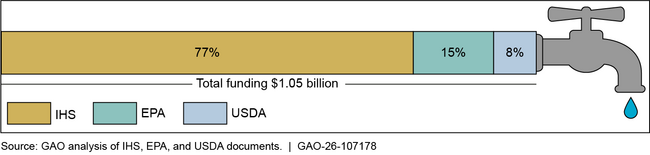
As part of the federal government’s efforts to support Tribes and tribal members’ health and to help prevent disease, an Indian Health Service (IHS) program provides Tribes with technical and financial assistance to build drinking water and wastewater infrastructure in tribal communities. Through this program, IHS staff work closely with Tribes to identify their needs and design and build water projects. Several U.S. Environmental Protection Agency (EPA) and U.S. Department of Agriculture (USDA) programs also provide assistance for tribal water projects, and the three agencies often work together and with Tribes.
Selected Agencies’ Funding for Tribal Water Projects, Fiscal Year 2025
IHS has determined that only certain homes are eligible for funding as part of a community tribal water project based on its interpretation of its statutory authority to build water infrastructure for “Indian homes, communities, and lands.” This excludes various homes that tribal members live in, such as those owned by a spouse or grandparent who is not a tribal member—something tribal officials said is common in tribal communities. It also excludes homes owned by Tribes or tribal members that are rented to other tribal members with fewer than 5 years on the lease or to community service providers (e.g., teachers or law enforcement) who are not tribal members.
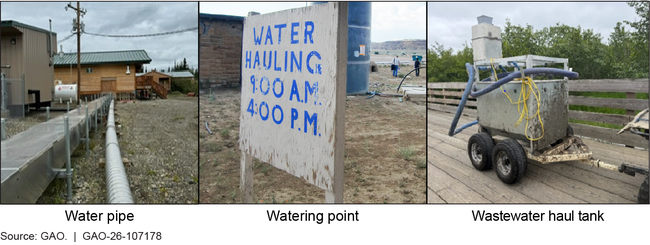
Examples of Water Infrastructure in Underserved Tribal Communities
When an IHS-funded project includes ineligible properties, such as nontribal homes or community buildings, Tribes and the IHS staff helping them must provide or obtain other funding for these properties’ costs. This can lead to high administrative costs, such as to help Tribes navigate other federal agencies’ differing application processes. This can be expensive and inefficient for IHS when such activities cost as much or more than the project costs of these properties. For example, IHS officials reported spending over 80 hours helping one Tribe obtain a $8,000 grant, plus more hours helping the Tribe report on how it spent the grant.
Congress could help IHS more efficiently fund projects and expedite delivering safe water to more tribal members by (1) defining in law “Indian homes, communities, and lands” to clarify which homes and buildings in a tribal community should be eligible for IHS funding, and (2) authorizing IHS to create an exception to allow it to fund ineligible properties when administrative costs would exceed the costs to serve them. These changes would enable IHS to focus more of its limited resources on projects when Tribes do not need to pursue other funding for IHS-ineligible properties.
EPA, USDA, and IHS have opportunities to streamline processes and requirements to reduce administrative burdens for Tribes and IHS staff, help Tribes more easily access funding, and make agency collaboration efforts more cost effective. For example:
- USDA requires additional financial information from Tribes for underwriting to help ensure project sustainability, which can be burdensome for Tribes. IHS and EPA do not require such information or underwriting for their programs.
- Further streamlining the standard interagency agreements that EPA and IHS use in part to facilitate joint funding of water projects, changing how IHS can distribute EPA funding for projects to Tribes, and streamlining EPA’s application process for certain projects in IHS’s project database could minimize the additional time IHS staff spend helping Tribes pursue EPA funding and administering that funding, which can be significant.
Maintenance of a Tribal Water Tank
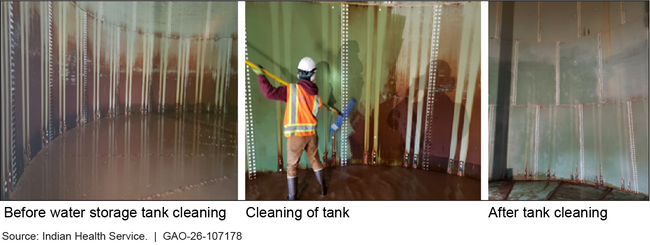
After water infrastructure construction is complete, Tribes’ limited financial capacity can contribute to challenges with operating and maintaining their infrastructure, which can lead to it deteriorating and failing early. For example, Tribes face difficulties with hiring and retaining certified water operators who keep systems in working order, according to an agency study. This can create risks to tribal health and increase costs to the federal government from needing to repair or replace infrastructure.
IHS generally does not provide funding to Tribes for routine operations and maintenance (O&M). While IHS has assessed tribal capacity to fund O&M, it has not assessed whether funding O&M could result in federal cost savings and better tribal health. Since Tribes’ needs can vary, more information on the effects of funding O&M on federal costs could help Congress make decisions on how to cost effectively meet those needs. However, IHS officials have said IHS does not have the authority or funding to pay O&M costs. By establishing an IHS pilot program for routine O&M assistance for tribal water infrastructure, Congress would enable IHS to provide direct, on-the-ground assistance to participating Tribes while collecting data that could inform decision-making on whether it is cost-effective to provide that assistance to Tribes on a broader scale.
Why GAO Did This Study
Safe drinking water and wastewater disposal are critical to public health, but many Tribes have limited resources to build, operate, and maintain water infrastructure. Tribes often do not have access to the same financing options and traditional tax bases as other communities. Tribal water systems have been underdeveloped, and many have fallen into disrepair because of chronic underfunding, according to the U.S. Commission on Civil Rights. IHS estimated that as of November 2025, $6 billion was needed to ensure all tribal communities have access to safe water.
GAO has previously reported that Tribes face systemic barriers to accessing federal assistance, including for tribal water infrastructure. IHS, within the Department of Health and Human Services, EPA, and USDA have taken steps to better collaborate with each other, including through a tribal infrastructure task force, but Tribes may continue to experience barriers. Many Tribes also have limited capacity to operate and maintain their water infrastructure, according to agency studies.
GAO was asked to review federal tribal water infrastructure assistance. This report examines the extent to which (1) IHS can fund water infrastructure for various properties in a tribal community, (2) opportunities exist to address differing agency processes and requirements when IHS collaborates with other agencies, and (3) IHS funds the operations and maintenance of tribal water infrastructure.
GAO reviewed agency data and program documents, including interagency and task force documents; conducted site visits to Alaska and Arizona; and interviewed Tribes, tribal organizations, and headquarters and regional agency officials.
Recommendations
GAO recommends that Congress consider (1) defining “Indian homes, communities, and lands” in the Indian Sanitation Facilities Act to clarify which homes and buildings in tribal communities should be eligible for IHS funding, (2) authorizing and directing IHS to create an exception to fund ineligible properties when their capital costs are less than IHS’s administrative costs, and (3) establishing a pilot program for IHS to provide assistance for Tribes’ routine O&M costs (e.g., operator salaries and energy costs).
GAO is also making 12 recommendations to the agencies, including that USDA streamline or eliminate requirements for obtaining financial information from Tribes; that IHS and EPA work together to address invoicing requirements and funds transfer processes that result in high administrative costs; and that EPA streamline its application process for certain projects.
IHS agreed with the recommendations and described actions it was taking or planned to take to address them. EPA generally agreed with the recommendation to work with IHS to address invoicing requirements and funds transfer processes. It disagreed with the recommendation as originally written regarding its required application process for certain projects, and GAO revised the recommendation to clarify that EPA should streamline the application process for those projects. USDA disagreed with the recommendation to streamline or eliminate its financial information grant application requirements. GAO maintains that the agencies should implement the recommendations.
Matter for Congressional Consideration
| Matter | Status | Comments |
|---|---|---|
| Congress should consider amending the Indian Sanitation Facilities Act to define "Indian homes, communities, and lands" to clarify which homes and buildings should be eligible for IHS financial assistance. (Matter for Consideration 1) | When we confirm what actions the agency has taken in response to this recommendation, we will provide updated information. | |
| Congress should consider authorizing and directing IHS to, in consultation with Tribes, create an exception to fund all or a portion of the capital costs associated with homes and community buildings in its projects that IHS has deemed ineligible and for which its administrative costs would likely exceed these capital costs. (Matter for Consideration 2) | When we confirm what actions the agency has taken in response to this recommendation, we will provide updated information. | |
| Congress should consider establishing a pilot program through which IHS, in consultation with Tribes and in collaboration with EPA, provides assistance for Tribes' routine O&M costs, such as personnel (e.g., water operator) salaries and energy costs. In establishing the program, Congress could consider directing IHS and EPA to follow leading practices for effectively designing a pilot program. (Matter for Consideration 3) | When we confirm what actions the agency has taken in response to this recommendation, we will provide updated information. |
Recommendations for Executive Action
| Agency Affected | Recommendation | Status |
|---|---|---|
| Indian Health Service | The Director of IHS should ensure that the Director of the Division of Sanitation Facilities Construction updates IHS policy, in consultation with Tribes, to reflect a new statutory definition of "Indian homes, communities, and lands" if such a definition is enacted. (Recommendation 1) |
When we confirm what actions the agency has taken in response to this recommendation, we will provide updated information.
|
| Indian Health Service | The Director of IHS should ensure that the Director of the Division of Sanitation Facilities Construction, in consultation with Tribes, evaluates whether $10,000 is an appropriate limit for funding existing community buildings, in light of inflation and increases in costs for labor and materials since the amount was set in 1985, and adjust the limit as appropriate. (Recommendation 2) |
When we confirm what actions the agency has taken in response to this recommendation, we will provide updated information.
|
| Indian Health Service | The Director of IHS should ensure that the Director of the Division of Sanitation Facilities Construction, in coordination with the HUD Deputy Assistant Secretary for Native American Programs, aggregates IHS's information about the potential estimated costs to serve homes and HUD's information about the number of new homes built with IHBG funding to estimate the cost of providing water connections for newly built HUD-funded homes, and report this information to Congress, to be updated as requested. (Recommendation 3) |
When we confirm what actions the agency has taken in response to this recommendation, we will provide updated information.
|
| Department of Housing and Urban Development | The Secretary of HUD should ensure that the Deputy Assistant Secretary for Native American Programs, in coordination with the IHS Director of the Division of Sanitation Facilities Construction, aggregates HUD's information about the number of new homes built with IHBG funding and IHS's information about the potential estimated costs to serve homes to estimate the cost of providing water connections for newly built HUD-funded homes, and report this information to Congress, to be updated as requested. (Recommendation 4) |
When we confirm what actions the agency has taken in response to this recommendation, we will provide updated information.
|
| Department of Housing and Urban Development | The Secretary of HUD should ensure that the Deputy Assistant Secretary for Native American Programs publicly communicates information to Tribes about how HUD considered tribal input provided through its tribal consultation about the statutory prohibition on IHS using its appropriations to provide water infrastructure for new homes built with HUD housing grant programs, along with any outcomes from that consultation. (Recommendation 5) |
When we confirm what actions the agency has taken in response to this recommendation, we will provide updated information.
|
| Environmental Protection Agency | The Administrator of EPA should direct its regions that use a solicitation process to administer the Drinking Water Infrastructure Grant Tribal Set-Aside program to streamline the application process for projects that are already included in IHS's Sanitation Deficiency System database and where Tribes request that EPA transfer project funding to IHS. (Recommendation 6) |
When we confirm what actions the agency has taken in response to this recommendation, we will provide updated information.
|
| Department of Agriculture | The Under Secretary for Rural Development, in consultation with Tribes, should develop a process to streamline or eliminate requirements for financial information and conducting underwriting for Tribes that submit grant applications to the Native American and Water and Waste Disposal programs. (Recommendation 7) |
When we confirm what actions the agency has taken in response to this recommendation, we will provide updated information.
|
| Department of Agriculture | The Under Secretary for Rural Development should develop a general applicability, tribal public interest waiver of American Iron and Steel requirements for projects funded by its Native American and Water and Waste Disposal programs. (Recommendation 8) |
When we confirm what actions the agency has taken in response to this recommendation, we will provide updated information.
|
| Indian Health Service | The Director of IHS should ensure that the Director of the Division of Sanitation Facilities Construction, working with the Administrator of EPA, identify and address areas of ongoing high administrative costs when EPA transfers funding to IHS for tribal water projects, including in relation to G-invoicing and interagency agreement terms and conditions that limit how IHS can distribute EPA-contributed funds to Tribes through advance payments. The agencies should document those changes in policy and in their updated interagency agreement standard terms and conditions, as needed. (Recommendation 9) |
When we confirm what actions the agency has taken in response to this recommendation, we will provide updated information.
|
| Environmental Protection Agency | The Administrator of EPA, working with the IHS Director of the Division of Sanitation Facilities Construction, should identify and address areas of ongoing high administrative costs when EPA transfers funding to IHS for tribal water projects, including in relation to G-invoicing and interagency agreement terms and conditions that limit how IHS can distribute EPA-contributed funds to Tribes through advance payments. The agencies should document those changes in policy and in their updated interagency agreement standard terms and conditions, as needed. (Recommendation 10) |
When we confirm what actions the agency has taken in response to this recommendation, we will provide updated information.
|
| Indian Health Service | The Director of IHS should ensure that the Director of the Division of Sanitation Facilities Construction, working with USDA's Under Secretary for Rural Development, develop program-level, standardized interagency agreements with agreed-upon terms and conditions for the Native American and Water and Waste Disposal programs and use them to transfer USDA program funds to IHS for tribal water projects when requested by Tribes. The standard terms and conditions could include, to the extent legally permissible, providing advanced lump-sum payments and removing additional or duplicative USDA administrative requirements. (Recommendation 11) |
When we confirm what actions the agency has taken in response to this recommendation, we will provide updated information.
|
| Department of Agriculture | The Under Secretary for Rural Development, working with the IHS Director of the Division of Sanitation Facilities Construction, should develop program-level, standardized interagency agreements with agreed-upon terms and conditions for the Native American and Water and Waste Disposal programs and use them to transfer USDA program funds to IHS for tribal water projects when requested by Tribes. The standard terms and conditions could include, to the extent legally permissible, providing advanced lump-sum payments and removing additional or duplicative USDA administrative requirements. (Recommendation 12) |
When we confirm what actions the agency has taken in response to this recommendation, we will provide updated information.
|