
Tribal Lands: Opportunities Exist to Improve Conditions of Columbia River Fishing Access Sites
Fast Facts
Federal dams submerged traditional tribal fishing areas along the Columbia River in the early 20th century. The government set up fishing sites on nearby federal lands to ensure Tribes' access per longstanding treaties. Decades of deferred maintenance and heavy use caused the sites’ infrastructure to deteriorate.
This Q&A looks at the Department of the Interior's work on these sites. Interior has rebuilt restrooms and replaced water lines. But it hasn't started safety projects such as lighting and security cameras.
We also looked at Interior's facilities management system and recommended updating the information in it for better decision-making.
Columbia River in Oregon, Near One of the 29 Fishing Access Sites Interior Administers
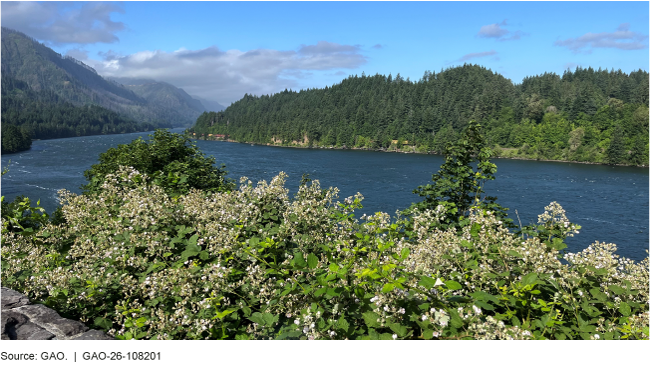
A scenic view of the Columbia River in Oregon.
Highlights
What GAO Found
Safety and sanitation conditions have been long-standing concerns at fishing access sites that the federal government developed, beginning in the 1950s, for four Tribes with treaty fishing rights in the Columbia River Basin. In 2011, the federal government completed its development of 31 sites, 29 of which are administered by the Department of the Interior.
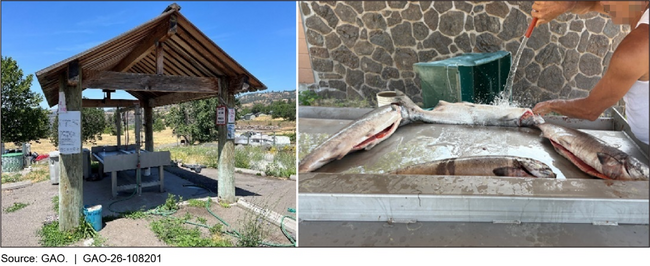
As of February 2026, Interior’s Bureau of Indian Affairs (BIA) Northwest Regional Office had spent $17.3 million since 2020 to assess site conditions and design and construct sanitation and safety improvement projects. A 2022 site assessment identified several urgent sanitation and safety issues across the sites, including dilapidated restrooms, outdated fish-cleaning stations, and the accumulation of abandoned property. Some sanitation projects have been completed while others are in the design phase. The improvement projects include water line replacement, well drilling, and restroom construction. According to Interior officials, safety infrastructure has not been improved due to funding constraints, but there are plans to add security features such as lights and cameras over the next few years.
Fish-Cleaning Stations at Columbia River Fishing Access Sites in June 2025
BIA uses a facility management system to track reoccurring operations and maintenance (O&M) needs and to allocate both annual O&M and project-based funding for its fishing access sites. However, regional BIA officials said the system may not include all BIA-administered sites due to incomplete data, making those sites ineligible for funding. Including the remaining sites in the system could help BIA better inform funding decisions. Additionally, Interior’s O&M funding formula does not account for grounds and structures unique to fishing access sites, such as fish-cleaning stations and wastewater treatment systems. Updating BIA’s O&M funding formula, in consultation with Tribes, could help ensure that all property at the sites is factored into funding decisions for each site.
Finally, BIA faces challenges completing improvements at the sites due to unclear policies and implementation guidance that cause inefficient communication, unclear roles, and unleveraged resources, such as overly narrow pools of staff who may conduct needed inspections. Updating policies and developing implementation guidance could facilitate actions to help improve conditions at fishing access sites for tribal members and site users and ensure agency-wide compliance with health and safety standards.
Why GAO Did This Study
Four Tribes—the Confederated Tribes and Bands of the Yakama Nation, the Confederated Tribes of the Umatilla Indian Reservation, the Confederated Tribes of the Warm Springs Reservation of Oregon, and the Nez Perce Tribe—signed treaties with the United States in 1855 that reserved the right to fish along the Columbia River. However, beginning in the 1930s, construction of federal dams in the area submerged traditional tribal fishing sites and hindered Tribes' ability to exercise their treaty rights. To help mitigate the dams’ impacts on these rights, the U.S. government created fishing access sites.
Since the 1960s, the four Treaty Tribes have expressed concerns about federal construction and maintenance of the sites. These concerns included health hazards and lack of sanitation facilities. Deferred maintenance and heavy usage have caused significant wear and tear on the sites’ infrastructure over several decades.
The 2019 Columbia River In-Lieu and Treaty Fishing Access Sites Improvement Act (Pub. L. No. 116-99) authorized Interior to assess current sanitation and safety conditions of lands that were set aside as fishing access sites. It also included a provision for GAO to evaluate whether Interior's actions improved these sites. This report examines Interior’s efforts to identify and assess sanitary and safety conditions, consult with the Tribes and coordinate with other entities, improve conditions at the sites, and manage future needs.
GAO reviewed laws, regulations, agency documents, funding data, interviews, and project reports, and applied agency policy and GAO internal control and collaboration criteria to findings. GAO visited 13 fishing access sites and conducted outreach to the four Tribes.
Recommendations
GAO recommends that Interior (1) include all fishing access sites in its site management system to inform future project funding decisions; (2) in consultation with Tribes, update the O&M funding formula to ensure that all property at fishing access sites is eligible to receive funding; and (3) update policies and develop guidance to help ensure consistent and timely improvements.
Recommendations for Executive Action
| Agency Affected | Recommendation | Status |
|---|---|---|
| Bureau of Indian Affairs | The Assistant Secretary for Indian Affairs should take the necessary steps to update incomplete information for remaining fishing access sites in Interior's facilities management system to inform future funding decisions and ensure all sites are inspected for safety. (Recommendation 1) |
When we confirm what actions the agency has taken in response to this recommendation, we will provide updated information.
|
| Bureau of Indian Affairs | The Assistant Secretary for Indian Affairs should, in consultation with Tribes, update its operations and maintenance funding formula to include all property, including structures that are not considered buildings, at fishing access sites that are eligible to receive funding for maintenance. (Recommendation 2) |
When we confirm what actions the agency has taken in response to this recommendation, we will provide updated information.
|
| Bureau of Indian Affairs | The Assistant Secretary for Indian Affairs should update its policy manual and develop implementation guidance to allow the Central Office to (1) improve communication with BIA regional officials, (2) clarify roles and responsibilities on who can maintain its facilities management system, and (3) more effectively delegate authority and leverage resources. (Recommendation 3) |
When we confirm what actions the agency has taken in response to this recommendation, we will provide updated information.
|