
Opportunity Zones: Effects of Original Tax Incentive Mostly Unknown and Revised Incentive May Offer Improvements
Fast Facts
Congress created the Opportunity Zone tax incentive to spur investment in low-income communities.
This incentive appears to be mostly funding real estate development in urban areas with access to community support and infrastructure. Some states said it led to increased job growth and housing in their communities, but most were unsure about the incentive's overall effects.
In 2025, Congress made this incentive permanent and added new reporting requirements that could help identify economic impacts. It also added more of an incentive to invest in rural areas.
Example of Opportunity Zone Investment Development, Aurora, Colorado
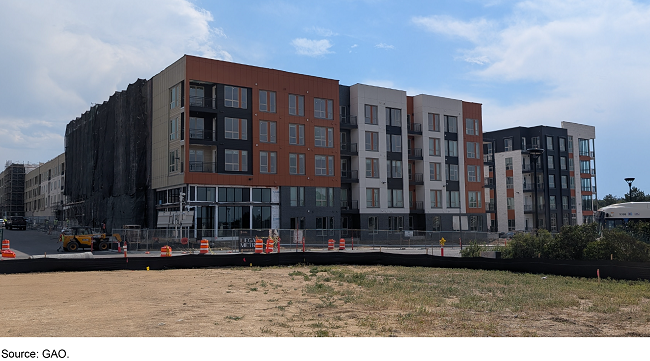
An apartment building under construction.
Highlights
What GAO Found
Qualified Opportunity Zones (Zone)—low-income census tracts nominated by governors and designated by the Department of the Treasury—have lower incomes and higher poverty than other census tracts. The law commonly known as the One Big Beautiful Bill Act (OBBBA) changed the eligibility criteria for Zone designation, which resulted in fewer eligible tracts for future selection. Stakeholders, including some states and subject-matter specialists, reported that this may allow better targeting of the tax incentive to the most economically distressed areas.
Stakeholders reported the incentive is primarily funding real estate development. According to state officials and Qualified Opportunity Fund representatives, Zones that received investment tended to be in urban locations and have access to infrastructure and community support. Tax benefits for investments in newly defined rural Zones could drive investment in those areas, but stakeholders were uncertain about the extent.
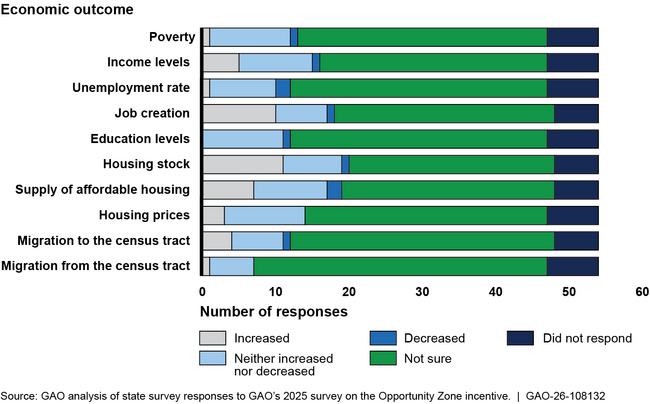
States were mostly unsure about the effects of investment on outcomes, but about 20 percent of states cited increased job creation and housing as effects.
States’ Views of Effects of Opportunity Zone Investment on Selected Outcomes in Their States, 2025
OBBBA’s changes to the tax incentive may mitigate some challenges state officials and fund representatives identified with the original incentive. For example, new requirements for funds and for Treasury to report on characteristics of investments will allow the government and the public to better understand investment and its potential economic effects in Zones. Further, the additional time the act provides for states to prepare to nominate census tracts to be designated as Zones may help states make informed selections.
Why GAO Did This Study
Congress created the Opportunity Zone tax incentive to spur investment in economically distressed communities. Taxpayers who invest in Qualified Opportunity Funds—funds organized for the purpose of investing in Zones—are eligible for certain tax benefits, such as deferral of taxes on the invested amount. These funds held more than $108 billion in assets as of the end of 2024. OBBBA made the incentive permanent and introduced a new category of Zones comprised entirely of a rural area with different potential tax benefits.
GAO was asked to review the Opportunity Zone tax incentive. This report describes (1) Zones’ characteristics and how the revised incentive under OBBBA could affect future Zones’ characteristics; (2) the experiences of states, Qualified Opportunity Funds, and other stakeholders with the original incentive and how the revised incentive may affect future investment activity; (3) stakeholders’ awareness of the original incentive’s effects on communities; and (4) the changes to the incentive introduced by OBBBA and the extent to which they address previous challenges.
GAO analyzed Census data on tracts designated as Zones and those eligible for the second round of Zone designation, analyzed data from a nongeneralizable sample of 16 Qualified Opportunity Funds, interviewed fund representatives, conducted site visits to investments from seven selected funds, surveyed all states and U.S. territories, and interviewed selected state officials and subject-matter specialists knowledgeable about the tax incentive from five organizations. GAO also reviewed documents and interviewed federal agency officials.
For more information, contact Jessica Lucas-Judy at lucasjudyj@gao.gov.