
Rural Water Infrastructure: Better Agency Coordination Could Help Unserved Communities Address Their Needs
Fast Facts
RURAL WATER INFRASTRUCTURE: Better Agency Coordination Could Help Unserved Communities Address Their Needs
Some rural communities across the U.S. don't have access to drinking water or wastewater utilities.
We found 28 U.S. Department of Agriculture and Environmental Protection Agency programs that can provide financial and expert-led assistance to these communities on getting funding to meet these needs. But varying application and funding deadlines and requirements make it difficult for communities to apply for federal and state grants.
We recommended both agencies regularly update and monitor their joint memorandum that includes best practices for improving access to water infrastructure financial assistance.
Rural Home Without Wastewater Treatment Services in 2024
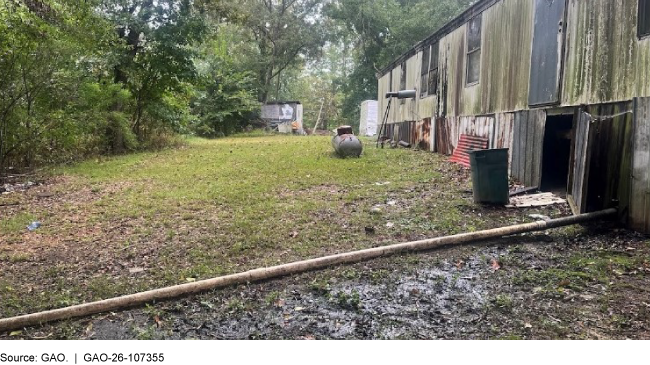
A home with a pipe extending from the foundation that carries untreated wastewater.
Highlights
What GAO Found
Rural communities that are not currently served by drinking water or wastewater utilities (unserved communities) often face challenges addressing their drinking water or wastewater infrastructure needs. The U.S. Department of Agriculture (USDA) and U.S. Environmental Protection Agency (EPA) have limited data about these unserved communities but can obtain some information through their agencies’ programs and datasets. The rural unserved communities known to USDA and EPA are often in unincorporated areas and frequently have financial and other constraints that limit their ability to address their water infrastructure needs, according to agency officials.
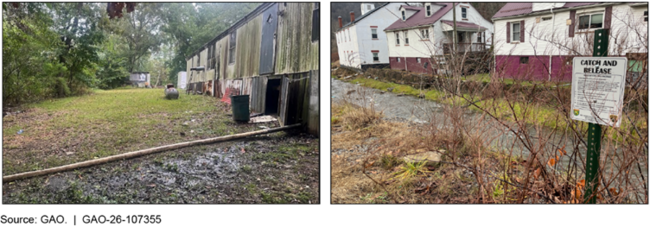
Homes Without Wastewater Services in Alabama and West Virginia in 2024
GAO identified 28 USDA and EPA programs that can provide rural unserved communities with financial and technical assistance to help build or improve drinking water or wastewater infrastructure. However, these communities sometimes face difficulty accessing this assistance. For example, communities or their representatives often need to apply for multiple grants from various federal and state funding sources, which can be difficult because of varying application and funding timelines and restrictions on how and when funds can be used. Delays with funding from one source can jeopardize other funding sources and the project itself. For example, one community that was awarded a federal grant did not receive the funding in time to get a matching state grant.
To help rural communities access financial resources for water infrastructure, USDA and EPA have taken steps to improve coordination with each other and states, including signing a 2017 joint memorandum. The memorandum outlines best practices states can use to help rural communities access federal and state financial assistance, such as reviewing processes for opportunities to streamline applications for financial assistance and increase coordination among funding partners. However, USDA and EPA have not collaborated to update and monitor the memorandum. Regularly updating and monitoring the joint memorandum, in consultation with states, would help the agencies better collaborate with each other to address the challenges rural communities face with accessing financial assistance for these projects.
In addition, EPA’s technical assistance providers can help rural unserved communities navigate available resources, but EPA does not provide them with guidance or other resources to ensure these providers are aware of local capacity and incorporate local knowledge. Doing so could help providers work with rural unserved communities more effectively.
Why GAO Did This Study
Some rural unserved communities across the U.S. lack water infrastructure or rely on private wells and wastewater treated through septic or onsite systems. Lack of access to safe drinking water or treated wastewater poses risks to public health.
GAO was asked to review issues related to rural water infrastructure. This report examines, among other things, (1) what USDA and EPA know about rural unserved communities; (2) which USDA and EPA programs can provide financial and technical assistance to these communities; (3) and challenges these communities face in accessing this assistance.
GAO reviewed USDA and EPA program documents and data; interviewed federal agency officials and officials from 10 selected states; and conducted site visits with rural unserved communities in three of these states and one Tribe.
Recommendations
GAO recommends that USDA and EPA regularly update and monitor their 2017 joint memorandum for increasing rural communities’ access to federal and state funding for water infrastructure. GAO is also recommending that EPA develop and monitor guidance or other resources for its water infrastructure technical assistance providers. EPA generally agreed with GAO’s recommendations and described its plans to address them and work with USDA. USDA disagreed with GAO’s recommendation to work with EPA to update the memorandum. GAO continues to maintain that USDA should work with EPA to better enable rural communities to address challenges they face with accessing financial assistance for water infrastructure projects.
Recommendations for Executive Action
| Agency Affected | Recommendation | Status |
|---|---|---|
| Department of Agriculture | The Secretary of Agriculture, in collaboration with EPA and in consultation with states, should regularly update and monitor the 2017 joint memorandum intended to increase rural communities', including rural unserved communities', access to federal and state funding sources to address water infrastructure needs. (Recommendation 1) |
In its written comments, USDA stated it disagreed with our recommendation to regularly update and monitor the 2017 joint memorandum, in collaboration with EPA and in consultation with states, citing new agency regulations issued in April 2026 that revised the agency's environmental processes. We continue to maintain that our recommendation is necessary. The joint memorandum between USDA and EPA outlines a number of best practices to improve coordination, of which coordinating environmental processes is one. The regulations that USDA cited do not affect the agency's ability to update and monitor the joint memorandum.
|
| Environmental Protection Agency | The Administrator of EPA, in collaboration with USDA and in consultation with states, should regularly update and monitor the 2017 joint memorandum intended to increase rural communities', including rural unserved communities', access to federal and state funding sources to address water infrastructure needs. (Recommendation 2) |
EPA agreed with this recommendation and described steps it would take to implement it. When we confirm what actions EPA has taken in response to this recommendation, we will provide updated information.
|
| Environmental Protection Agency | The Administrator of EPA should develop and monitor the implementation of guidance, or other resources, to ensure its providers for water infrastructure technical assistance are aware of local capacity and incorporating local knowledge effectively when delivering technical assistance to rural communities, including rural unserved communities. (Recommendation 3) |
EPA generally agreed with this recommendation and described steps it would take to implement it. When we confirm what actions EPA has taken in response to this recommendation, we will provide updated information.
|