
Energy Security: Congress and DOE Need a Unified Plan to Align Priorities and Investments for the Strategic Petroleum Reserve
Fast Facts
The Department of Energy's Strategic Petroleum Reserve was created to reduce the impact of oil market disruptions, like the war in Iran.
Long-running questions persist about how large the reserve should be to meet evolving energy security needs and international obligations. The reserve's aging infrastructure also needs further updates to ensure it remains capable of receiving and releasing oil as designed. However, Congress hasn't specified its priorities or identified a target size for the reserve, and DOE doesn't have a long-term plan to inform operational and investment decisions.
We made several recommendations to Congress and DOE.
Leaking Brine Disposal Pumps at the Big Hill Strategic Petroleum Reserve Site
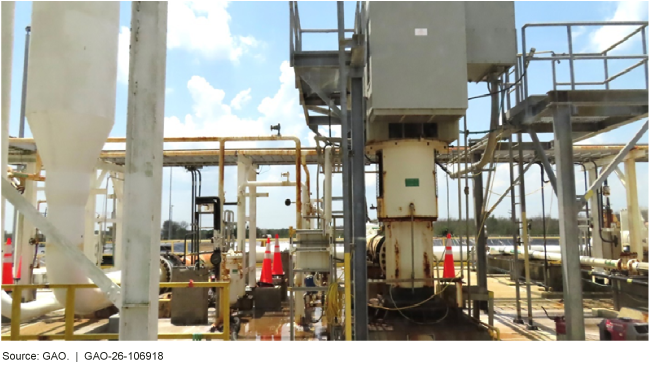
A system of pipes, tanks, and scaffolding dotted with orange safety cones, all on a concrete platform that is visibly wet.
Highlights
What GAO Found
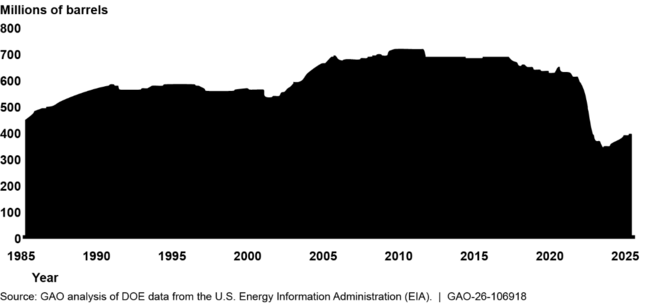
The Strategic Petroleum Reserve (SPR) met increasingly frequent and large drawdown directives. Since 1985, the Department of Energy (DOE) has released more than 500 million barrels of crude oil from the SPR. More than half of the amount released through 2025 was for emergencies—such as wars—and nearly 70 percent of all releases occurred from 2014 through 2025. A 180-million-barrel emergency release in 2022 after Russia invaded Ukraine tested the SPR’s capabilities, as it was both the largest drawdown ever and occurred in the context of an extended backlog of deferred maintenance. In March 2026, DOE began a 172-million-barrel emergency release planned in response to the war in Iran.
U.S. Crude Oil Held in the Strategic Petroleum Reserve 1985–2025
The SPR’s operational capability to meet mission demands is at risk. DOE has completed some life extension work, triaged major maintenance needs, and continued to monitor and assess risks to the SPR. However, investments in the SPR are again not keeping pace with the aging reserve’s needs, resulting in a growing backlog and looming operational limitations—as in 2014 when DOE last identified the need to invest in a life extension project. DOE has identified concerns that significant remaining issues with aging SPR infrastructure will increasingly limit the SPR’s capability to meet fill or drawdown directives.
Congress and DOE lack a unified long-term plan for the SPR. DOE last completed a long-term strategic review of the SPR in 2016, after Congress directed it to do so. Since then, DOE has drafted but not completed several similar reviews. Congress has not mandated a timeline or requirements for the next long-term plan or set a target SPR size. Without an updated long-term plan or target size for the SPR, DOE and Congress are making operational and investment decisions amidst uncertainty about what the SPR is capable of at present, what it should be capable of in the future to meet changing U.S. needs and obligations, and what investments and other actions may be required to bridge any gaps. Relatedly, DOE has not reassessed the technical and performance criteria that establish the SPR’s operational requirements for drawdown and fill rates to reflect significant changes in crude oil markets over the last three decades. Doing so would inform congressional and DOE strategic planning and investment decisions for the SPR to better ensure it can meet U.S. energy security needs and obligations.
Why GAO Did This Study
In the aftermath of international oil embargoes, Congress authorized DOE to create the SPR in 1975 to reduce the impact of disruptions in petroleum supplies. Members of Congress, GAO, and others have long raised questions about the SPR’s optimal size and configuration to meet evolving energy security needs and international obligations. Additionally, in 2015 Congress directed DOE to begin a large project to extend the operational life of the aging SPR infrastructure, after DOE found in 2014 that a large portion of it required replacement.
GAO was asked to review DOE’s management of the SPR. This report assesses the extent to which (1) the SPR has met mission demands, (2) DOE has ensured its operational capability, and (3) DOE has completed long-term plans in consultation with Congress. GAO reviewed legal and policy requirements, analyzed DOE data and documents, interviewed agency officials and contractors, and visited SPR sites in Texas and Louisiana.
Recommendations
GAO is making three matters for congressional consideration, including mandating a timeline and requirements for DOE to complete long-term SPR plans. GAO previously recommended in 2018 that Congress identify a target SPR size (GAO-18-477). GAO is also making four new recommendations to DOE, including reassessing the SPR’s technical and performance criteria and revising them as appropriate. DOE concurred with our recommendations.
Matter for Congressional Consideration
| Matter | Status | Comments |
|---|---|---|
| To the extent that Congress wants additional and more timely information to inform its oversight of the SPR, Congress should consider mandating a timeline and requirements for DOE to complete periodic long-term plans for the SPR. (Matter for Consideration 1) | When we confirm what actions the agency has taken in response to this recommendation, we will provide updated information. | |
| To the extent that Congress wants to limit further SPR size decreases or avoid operational inefficiencies, including strain on aging infrastructure during ongoing capital projects, Congress should consider temporarily limiting non-emergency sales—such as by further canceling or delaying mandated sales or temporarily limiting drawdown authorities except in case of emergencies. (Matter for Consideration 2) | When we confirm what actions the agency has taken in response to this recommendation, we will provide updated information. | |
| To the extent that Congress wants to prioritize sustaining the SPR's operational capability, it should consider authorizing a funding mechanism that aligns with long-term plans to facilitate DOE's cost-effective management of investments to maintain the SPR—such as budget authority for DOE to collect and retain a portion of the revenues from any sales or leased assets for the purpose of covering ongoing or periodic costs. (Matter for Consideration 3) | When we confirm what actions the agency has taken in response to this recommendation, we will provide updated information. |
Recommendations for Executive Action
| Agency Affected | Recommendation | Status |
|---|---|---|
| Department of Energy | The SPR Project Management Office in coordination with the Office of Petroleum Reserves should assess lessons learned from the 2022 drawdown—including on the SPR's effective operational capability and limitations—and incorporate those lessons into any long-term plans or capability assessments. (Recommendation 1) |
When we confirm what actions the agency has taken in response to this recommendation, we will provide updated information.
|
| Department of Energy | The SPR Project Management Office in coordination with the Office of Petroleum Reserves should assess lessons learned from the LE2 project—including on scoping, staffing, and contractor oversight—and incorporate those lessons into any long-term or more immediate action plans for further infrastructure projects. (Recommendation 2) |
When we confirm what actions the agency has taken in response to this recommendation, we will provide updated information.
|
| Department of Energy | The Office of Petroleum Reserves in coordination with the SPR Project Management Office should assess the need to update the SPR's technical and performance criteria and revise them as deemed appropriate. (Recommendation 3) |
When we confirm what actions the agency has taken in response to this recommendation, we will provide updated information.
|
| Department of Energy | The Secretary of Energy in coordination with the Office of Petroleum Reserves should provide Congress with more complete information on the ongoing and periodic costs to sustainably maintain and operate the SPR, including the scope of work required to restore the SPR's operational capability. (Recommendation 4) |
When we confirm what actions the agency has taken in response to this recommendation, we will provide updated information.
|