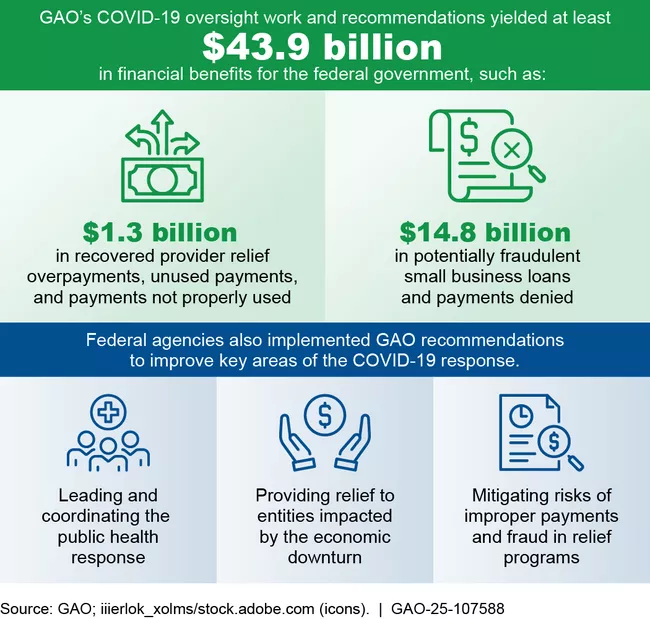
In response to the COVID-19 pandemic, Congress appropriated $3.1 trillion in emergency assistance for people, businesses, the health care system, and state and local governments. GAO is examining many aspects of the federal response and is your source for that fact-based, nonpartisan information. The CARES Act requires GAO to issue bi-monthly reports on the impact of COVID-19.
GAO's Latest Findings
On March 31st, we issued our latest bi-monthly report on the federal pandemic response and our recommendations for improving it. The latest report discusses small business loan fraud, unemployment overpayments, K-12 education, vaccine data, and more. We urge swift action on the 28 new recommendations in this report as well as 38 of 44 prior recommendations that have not been fully implemented. Read more about our latest report in our press release here and below.
Small Business Loan Fraud. Since March 2020, the Department of Justice has been announcing charges in numerous fraud-related cases associated with the Paycheck Protection Program (PPP) andEconomic Injury Disaster Loans (EIDL) program. To mitigate fraud risks, GAO is recommending that the Small Business Administration:
Conduct and document a fraud risk assessment for the EIDL and PPP programs
Implement a comprehensive oversight plan that looks for fraud risks in the EIDL program
Develop a strategy for how to address those risks in the EIDL program
Outline specific actions for how to monitor and manage PPP fraud risks on an ongoing basis
Unemployment Overpayments. As of March 2021, more than $3.6 billion in Pandemic Unemployment Assistance (PUA) overpayments from March 2020 through January 2021 have been identified by states, according to the Department of Labor. DOL has taken some steps to implement our recommendation to collect data on states’ recovery of PUA overpayments, but without data on the amount of overpayments waived by the states, it’s unclear how much states will or will not recover. GAO is recommending that DOL collect data on how much of the PUA overpayments have been waived by states.
Collecting and Sharing Vaccine Data. Almost half of all data collected from states on vaccine recipients were missing the race and ethnicity of the recipient, according to the Department of Health and Human Services (HHS). GAO recommends that HHS take steps to ensure the complete reporting of race and ethnicity from state data. GAO is also urging HHS to require nursing homes to offer the COVID-19 vaccines to residents and staff. To improve monitoring and transparency, HHS ought to make all data related to nursing home vaccination efforts publicly available.
Communicating Pandemic Data. HHS publishes its COVID-19 data across multiple websites, making it difficult for the public to access information on COVID-19. To remedy this, GAO is suggesting HHS make all of its COVID-19 data available from a centralized internet location.
K-12 Education. The Department of Education has taken steps to begin tracking state and school district spending on certain COVID-19 relief funds, but there is a lag between when schools use the funds and when it is reported as spent to Education. Due to this lag, policymakers are missing timely information that could be used to address pandemic-related education needs. GAO is recommending that Education regularly collect and make publicly available information on school districts’ financial commitments.
With our latest report, we have now made 72 recommendations since June 2020.
When it passed the CARES Act in March of 2020, Congress allocated $10 billion to the Operation Warp Speed (OWS) program to accelerate vaccine production and distribution. OWS—a partnership between the Departments of Health and Human Services and Defense—aimed to help accelerate the development of a COVID-19 vaccine. GAO analyzed the readiness of each company’s vaccine technology.
In February, we released an online dashboard that provides an interactive view of vaccine development data. We released a report that looks at how the vaccine companies accelerated and combined some steps in the development process to meet unprecedented timeframes. It also looks at manufacturing challenges and what is being done to address them. For example, agencies have worked to expedite procurement and delivery of critical manufacturing equipment to address manufacturing challenges.
GAO is well-positioned to oversee the federal COVID-19 response, as we have extensive experience reporting fact-based information from officials and organizations across a wide array of federal issues.
GAO, other oversight bodies, and federal officials can use our past pandemic-related reports—and the many recommendations that still apply—to inform their own work. You can find a categorized list of these reports on this page: Past Pandemic-Related Reports.
Newest COVID-Related Reports
How to Get Notified about New Reports
Be the first to know when GAO issues new work related to the pandemic and Coronavirus oversight.
Live Feed of Reports: Embed a feed of reports on your website.
Daily Emails: Sign up for our daily emails on this topic or several others.
Twitter: The fastest way to know we have issued new work is to follow us on Twitter @usgao.
Our published reports and congressional testimonies that are relevant to the Coronavirus pandemic are available below. The list will be updated with new reports as they are published.
Bi-Monthly CARES Act Reports
The CARES Act requires GAO to issue bi-monthly reports on the impact of COVID-19. We have made a total of 72 recommendations and 4 matters for congressional consideration to improve the COVID-19 response in these reports. You can view each report and its recommendations here:
As part of our oversight, we draw on the lessons learned from our broad portfolio of work on how the federal government can prepare for, respond to, and help people recover from disasters and pandemics.
This feed shows our published reports and congressional testimonies that are relevant to the Coronavirus pandemic. It will be updated with new reports as they are published.
GAO is well-positioned to oversee the federal COVID-19 response, as we have extensive experience reporting fact-based information from officials and organizations across a wide array of federal issues.
GAO, other oversight bodies, and federal officials can use our past pandemic-related reports—and the many recommendations that still apply—to inform their own work. You can find a categorized list of these reports on this page: Past Pandemic-Related Reports.
Report Suspected Fraud to GAO
Image
Federal agencies will be responsible for ensuring that all the funds from the record $2 trillion stimulus package end up where they’re supposed to. GAO has been tasked with tracking that money. If you suspect waste, fraud, or abuse of stimulus funds, you can help us out by using FraudNet to report your concerns. Read April 10 press release.
FraudNet is a GAO program for the public, government workers, and contractors to report allegations of improper activities in the federal government—including fraud, waste, or abuse of funds provided under the CARES Act.