
Tax Fraud Costs Up to $304 Billion Each Year
Federal taxes help pay for everything from Social Security to national defense. But we estimate that as much as $304 billion in tax revenue is lost to fraud each year.
How is this fraud committed and what can be done to prevent it? Today’s WatchBlog post looks at our new report on this issue.
Image

The tax fraud schemes that cost billions each year
Tax fraud schemes are constantly evolving. But many of these schemes fall into three broad categories—tax evasion, return preparer, and identity theft.
Tax evasion. This occurs when taxpayers intentionally misreport their expenses or income on annual returns with a goal of reducing the amount of taxes due. For example, taxpayers may claim credits for which they do not qualify, such as the Earned Income Tax Credit. This fraud may also occur when no tax return is filed.
Return preparer fraud. In this fraud scenario, tax professionals prepare and file false returns for clients. These returns may include inflated expenses, fake deductions, or excessive exemptions. This form of fraud may occur with or without the taxpayer’s knowledge.
Identity theft. Fraudsters may steal someone’s personal information and use it to file a tax return in their name with a goal of stealing refunds. This form of fraud is often perpetrated by large criminal enterprises.
How much do we lose to tax fraud? We estimate that the federal government could lose between $116 billion and $304 billion each year to tax-related fraud. This is about 2% to 6% of total tax owed. To put that in perspective, revenues lost to tax fraud could be as much as the entire annual budget of the Navy, which was $292 billion in FY 2026.
GAO’s Estimated Range of Tax Fraud Loss as a Percentage of Estimated Total Federal Taxes Owed, Tax Year 2022
Image
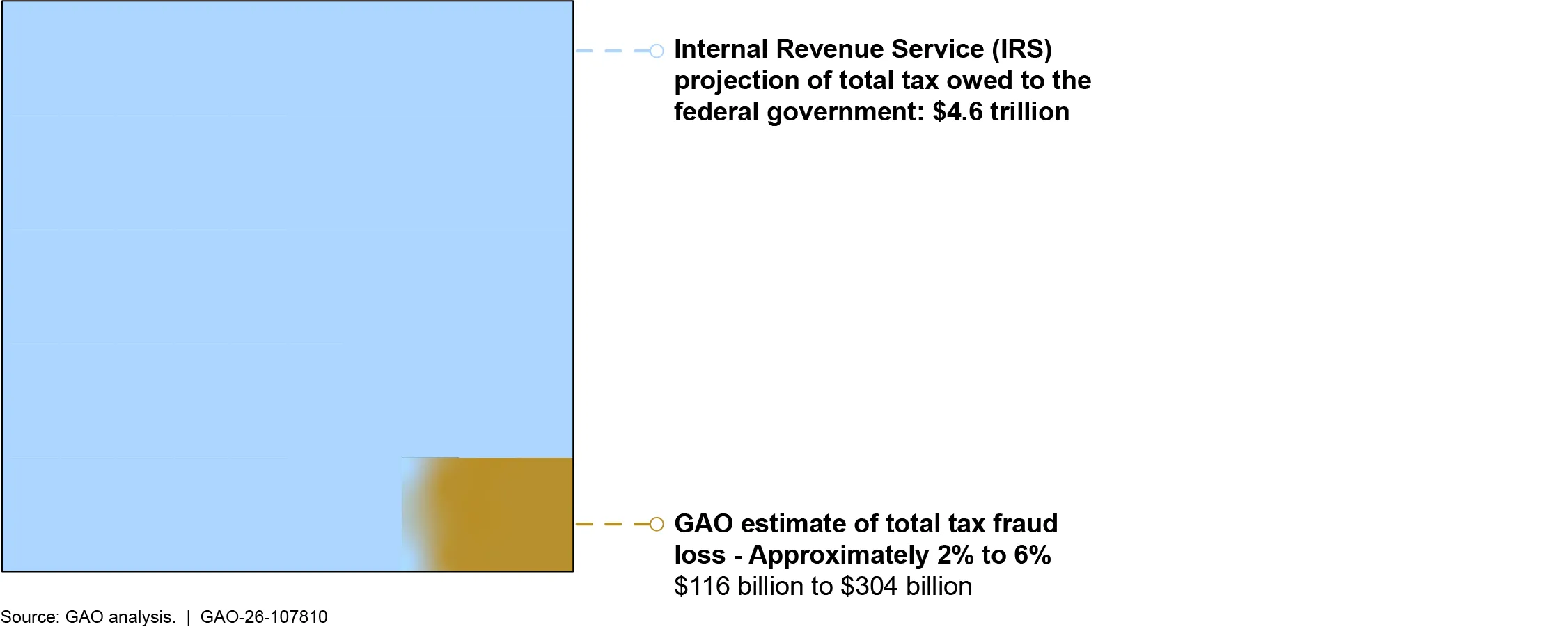
We recently created a first-of-its-kind estimate of how much the government could lose to tax fraud, both detected and undetected, based on data from 2018 to 2024. To develop this estimate, we gathered data on cases that were handled in court or addressed directly by the IRS. We also considered federal tax evasion in the “shadow economy,” which includes legal economic activity purposefully hidden from the government.
What is the IRS doing to stop tax fraud?
It’s not possible to eliminate fraud entirely. But the IRS regularly undertakes a broad range of actions to reduce it. These actions include:
- Preventing fraud using automated systems that screen for noncompliance, characteristics indicative of identity theft, and other tax refund fraud. The IRS estimates that it prevented $88 billion in invalid and potentially fraudulent tax refund payments from fiscal years 2018 through 2024.
- Detecting fraud with specialized staff who help IRS auditors identify indicators of fraud for further investigation.
- Responding to fraud by, for example, issuing penalties or opening a criminal investigation into taxpayers and tax preparers. In fiscal year 2024, the IRS issued 1,400 penalties totaling $115 million and initiated more than 2,600 criminal investigations.
Example of IRS Fraud Detection and Response
Image
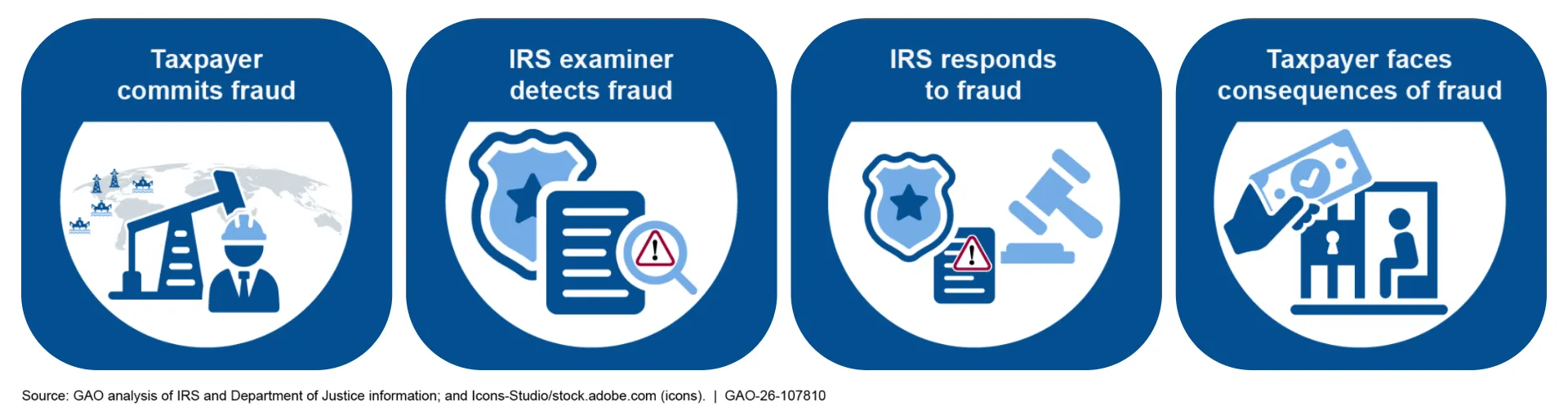
Though the IRS has made efforts to reduce fraud, its approach has been ad hoc and decentralized. Specifically, the IRS does not have an agency-wide strategy to handle fraud risks in a strategic and coordinated manner. We recommended that the IRS create an anti-fraud strategy to help reduce revenue lost to fraud.
In addition, we recommended that the IRS designate an office to lead coordination of these initiatives. This entity could help facilitate communication across the entire agency on these issues and share knowledge on anti-fraud practices.
Learn more about the scale of tax fraud and how the IRS could improve its efforts to prevent it by reading our new report.
- GAO’s fact-based, nonpartisan information helps Congress and federal agencies improve government. The WatchBlog lets us contextualize GAO’s work a little more for the public. Check out more of our posts at GAO.gov/blog.
- Got a comment, question? Email us at blog@gao.gov.
GAO Contacts
Image

Image





GAO's mission is to provide Congress with fact-based, nonpartisan information that can help improve federal government performance and ensure accountability for the benefit of the American people. GAO launched its WatchBlog in January, 2014, as part of its continuing effort to reach its audiences—Congress and the American people—where they are currently looking for information.
The blog format allows GAO to provide a little more context about its work than it can offer on its other social media platforms. Posts will tie GAO work to current events and the news; show how GAO’s work is affecting agencies or legislation; highlight reports, testimonies, and issue areas where GAO does work; and provide information about GAO itself, among other things.
Please send any feedback on GAO's WatchBlog to blog@gao.gov.