
Limited Corporate Transparency Opens the Door for Fraud & Other Crimes
Knowing who owns a company provides transparency into where its funds are coming from and where they are going. Sometimes, drug cartels and fraudsters may disguise a company’s ownership to help them launder money or even access federal funding they otherwise couldn’t get.
Today’s WatchBlog post looks at our recent work on the importance of knowing who owns a company—or its “beneficial ownership”—and how not knowing increases fraud risks.
Image

Disguising beneficial ownership, cheating taxpayers
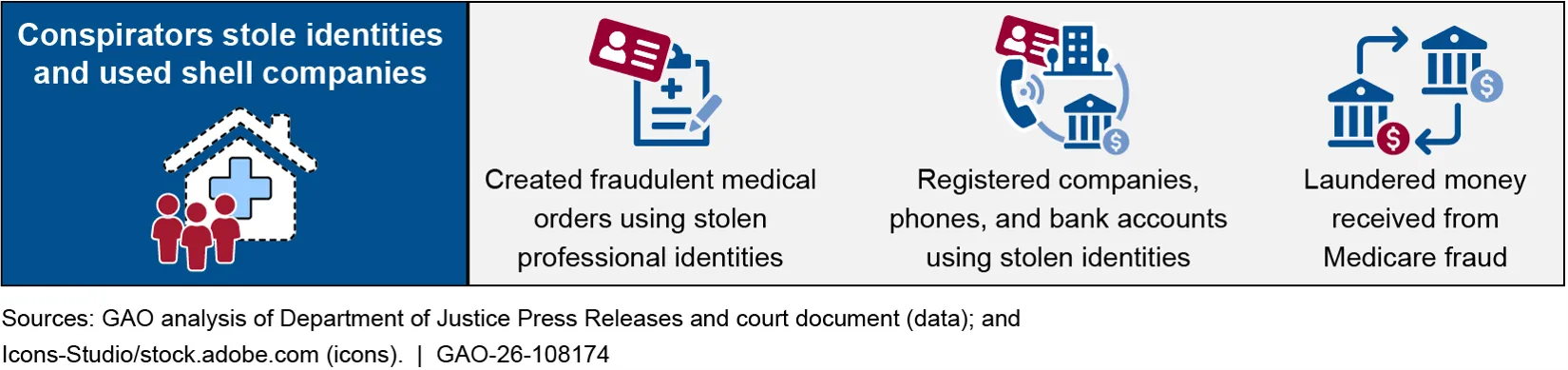
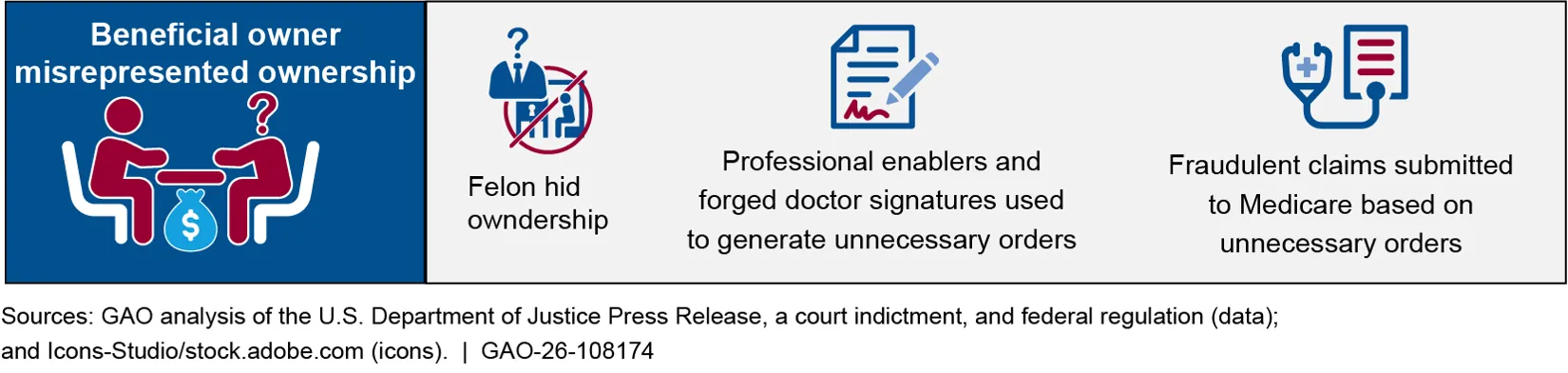
The registered owners of a company may or may not be the people who ultimately benefit from or control it. The person or people who do benefit are known as the “beneficial owners.” Disguising beneficial ownership information can help criminals commit fraud and other illegal activities. These actors can hide a company’s ownership in several ways, including using:
- Stolen identities to act as a company’s owners
- “Shell” companies or created corporate entities to obscure ownership
- “Straw” owners (or an “owner in name only”) who have limited authority and little or no control over company assets
- Professional enablers or stolen identities of professionals—such as doctors or lawyers—to provide legitimacy to fraudulent claims
- Pass-through billing schemes to obscure billing and enable fraud, such as the submission of false invoices
Using Stolen Identities and Shell Companies to Defraud Medicare
Image
Misrepresenting Ownership and Using Professional Enablers to Scam Medicare
Image
Companies are not required to provide their beneficial ownership information when applying for federal awards such as contracts or grants.
As a result, these programs, which are funded by taxpayer dollars, may be exploited by criminals and fraudsters. Hundreds of billions of federal dollars are vulnerable to beneficial ownership-related fraud risks. Awards, such as contracts with foreign businesses, are among those vulnerable to beneficial ownership fraud risks.
Despite the risks, most companies are exempt from reporting their beneficial ownership
In 2024, the Department of the Treasury began requiring that some U.S. and foreign companies report their ownership information to the Financial Crimes Enforcement Network (FinCEN). This information was then added to a registry intended to help prevent and combat money laundering, terrorist financing, corruption, and tax fraud.
But then, in 2025, FinCEN expanded exceptions for reporting this ownership information. Specifically, a new rule exempted all U.S. companies and U.S. persons who are beneficial owners of foreign companies from reporting requirements. This expanded exemption applies to about 99% of entities previously required to report.
We recently sat down with expert Mike Clements to discuss this rule change and how it could affect corporate transparency. Listen to our conversation below:
More could be done to understand how expanded exemptions affect transparency of ownership and the risks of not knowing this information. But so far, Treasury hasn't determined how to address these risks and their effects on policymakers’ and law enforcement’s efforts to counter criminal activity. We recommended it do so. Learn more by reading our recent report.
- GAO’s fact-based, nonpartisan information helps Congress and federal agencies improve government. The WatchBlog lets us contextualize GAO’s work a little more for the public. Check out more of our posts at GAO.gov/blog.
- Got a comment, question? Email us at blog@gao.gov.
GAO Contacts
Image

Image


Related Products
GAO's mission is to provide Congress with fact-based, nonpartisan information that can help improve federal government performance and ensure accountability for the benefit of the American people. GAO launched its WatchBlog in January, 2014, as part of its continuing effort to reach its audiences—Congress and the American people—where they are currently looking for information.
The blog format allows GAO to provide a little more context about its work than it can offer on its other social media platforms. Posts will tie GAO work to current events and the news; show how GAO’s work is affecting agencies or legislation; highlight reports, testimonies, and issue areas where GAO does work; and provide information about GAO itself, among other things.
Please send any feedback on GAO's WatchBlog to blog@gao.gov.