
Corporate Transparency: Treasury Should Address Gaps in Ownership Information Resulting from Expanded Exemptions
Fast Facts
U.S. companies aren't usually required to disclose the identities of people who own them. This lack of transparency can be attractive to criminals hiding illegal activities. In 2024, the Department of the Treasury started to require some U.S. and foreign companies to report ownership information to the Financial Crimes Enforcement Network (FinCEN).
In March 2025, FinCEN exempted domestic companies and U.S. persons from this requirement. This limited reporting to foreign companies registered to do business in the United States. But Treasury hasn't determined how to address the resulting gap in ownership information.
We recommended doing so.

Blank white puzzle pieces partially covering a US 100 dollar bill
Highlights
What GAO Found
The Corporate Transparency Act (CTA) requires the Department of the Treasury’s Financial Crimes Enforcement Network (FinCEN) to develop reporting requirements for and create a registry of beneficial owners—individuals who own or control business entities. The CTA and FinCEN’s 2022 beneficial ownership rule explicitly exempts 23 categories of entities from these requirements, largely because they already are subject to federal or state regulation or must report similar information to a governmental authority. Federal and state regulators overseeing exempt categories generally require some identifying information for individuals who may be owners or exercise control over those entities, according to GAO review of regulatory documentation and interviews.
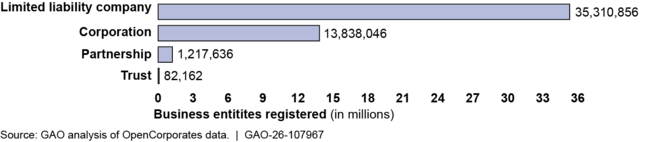
In March 2025, FinCEN issued an interim final rule exempting domestic companies and U.S. persons from beneficial ownership reporting requirements. Most of these entities were limited liability companies (LLC) and corporations—the largest categories of U.S.- registered businesses (see figure). The expanded exemption—made to reduce burden on legitimate businesses—applies to over 99 percent of entities that previously were required to report.
Numbers of Business Entities Registered in the U.S., July 2025
Most states require entities operating within their borders to file reports that may collect ownership and control information, such as the names of corporate officers and directors or LLC managers and members, according to a 2024 National Association of Secretaries of State report. However, these individuals may not be the beneficial owners or exercise substantial control over the entity. Moreover, states vary in the extent to which they collect such information.
U.S.-based shell companies, often structured as LLCs or corporations, can pose significant risks of illicit finance activity. Treasury’s 2026 National Money Laundering Risk Assessment identified several cases in which shell companies were used to facilitate financial crimes, including laundering the proceeds of drug trafficking, cybercrime, and fraud, among others, indicating the continued risk posed by shell companies. The 2025 domestic reporting company exemption may perpetuate these risks because state requirements for reporting ownership and control information vary in scope.
Treasury is statutorily required to provide information to law enforcement that could be highly useful and to report to Congress on exempt entities that are significantly abused for illicit finance. However, Treasury has not identified potential actions or taken steps to address gaps in beneficial ownership information resulting from the broadened reporting exemptions. Doing so would better position policymakers and law enforcement to respond to potential shell company misuse while minimizing regulatory burden on legitimate businesses.
Why GAO Did This Study
Illicit actors frequently use corporate structures such as shell companies to launder criminal proceeds. These structures can be exploited because they allow the identities of people who benefit from or control them to be hidden from law enforcement.
The Anti-Money Laundering Act of 2020 includes a provision for GAO to report on the regulation of entities exempted from beneficial ownership reporting and the extent to which they pose significant illicit finance risks. This report (1) describes regulatory and reporting requirements for exempt entities, (2) assesses the extent to which such entities can pose significant risks of illicit finance activity, and (3) examines Treasury’s plans to monitor and report on those risks.
GAO reviewed documentation from federal and state regulators related to their collection of ownership and control information on exempted entities and interviewed agency officials. GAO also reviewed reporting requirements in six states, selected largely because they had the highest numbers of filings. In addition, GAO reviewed federal assessments, international standards, and press releases on cases involving exempted entities and interviewed law enforcement officials.
Recommendations
GAO recommends that Treasury identifies potential actions to address the risks posed by the domestic reporting company and U.S. person exemptions and provides Congress and law enforcement with highly useful information that addresses these risks. Treasury disagreed with the recommendation. GAO continues to believe that actions for this recommendation are needed as discussed in the report.
Recommendations for Executive Action
| Agency Affected | Recommendation | Status |
|---|---|---|
| Department of the Treasury | The Secretary of the Treasury should ensure that the Director of FinCEN identifies potential actions to address the risks posed by the domestic reporting company and U.S. person exemptions and, as appropriate, provides Congress and law enforcement with highly useful information that addresses these risks. (Recommendation 1) |
When we confirm what actions the agency has taken in response to this recommendation, we will provide updated information.
|