
Medicare’s Hospice Bill Doubled Over the Last Decade
In recent years, Medicare’s spending on hospice has nearly doubled. We looked at this spending and found that the way Medicare pays for hospice care could be costing taxpayers billions more than it should.
Today’s WatchBlog post looks at our new report about inefficiencies in Medicare's payments.
Image

What is causing increases in Medicare spending
Medicare is the federal government’s health insurance program for people age 65 and older and people with disabilities. It is the largest insurance provider in the United States.
Medicare covers hospice care for beneficiaries with 6 months or less to live. The bulk of hospice care is routine home care delivered through visits by nurses, aides, and social workers to address a patient’s pain and symptoms. In 2024, almost 2 million Americans relied on Medicare to pay for this end-of-life care.
Over time, spending on hospice care has increased substantially, nearly doubling during the last decade. Specifically, hospice care spending went from $15.5 billion to $27.5 billion between FY 2015 to 2024.
Some of the spending increases can be explained by the growing number of patients receiving care. During that 10-year time frame, the number of people enrolled in hospice care per year grew by 32%. And the average number of days in care increased 15% during this time, with long stays (more than 180 days) accounting for the majority of hospice spending in 2024.
But while these changes are contributing to higher costs, another key driver is how Medicare is paying for hospice care—by day instead of by visit.
Medicare may have overspent by billions on hospice home care
Medicare pays a daily rate for hospice home care. With some exceptions, the daily rates generally do not depend on the number of visits or the type of health care professional delivering care. What does this mean? For Medicare, it means that regardless of how often a patient is visited or by whom, the cost to taxpayers is the same.
Hypothetical Examples of Payment per Visit for Low- and High-Visit Hospices
Image
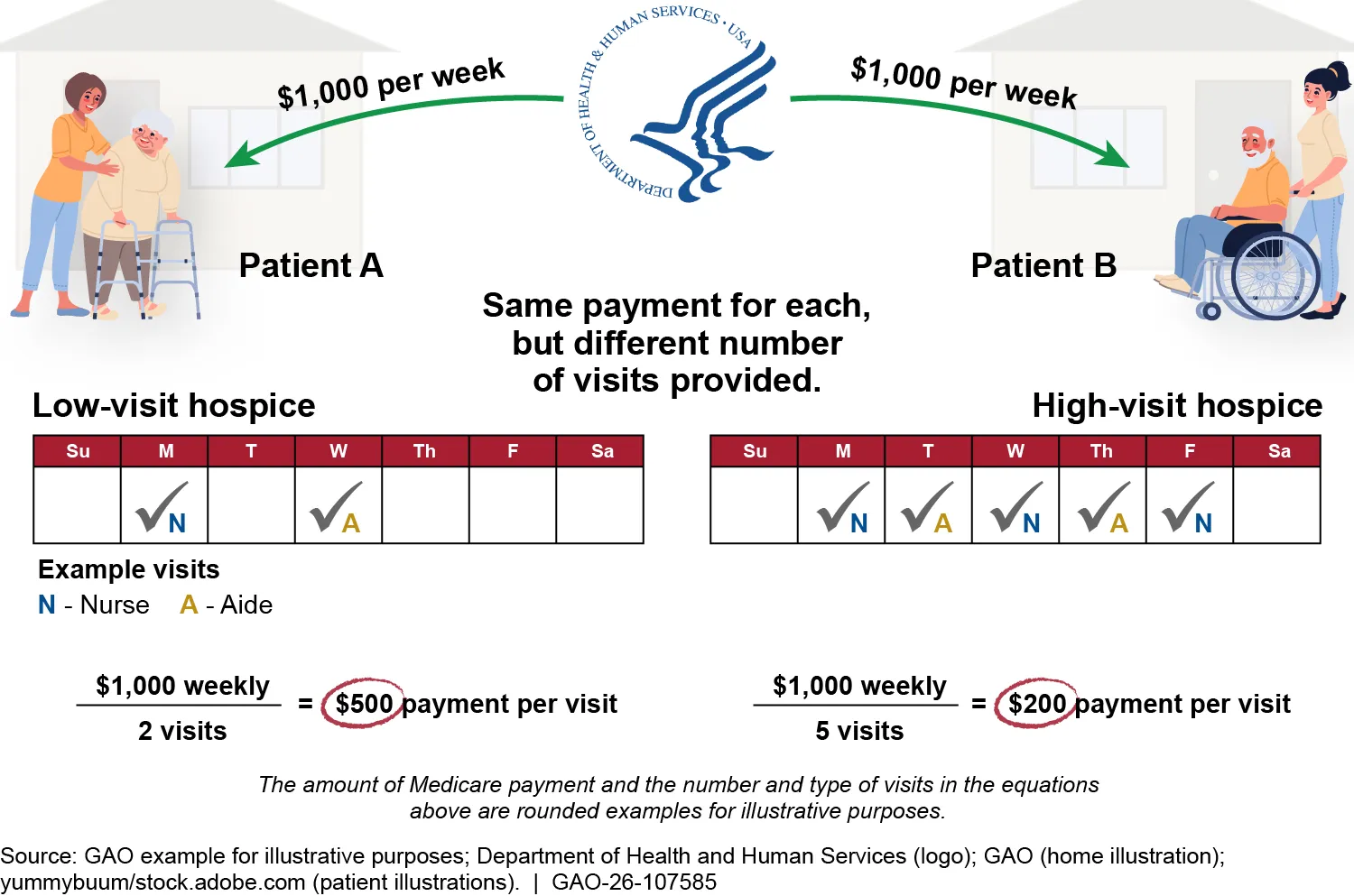
There are concerns that paying per day for hospice care creates financial incentives for hospices to minimize the care they provide. Said another way, if you’re getting paid the same no matter how often you show up, why show up often?
We also looked at payments based on whether hospices provided a low or high number of visits. Specifically, we looked at the 20% of hospices that delivered the fewest visits (low-visit) and the 20% that delivered the most visits (high-visit).
- Low-visit hospices provided about 2.5 visits per patient per week, on average. Over half of these hospices were in seven states, four of which the Centers for Medicare & Medicaid Services (CMS) selected for increased oversight, such as California and Texas.
- High-visit hospices provided about 5.5 visits per week.
When we compared payments to these two groups, we found that Medicare effectively paid low-visit hospices twice as much per visit than high-visit hospices, on average.
Hospices received higher payments than under home health per visit rates. We estimated that Medicare paid about $16.7 billion for routine home care in recent years. But it would have paid about $9.1 billion if care had been paid per visit using home health prices instead of by day. That’s a difference of about $7.6 billion.
Average Per-Visit Payment and Home Health Rates for Low- and High-Visit Hospices, 2024
Image
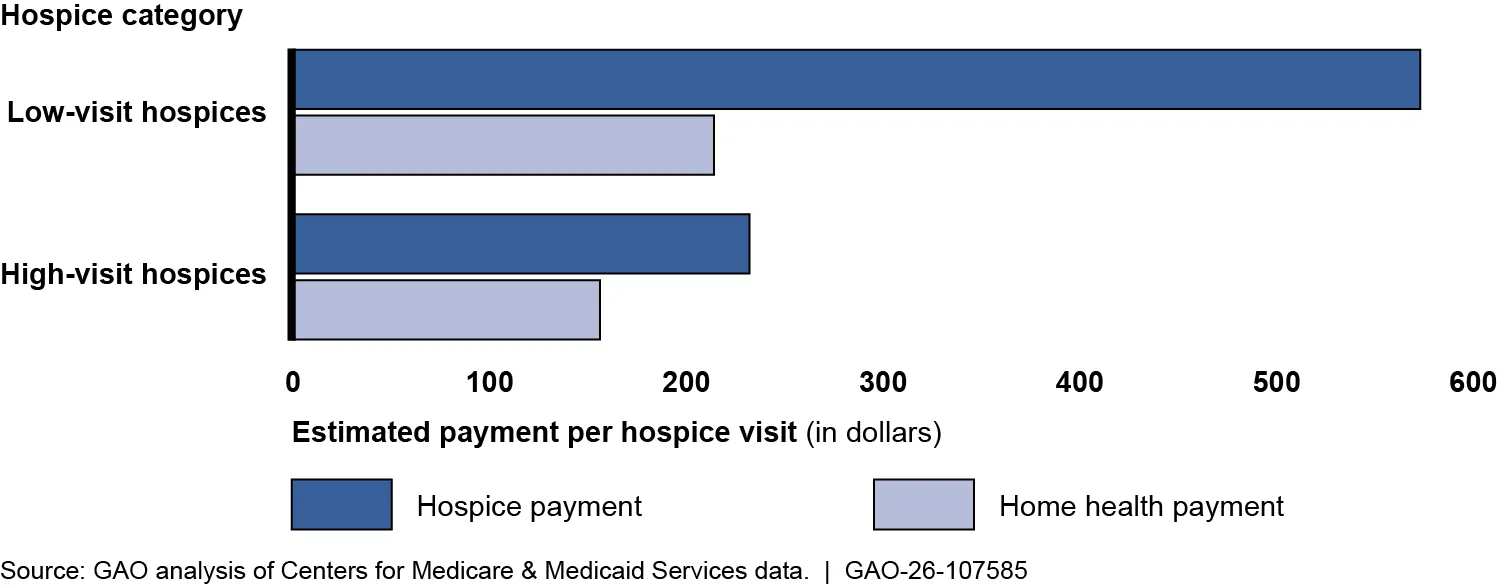
Note: GAO made several adjustments to account for differences between hospice payment rates and home health per-visit payment rates, including services that are covered by hospice, but not home health.
Large payments may attract fraudsters. CMS and law enforcement agencies have taken steps recently to address likely fraudulent behavior in hospice care. For example, in January, CMS said it was increasing reviews of new hospices in six states. Law enforcement agencies have also reported actions to address fraud schemes, some of which were alleged to have caused more than $100 million in losses to fraud.
So why not just change the way Medicare pays for hospice? CMS says it doesn’t have the statutory authority to make this kind of change. But it could if directed to do so by Congress. We think Congress should consider directing CMS to revise its hospice payment system. Doing so could make Medicare payments more efficient and reduce the incentive for fraudsters.
Learn more about our work on Medicare’s hospice care payment system by reading our full report.
- GAO’s fact-based, nonpartisan information helps Congress and federal agencies improve government. The WatchBlog lets us contextualize GAO’s work a little more for the public. Check out more of our posts at GAO.gov/blog.
- Got a comment, question? Email us at blog@gao.gov.
GAO Contacts
Image



Related Products

GAO's mission is to provide Congress with fact-based, nonpartisan information that can help improve federal government performance and ensure accountability for the benefit of the American people. GAO launched its WatchBlog in January, 2014, as part of its continuing effort to reach its audiences—Congress and the American people—where they are currently looking for information.
The blog format allows GAO to provide a little more context about its work than it can offer on its other social media platforms. Posts will tie GAO work to current events and the news; show how GAO’s work is affecting agencies or legislation; highlight reports, testimonies, and issue areas where GAO does work; and provide information about GAO itself, among other things.
Please send any feedback on GAO's WatchBlog to blog@gao.gov.