
Medicare Hospice: Action Needed to Pay More Efficiently for Routine Home Care
Fast Facts
Medicare covers hospice care—through nurse, aide, and social worker home visits—for terminally ill beneficiaries. Medicare spent $27.5 billion on hospice in 2024.
Medicare pays for similar care through its home health benefit for beneficiaries who aren't in hospice. But Medicare pays daily rates for hospice care (regardless of the number of visits) and it pays per-visit rates for certain other home health care.
If Medicare paid per-visit payment rates for hospice care, it would have paid $7.6 billion less for a group of beneficiaries receiving hospice care in 2024.
We recommended that Congress consider directing Medicare to revise its payments.

A woman holding the hand of an older man who is receiving supplemental oxygen from a medical device while in bed.
Highlights
What GAO Found
The routine home care that makes up the bulk of Medicare hospice care for its beneficiaries is primarily delivered through visits made by nurses, aides and social workers. GAO found that in 2024 for selected beneficiaries and hospices, low-visit hospices—the 20 percent of hospices that delivered the fewest visits per week per beneficiary—averaged about half as many visits per week as high-visit hospices—the 20 percent that delivered the most visits per week. Low-visit hospices delivered a total of 2.5 visits per week on average, compared to a total of 5.5 visits per week on average for high-visit hospices.
Because Medicare’s hospice daily payment rates are the same regardless of the number of visits delivered, Medicare effectively paid low-visit hospices twice as much per visit as high-visit hospices, on average. Also, Medicare effectively paid more per visit under hospice payment rates than it would have under rates for comparable home health visits. (See figure.) (GAO adjusted home health rates to account for, among other things, differences between services covered under the payment rates for each program.) Hospice routine home care visits and home health visits are comparable because they involve similar services provided by the same types of health care professionals. GAO’s analysis of claims from 2022 through 2024 showed that Medicare paid about $16.7 billion for the hospice routine home care but estimated Medicare would have paid about $9.1 billion if the care had been reimbursed under the home health per-visit payment rates for comparable services—a $7.6 billion difference.
Average Per-Visit Hospice Payment and Home Health Per-Visit Rates for Low- and High-Visit Hospices for Selected Beneficiaries Discharged from Hospice in 2024
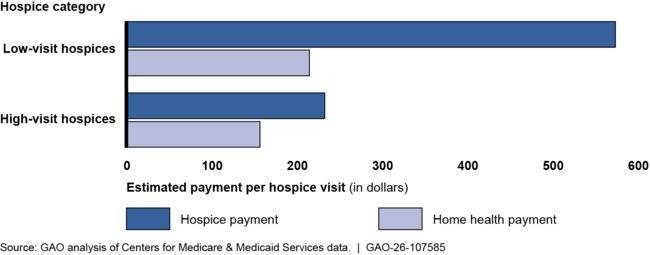
Note: GAO made several adjustments to account for differences between hospice payment rates and home health per-visit payment rates, including services that are covered by hospice, but not home health.
Though GAO found Medicare spending for routine home care is higher than what it would be under home health per-visit rates, Centers for Medicare & Medicaid Services (CMS) officials said the statute requires daily hospice payment rates and does not provide flexibility for further refinements to the payment structure beyond those made in 2016 and 2020. Officials also said CMS will continue to monitor hospice utilization to determine if there is a need for further refinements consistent with their statutory authority. Any excess hospice spending may have negative implications for the sustainability of the Medicare program and is inconsistent with Medicare’s responsibility to be an efficient purchaser of health care services.
Why GAO Did This Study
Medicare beneficiaries who are terminally ill may be able to enroll in Medicare’s hospice benefit, and the number who have done so has increased. Medicare’s spending on hospice care nearly doubled from $15.5 billion in fiscal year 2015 to $27.5 billion in fiscal year 2024.
For routine home care provided through its hospice benefit, Medicare generally pays a set amount per day regardless of the number and type of visits delivered. A daily rate may create financial incentives for hospices to provide a limited number of visits, which could affect the quality of hospice care.
GAO was asked to review Medicare hospice services and payments for those services. In this report, GAO (1) describes the frequency of hospice routine home care visits provided by selected hospices; and (2) examines how estimated per-visit payment rates for hospice routine home care compare across selected hospices as well as to home health per-visit payment rates.
GAO analyzed Medicare claims for routine home care from 2022 through 2024 for a selection of 1,225,049 beneficiaries discharged from hospice in 2024 and a selection of 4,340 hospices that served more than 30 beneficiaries. GAO also reviewed documents and interviewed researchers and national organizations and CMS officials on hospice payment reform.
Recommendations
GAO recommends that Congress consider directing the Secretary of the Department of Health and Human Services (HHS) to revise the hospice payment system for routine home care services to better promote payment efficiency and realize savings for the Medicare program. HHS provided technical comments, which we incorporated as appropriate.
Matter for Congressional Consideration
| Matter | Status | Comments |
|---|---|---|
| Congress should consider directing the Secretary of the Department of Health and Human Services to revise the hospice payment system for routine home care services to better promote payment efficiency and realize savings for the Medicare program. (Matter for Consideration 1) | When we confirm what actions the agency has taken in response to this recommendation, we will provide updated information. |