
Tax Fraud: The Federal Government Loses an Estimated $116 Billion to $304 Billion Annually
Fast Facts
We estimated that the federal government could lose between $116 billion and $304 billion annually to tax fraud.
Tax fraud includes people or businesses intentionally failing to pay or deliberately underpaying the taxes they owe. It also includes criminals using stolen identity information to obtain taxpayer refunds.
While the IRS is working to safeguard taxpayer dollars, it doesn't have an antifraud strategy. It also hasn't designated a lead office to manage antifraud activities across the agency. Both are important to address tax fraud in a strategic and coordinated way.
We recommended that the IRS address these issues.

A magnifying glass over the words tax fraud
Highlights
What GAO Found
GAO estimated that annual federal tax fraud loss is between $116 billion and $304 billion based on data and information from 2018 through 2024. GAO’s estimate is informed by data on Internal Revenue Service (IRS) cases of fraud and potential fraud, potential fraud in the tax gap, and tax evasion from economic activities purposefully hidden from the government (i.e., shadow economy).
The estimated range reflects approximately 2 percent to 6 percent of estimated tax owed to the federal government (tax liability) if applied to tax year 2022, the most recent year for which an estimate of the tax liability is available.
GAO Estimated Range of Tax Fraud Loss as a Percentage of Estimated Total Tax Owed to the Federal Government, Tax Year 2022
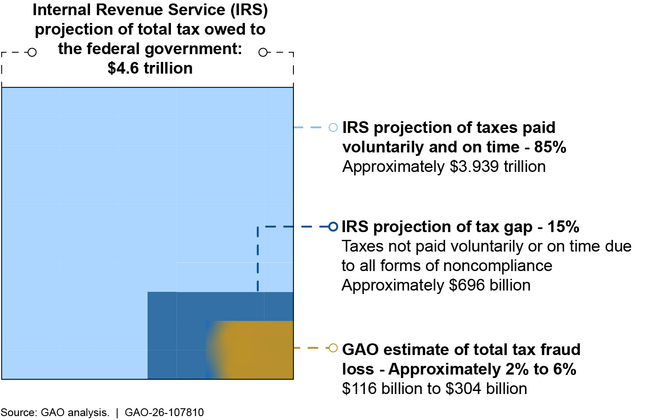
The estimated range represents GAO’s best estimate of the extent of tax fraud based on the available evidence and analytical methods. The methodology accounts for the inherent uncertainties associated with fraud estimation and data limitations.
The estimate could help Congress and agency officials understand the potential scale and scope of tax fraud loss and decide how to allocate resources for fraud risk management. For example, the estimate could inform decisions about the costs and benefits of implementing new controls to prevent, detect, and respond to tax fraud.
While it is not possible to eliminate fraud completely, different divisions within IRS undertake a broad range of activities that help manage tax fraud risk and safeguard taxpayer dollars. Some of these activities are directly aimed at preventing, detecting, and responding to tax fraud. Other activities are aimed at improving overall taxpayer compliance but nonetheless help the agency reduce tax fraud risk. For example, IRS’s Return Review Program screens certain individual tax returns for characteristics indicative of fraud. Through this program, according to IRS, it prevented $88 billion in invalid, and potentially fraudulent, tax refund payments from 2018 through 2024.
Additionally, tax return audits play a key role in helping IRS detect fraud. IRS trains auditors to recognize indicators of fraud when reviewing tax returns for overall compliance. Once IRS detects potential fraud in a tax return, it may respond in various ways, including through assessing civil penalties, criminal investigation, and referral for prosecution.
Example of Internal Revenue Service (IRS) Fraud Detection and Fraud Response
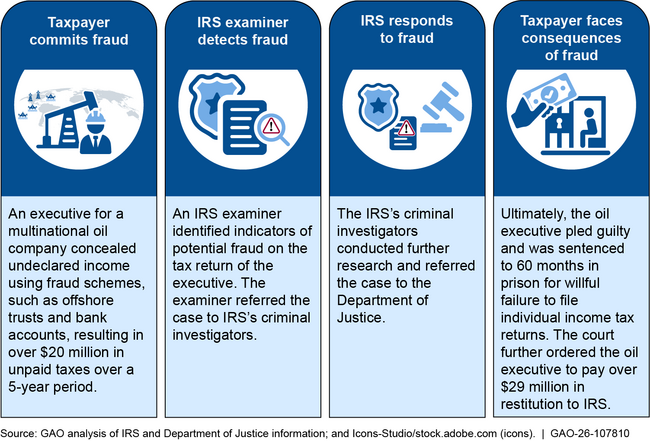
IRS has routinely assessed fraud risks consistent with leading practices for fraud risk management. However, the agency has not developed an antifraud strategy or designated an antifraud entity to mitigate fraud risks in a strategic and coordinated manner. An antifraud strategy could help IRS better manage fraud risks, which in turn could help reduce revenue lost to tax fraud. Further, designating an antifraud entity to undertake key fraud risk management activities—such as coordinating antifraud initiatives across the agency—would help IRS better mitigate the billions of dollars lost to fraud each year.
Why GAO Did This Study
Each year, the federal government collects trillions of dollars in revenue, the single largest source of which comes from taxes that IRS collects. Most taxpayers pay their taxes voluntarily and on time. However, some taxpayers do not comply with tax law, including by committing fraud—willful misrepresentation to obtain something of value. Tax fraud diverts revenue that could be used for critical government operations and services and exacerbates budget deficits.
This report (1) describes the estimated amount of federal tax revenue lost to fraud annually and (2) examines the ways in which IRS safeguards federal tax revenue and manages fraud risks.
GAO estimated the amount of federal tax revenue lost to fraud annually using a well-established probabilistic method for estimating ranges of outcomes under different assumptions and scenarios where there is a high degree of uncertainty, such as with fraud estimation. The simulation incorporated IRS data from 2018 through 2024, as well as information on tax fraud from other sources, such as academic literature.
GAO also analyzed IRS documentation and interviewed IRS officials.
Recommendations
GAO is making two recommendations to IRS, that it develop and document an antifraud strategy and designate an antifraud entity.
IRS partially agreed with both recommendations. GAO continues to believe that IRS should develop an antifraud strategy and designate an antifraud entity.
Recommendations for Executive Action
| Agency Affected | Recommendation | Status |
|---|---|---|
| Internal Revenue Service | The Commissioner of Internal Revenue should develop and document an agency-wide antifraud strategy, or direct divisions to develop and document antifraud strategies at the operating level with oversight by the designated antifraud entity. (Recommendation 1) |
When we confirm what actions the agency has taken in response to this recommendation, we will provide updated information.
|
| Internal Revenue Service | The Commissioner of Internal Revenue should designate an antifraud entity responsible for coordinating and overseeing fraud risk management activities. (Recommendation 2) |
When we confirm what actions the agency has taken in response to this recommendation, we will provide updated information.
|