
Beware of Ghost Preparers—They Can Haunt Your Tax Filings
Filling out and filing tax forms correctly can be confusing. That is why more than half of all taxpayers pay to get help on these forms. But beware...Sometimes, these paid preparers aren’t who they seem. And if they ghost you, that could be a sign of fraud. For this very reason, these fraudsters are known as “ghost preparers.”
They can be a big problem for taxpayers.
Today’s WatchBlog post looks at our new report about how to spot a ghost preparer and what IRS should do to better protect taxpayers.
Image

How can you spot a ghost preparer?
Don’t be haunted by a bad decision. Choose your tax professional wisely. Here are some ways to spot a ghost preparer:
- They won’t sign your return. Honest tax professionals will sign your tax return as proof that they assisted you. Ghost preparers won’t.
- Cash only. Think twice. If they insist on being paid in cash, they could be trying to keep the transaction off the books.
- A bigger refund means a bigger fee. Be cautious. Preparers who base fees on a percentage of your refund may have an incentive to claim more tax credits or fake deductions. The bigger the refund, the more they make.
- Your refund should go to you. Be wary of anyone who asks you to have your tax refund deposited into another person’s or businesses’ bank account.
- Ask you to sign a blank form. Never sign a blank or incomplete return. And you should always review forms before they are submitted.
If you are victimized by a ghost preparer, tax filing can quickly become a scary experience. They may steal your refund or your personal information, which can be used to cause financial and other problems well beyond your tax return.
At the end of it all, the ghost preparer disappears into thin air, leaving you responsible for the false information on the return. Their actions can cost you and the government. For example, preparers at a fraudulent Florida tax preparation business concealed their identities to file almost 2,000 false tax returns on behalf of clients. They defrauded the government out of over $900,000.
Ghost preparers may also target vulnerable communities, taking advantage of low-income or immigrant clients, who may face challenges finding a trusted tax professional. For example, a father and daughter duo in Iowa posed as professional tax preparers and exploited hundreds of victims within their own immigrant community.
What is IRS doing to find and fight ghost preparers?
Ghost preparers are, by definition, difficult to find. When IRS suspects a ghost preparer was used, it will send the taxpayer a letter asking for information about who prepared the return. IRS can also identify these fraudsters through internal research, data analysis, and examinations.
What happens to an identified ghost preparer depends on the circumstances and severity of the conduct. IRS can take a range of actions. These include everything from sending letters or charging a monetary penalty to more serious enforcement actions, including opening a criminal investigation or possible referral to the Department of Justice for prosecution.
IRS Uses Several Approaches to Address Ghost Preparers
Image
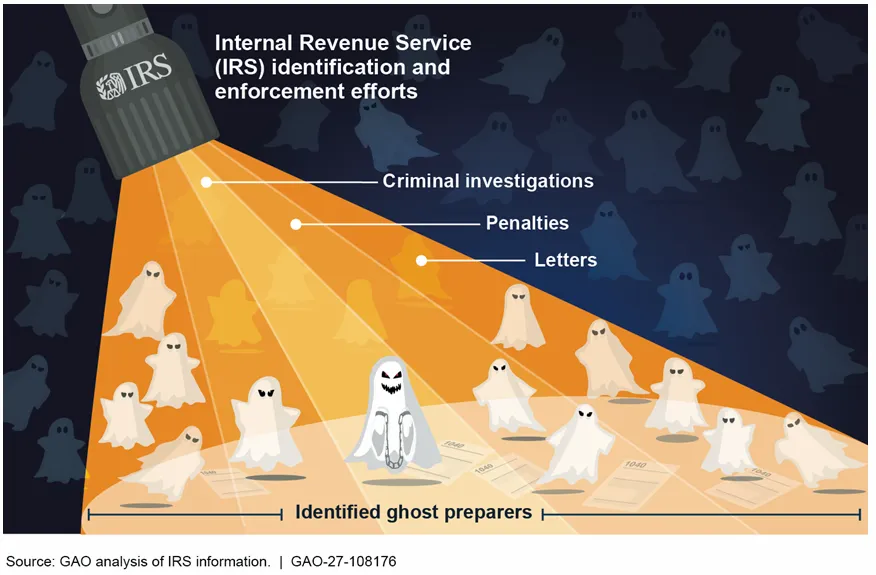
While IRS is working to ghost bust, we think there’s more the agency could do to improve its efforts. For example, we found that IRS does not have comprehensive information on ghost preparers it has already identified. Having this information could give IRS a more complete picture of the problem and help inform a strategy for protecting taxpayers.
Similarly, requiring all preparers to comply with IRS standards would better protect taxpayers from fraudsters. It would also help taxpayers file more accurate returns and avoid trouble with IRS. But IRS doesn’t currently have this authority. We’ve previously asked Congress to give IRS the authority to establish professional requirements for paid preparers to help protect taxpayers.
What can you do to protect yourself from ghost preparers?
There are a couple ways to defend against this type of fraud.
- Check the IRS Directory of Federal Tax Return Preparers to confirm a preparer has a valid PTIN and is licensed.
- Review your entire return before signing it and request a copy of the filed return.
- Once filed, track the status of your refund using IRS’s Where’s my Refund tool.
A good tax preparer should be willing to stand behind their work. A ghost preparer will not. Learn more in our new report.
- GAO’s fact-based, nonpartisan information helps Congress and federal agencies improve government. The WatchBlog lets us contextualize GAO’s work a little more for the public. Check out more of our posts at GAO.gov/blog.
- Got a comment, question? Email us at blog@gao.gov.
GAO Contacts
Image



Related Products

GAO's mission is to provide Congress with fact-based, nonpartisan information that can help improve federal government performance and ensure accountability for the benefit of the American people. GAO launched its WatchBlog in January, 2014, as part of its continuing effort to reach its audiences—Congress and the American people—where they are currently looking for information.
The blog format allows GAO to provide a little more context about its work than it can offer on its other social media platforms. Posts will tie GAO work to current events and the news; show how GAO’s work is affecting agencies or legislation; highlight reports, testimonies, and issue areas where GAO does work; and provide information about GAO itself, among other things.
Please send any feedback on GAO's WatchBlog to blog@gao.gov.