
Tax Filing: IRS Should Enhance Ghost Preparer Identification and Compliance Efforts in a Comprehensive Preparer Strategy
Fast Facts
Ghost preparers are paid tax preparers who hide their identities on returns and avoid accountability for making errors, committing fraud, or stealing refunds. But ghost preparers are hard for IRS to identify—leaving taxpayers responsible for errors or fraud.
The IRS has started addressing this problem, but its efforts are fragmented. For example, relevant data is scattered across several databases. This makes it hard for IRS to use this information to better understand ghost preparer behavior and protect taxpayers.
IRS also doesn't have a strategy, goals, or ways to measure the success of its efforts.
Our recommendations address these issues.

A pen points to the paid preparer section of a tax return.
Highlights
What GAO Found
Ghost preparers are paid tax preparers who do not comply with requirements to identify themselves on tax returns they prepare for others. Ghost preparers may intentionally leave identifying information off to get away with filing fraudulent income tax returns, stealing taxpayers’ refunds, and stealing taxpayers’ identities. Courts have ordered individual ghost preparers to pay millions in restitution to the government, but according to Internal Revenue Service (IRS) officials, the total effect of ghost preparers is likely greater, in part, because ghost preparers are difficult to detect.
IRS maintains some data on identified ghost preparers, but the systems IRS uses to track ghost preparer cases and outcomes are not connected and have limitations that impede their usefulness. As a result, IRS does not know how many ghost preparers it has identified, investigated, and addressed. Better understanding existing data, including its limitations, would help IRS direct enforcement resources and protect taxpayers from fraudulent returns or stolen refunds.
IRS identifies and addresses ghost preparers through data analysis, referrals, taxpayer education, and enforcement actions such as investigations. However, these efforts are fragmented across six offices and IRS is missing opportunities to share information and better address risks. A comprehensive, coordinated preparer strategy, including efforts addressing ghost preparers, could help IRS better align resources with risks and identify additional needs.
Notional Example of Fragmented Activities Compared to a Comprehensive, Coordinated Strategy
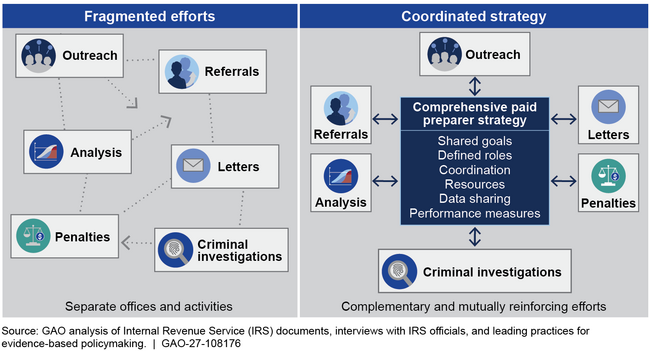
While IRS has some activities to address ghost preparers, including data analysis and taxpayer education, it has not developed measurable objectives or performance goals. Defining objectives, goals, and performance measures could help IRS reliably assess whether its efforts are reducing ghost preparer activity and adjust its strategy and allocate resources more effectively.
Why GAO Did This Study
Paid tax preparers prepared more than half of all tax returns in fiscal year 2025 and have an enormous effect on IRS’s ability to administer tax laws effectively. However, ghost preparers may hide their identities to avoid accountability and leave taxpayers responsible for inaccurate or fraudulent returns they prepare.
GAO was asked to examine IRS’s efforts to address ghost preparers. This report (1) describes how ghost preparers have harmed taxpayers and IRS, (2) assesses the extent to which IRS maintains data on ghost preparers, and (3) evaluates IRS actions to identify and address ghost preparers.
GAO reviewed federal court cases, and IRS documentation and data. GAO compared IRS’s efforts to leading practices for evidence-based policymaking and consumer education planning. GAO also interviewed IRS and Department of Justice officials and stakeholder groups, such as IRS oversight and industry groups.
Recommendations
GAO is making three recommendations including that IRS identify opportunities to enhance data collecting, sharing, and analysis to inform its ghost preparer efforts, incorporate ghost preparer efforts within a comprehensive, coordinated paid preparer strategy, and define measurable objectives and goals. IRS agreed with GAO’s recommendations and described steps it plans to take or started taking, in response to each recommendation.
Recommendations for Executive Action
| Agency Affected | Recommendation | Status |
|---|---|---|
| Internal Revenue Service | The Commissioner of Internal Revenue should review the quality and usefulness of existing data and identify opportunities to enhance data collecting, sharing, and analysis to inform its ghost preparer efforts. (Recommendation 1) |
When we confirm what actions the agency has taken in response to this recommendation, we will provide updated information.
|
| Internal Revenue Service | The Commissioner of Internal Revenue should incorporate efforts to identify and address ghost preparers within a comprehensive, coordinated paid preparer strategy and identify the resources needed to implement it. (Recommendation 2) |
When we confirm what actions the agency has taken in response to this recommendation, we will provide updated information.
|
| Internal Revenue Service | The Commissioner of Internal Revenue should define and document measurable strategic objectives and performance goals for ghost preparer initiatives, including methods and measures to assess the effectiveness of taxpayer outreach. (Recommendation 3) |
When we confirm what actions the agency has taken in response to this recommendation, we will provide updated information.
|