America's Fiscal Future
GAO takes a big-picture look at the nation’s fiscal condition and offers resources to help policymakers get the nation on a more sustainable fiscal path.
The federal government's unsustainable fiscal outlook poses serious economic, national security, and societal challenges. In June 2026, we released our annual report on the nation’s fiscal health. We reported that:
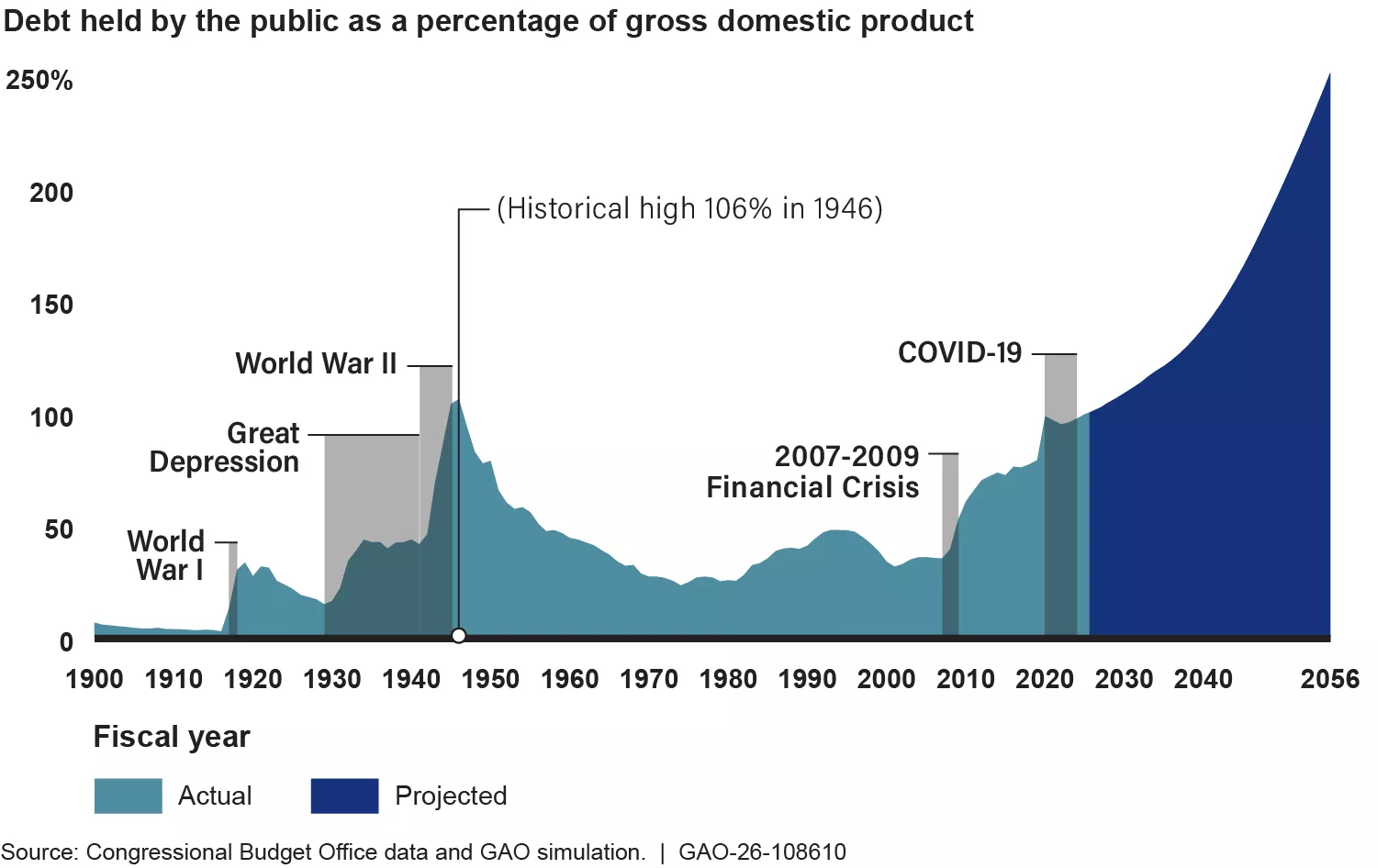
Publicly held debt is projected to grow more than twice as fast as the economy over the next 10 years, reaching 123% of the size of the economy in 2036
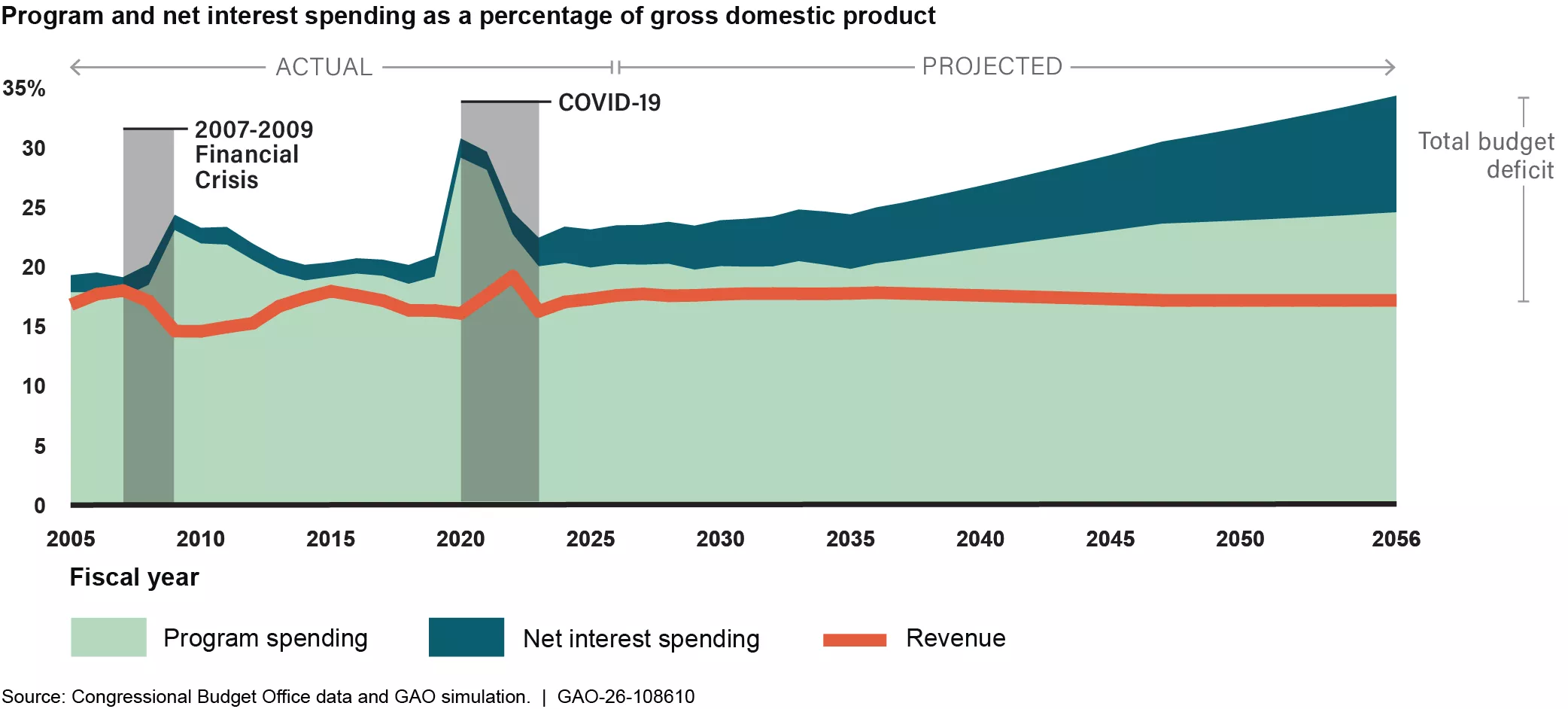
Government spending on net interest in FY 2025 exceeded federal spending on national defense, and is projected to keep growing
We continue to recommend that Congress develop a strategy to address the unsustainable fiscal path.
Our report highlights the necessity of a strategy that promotes fiscal discipline, builds consensus on how to reduce persistent annual deficits, addresses financing gaps in the Social Security and Medicare trust funds, and considers other opportunities to improve fiscal responsibility.
Without policy changes, federal debt held by the public (that is, the total amount of money that the federal government owes to its investors) will continue to grow faster than the economy, which is unsustainable. These challenges may intensify over time if unaddressed. You can learn more about the government's current financial condition here.
Federal debt held by the public—past, present, and future
Image
Debt held by the public is driven by the accumulated budget deficits—including interest costs—over time. Unless current revenue and spending policies change, our simulation shows that debt will reach its historical high of 106 percent of gross domestic product (GDP) in 2029, and that it will grow more than twice as fast as the economy over a 30-year period, reaching 251 percent of GDP in 2056.
Why is U.S. Debt Projected to Grow So Much?
The debt outlook is the result of a structural imbalance between government spending and revenue, resulting in persistent and increasing budget deficits. For most of the nation’s history, debt held by the public relative to GDP rose during wartime and recessions—when government spending sharply increased or revenue sharply decreased. Debt then fell during peacetime and periods of economic growth—when spending and revenue returned to more typical levels. Over the past two decades, this pattern has changed, as the debt has grown faster than the economy, even during times of economic growth.
The government finances annual deficits by issuing federal debt (Treasury bills, notes, and bonds) to domestic and foreign investors (debt held by the public). The government—like businesses and individuals—must pay interest to the investors: this is the cost of borrowing. As debt grows, interest rates can increase, which further increases borrowing costs.
Government Spending, Interest Spending and Revenues
Image
Why Does the Fiscal Outlook Matter?
The worsening fiscal outlook could have a range of negative effects on individuals, businesses, and the country as a whole. growing debt could create additional challenges for federal fiscal management, which could in turn cause challenges for American households and individuals, too. These potential challenges include:
A high and rising debt-to-GDP ratio increases interest rates on U.S. debt as investors demand a higher return to compensate for the increased risk of default.
The interest rates for certain consumer and business loans are tied to the interest rates for certain federal debt products. Therefore, higher interest rates for the government would mean higher rates for households and businesses as well, which would increase the costs of goods, such as housing and cars, if purchased with a mortgage or loan.
Higher interest rates for businesses may decrease long-term economic growth by making it more expensive to make productive investments such as factories and new technologies. Less investment could lower productivity, reduce workers’ wage growth, and contribute to rising prices for goods and services.
Increasing levels of debt may affect the government’s flexibility to respond effectively to unexpected events, such as a natural disaster, military conflict, or financial crisis.
What’s the Solution?
Congress and the administration will need to make difficult budgetary and policy decisions to address persistent deficits and reduce the nation’s borrowing needs. The longer actions are delayed, the more dramatic they will need to be. For example, our modeling shows that waiting 5 or 10 years from now to make any policy changes needed to maintain publicly held debt at 100 percent of GDP (the level reached in 2026) in 2056 will require substantially larger adjustments to spending and revenue.
We continue to recommend that Congress and the administration develop a coordinated strategy to guide the policy decisions needed for a sustainable fiscal outlook.
Effect of Different Timeframes for Implementing a Fiscal Target Scenario of 100 Percent Debt Held by the Public to Gross Domestic Product (GDP) in 2056
Time Frame for Starting Deficit Reduction
Annual Primary Balance (Excluding Interest Costs) Needed to Achieve Target
Change Needed to Achieve Target Only Through Revenue Increases
Change Needed to Achieve Target Only Through Decreases in Program Spending
Start in 2026
Primary surplus of 0.2% of GDP
26% more revenue each year (2026-2056)
21% less spending each year (2026-2056)
Wait Until 2032
Primary surplus of 1.0% of GDP
33% more revenue each year (2032-2056)
26% less spending each year (2032-2056)
Wait Until 2037
Primary surplus of 1.7% of GDP
42% more revenue each year (2037-2056)
31% less spending each year (2037 -2056)
Source: GAO simulation. | GAO-26-108610
How Does GAO Help?
Fiscal simulation. We update this simulation each year to assess how changes in the economy, demographics, and policy will affect the country’s fiscal outlook. We estimate the spending and revenue changes that are needed today to achieve a more sustainable fiscal future. Find the details in our annual fiscal health report.
How Could Federal Debt Affect You?
The federal government’s debt is growing faster than the economy—this is unsustainable over the long term. Learn more about how the debt could affect you here.