
How Could Federal Debt Affect You?
The federal government’s debt is growing faster than the economy—this is unsustainable over the long term.
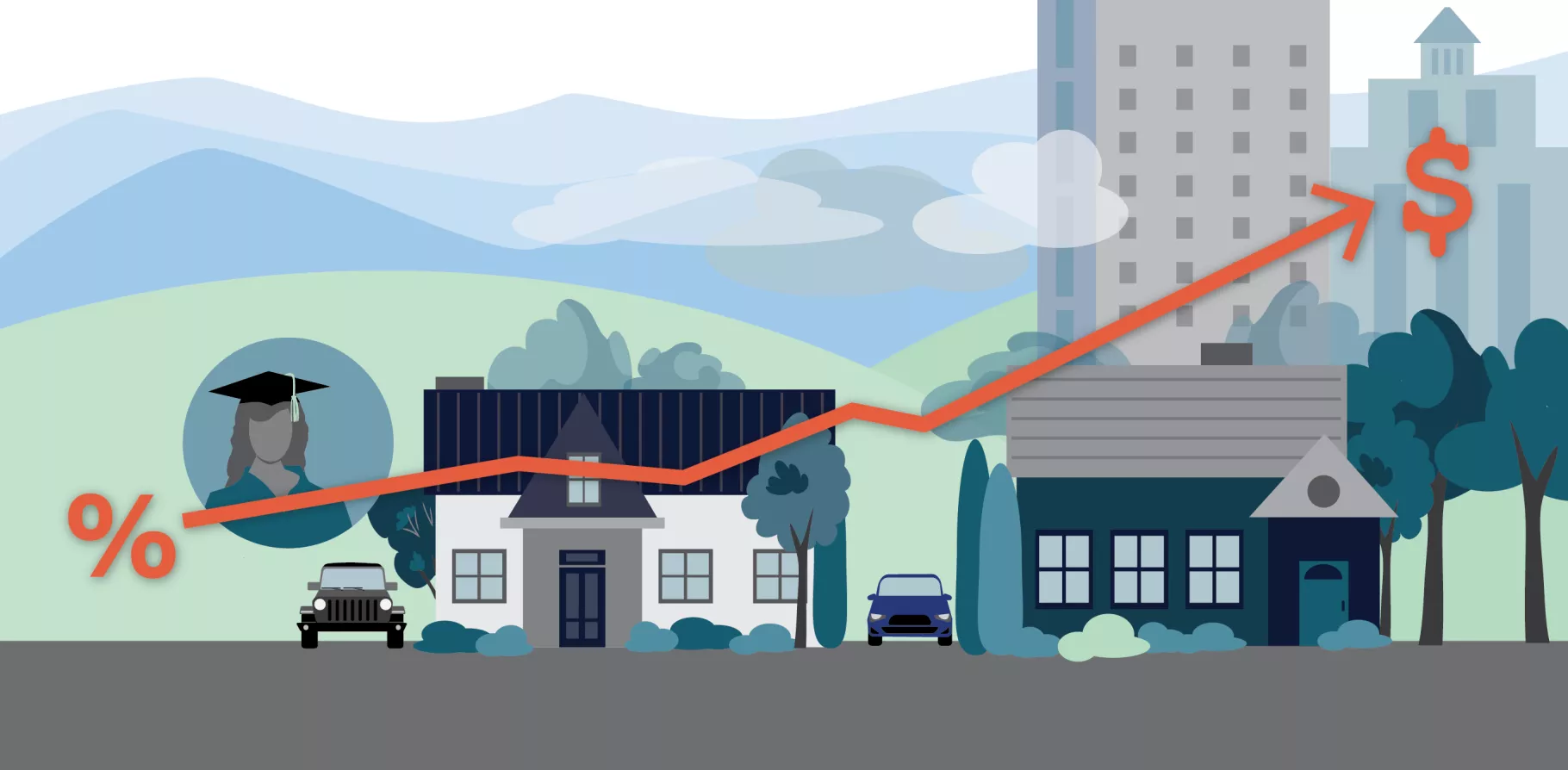
Americans may find that rising federal debt hurts their own personal finances.
- Higher borrowing costs. Someone taking out a loan, for a house or a car for example, will likely have less money to spend on other priorities.
- Stagnant wages. Businesses could also face higher borrowing costs or find they have less money available to invest, leading to slower wage growth.
- More expensive goods and services. Because businesses may invest less in technologies that make it easier and cheaper to produce goods and services, prices are likely to increase, and shortages may be more likely.
Image
How Do We Know If Federal Borrowing Is Sustainable?
Image
Sustainable borrowing means that federal debt grows at the same—or slower—rate than the economy.
Borrowing can be an effective tool to support expensive investment, such as recovering from public health crises and natural disasters or building infrastructure that will last a long time.
But unsustainable borrowing—particularly for recurring and more predictable expenses—can have adverse effects, including causing interest rates to rise.
The nation’s current fiscal path is unsustainable.
In the past, debt would spike during recessions or crises, but then decline after those events. More recently, the government’s debt has grown even when the economy is doing well. For example, when the economy started growing again after the 2007-2009 financial crisis, debt grew even faster.
Debt Held by the Public Is Projected to Grow Faster Than the Economy
Image
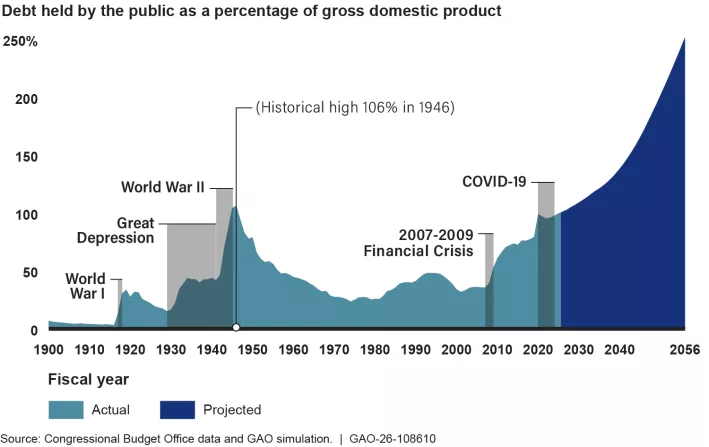
Unless spending and revenue policies change, the debt will continue to grow faster than the economy—even during times of growth.
What Is Driving the Growing Debt?
Persistent and widening annual budget deficits. When the federal government spends more than it collects in revenue, it borrows money to make up that deficit. The federal debt is the accumulation of this borrowing.
Deficits Are Growing Because Spending Outpaces Revenue
Image
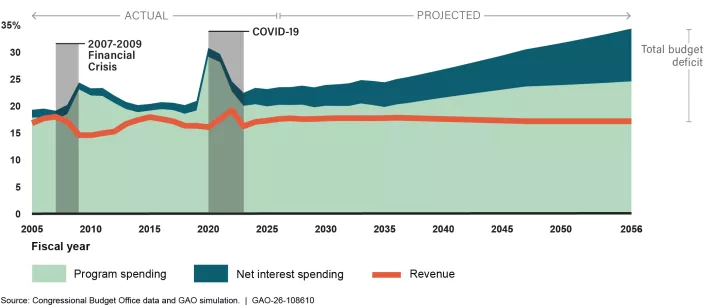
The debt is being driven by a structural imbalance between revenue and spending policy.
- Tax revenues have not kept pace with spending and are not projected to catch up over the long term, under current policy.
- A few drivers are causing spending to grow:
- Spending on Medicare and Social Security are increasing as the U.S. population ages and health care costs grow rapidly.
- The government has to pay more in interest as it accumulates debt.
- Spending can increase suddenly and dramatically as the government responds to unexpected events like public health crises, natural disasters, and military conflicts.
Image

How Much Interest Is the Government Paying on the Debt?
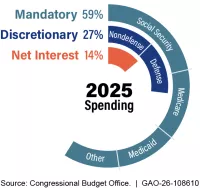
The government spent almost $1 trillion on interest last year. That exceeds spending on national defense and it’s almost as much as Medicare.
Under current policy, interest costs will grow faster than other areas of spending and will take up an increasingly large share of total spending.
Interest Spending Increases Relative to Other Federal Spending
Image
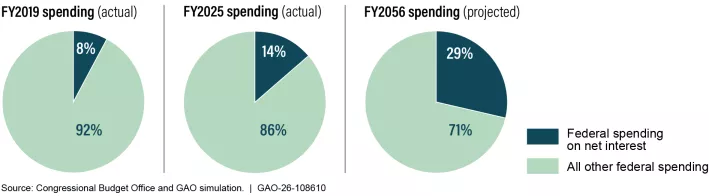
Government funds that are used to pay interest is money that otherwise could have been used for other government programs (e.g., infrastructure, technological advances) and policy priorities (e.g., reducing the deficit, lowering taxes).
As federal debt grows and interest rates rise, the government’s cost to borrow increases and interest spending grows.
Interest Spending is Projected to Grow Faster Than the Economy
Image
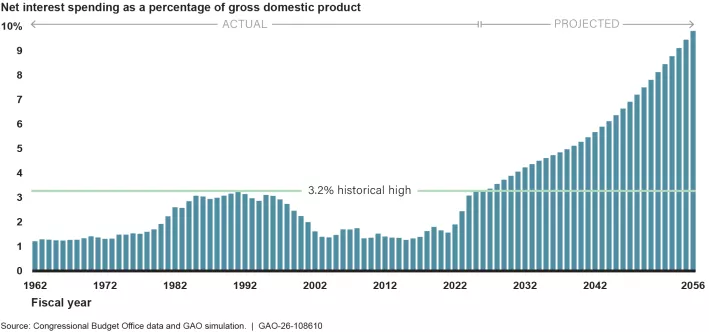
What Needs to Be Done?
Congress and the administration will need to make major changes to revenue and spending policies to put the country on a sustainable long-term fiscal path. These changes will involve hard choices to balance the potential effects on individuals and businesses.
GAO has suggested that Congress develop a strategy for achieving fiscal sustainability.
The longer actions are delayed, the more dramatic they will need to be.

Image
Reduce annual deficits
To meaningfully reduce annual deficits, Congress and the administration will need to make decisions about spending programs, including mandatory spending programs like Social Security and Medicare—that make up about 60 percent of all federal spending.
Revenue will also be an important piece of the puzzle. For example, in fiscal year 2025 we estimated that tax deductions, credits, and other tax benefits reduced federal revenue by $1.8 trillion, compared to total revenue collections of $5.2 trillion. It is not always clear how successful these tax policies are at meeting their goals.
To move toward a sustainable fiscal outlook, Congress should consider establishing fiscal targets and rules. These mechanisms can help control budget factors like spending and revenue.

Address urgent financing gaps for Social Security and Medicare
Decisions will also need to be made to shore up the trust funds that support the Social Security and Medicare Hospital Insurance programs. It is projected that within 7 years the funds won’t have enough money to pay for full benefits for all recipients (over 69 million people in 2025). Legislation will be needed to address the problem.

Pursue other opportunities to improve fiscal responsibility
There are other opportunities for the federal government to improve its fiscal position. The government could save billions of dollars if it limited improper payments—those that should not have been made or that were made in the wrong amount—and fraud, waste, abuse. The government could improve efforts to collect a portion of the hundreds of billions of dollars in taxes that are owed but not paid.