
Broadband: Actions Needed to Strengthen Fragmented Federal Effort
Fast Facts
We testified on federal efforts to increase access to broadband internet.
Our testimony, given before the House Subcommittee on Communications and Technology, Committee on Energy and Commerce, is primarily based on
Broadband: National Strategy Needed to Guide Federal Efforts to Reduce Digital Divide
Broadband Programs: Agencies Need to Further Improve Their Data Quality and Coordination Efforts
We also discuss recommendations we've made.
GAO Testimony to Congress written next to an image of the U.S. Capitol.
Highlights
What GAO Found
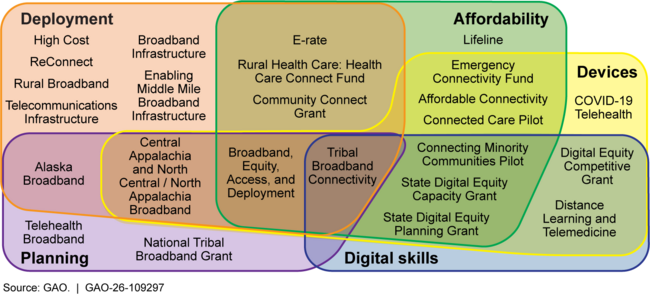
Federal broadband efforts are fragmented, with over 100 programs administered by 15 agencies, as GAO reported in May 2022. Some programs support broadband as their main purpose, while others support broadband as one possible purpose (see figure).
The Mosaic of Federal Programs with Broadband as a Main Purpose as of November 2021, by Purpose Category
GAO has found that a national strategy, continued interagency coordination, and better mapping data could strengthen federal broadband efforts.
National Strategy. Strategies to coordinate programs that address issues of broad national need can help mitigate the negative effects of fragmented federal programs, but no national strategy exists for federal broadband efforts. In May 2022, GAO recommended creating such a strategy to synchronize these efforts.
Interagency Coordination. With or without a national strategy, effective coordination among agencies that administer broadband programs is also important. In April 2025, GAO reported that the Federal Communications Commission (FCC), National Telecommunications and Information Administration (NTIA), and Departments of Agriculture (USDA) and the Treasury coordinate to administer the bulk of federal broadband funding and have mechanisms in place to do so. GAO recommended improvements to further strengthen those efforts. Agency officials reported taking steps to implement these recommendations, but have not yet fully addressed them, as of July 2026.
Mapping Data. Agencies rely on FCC’s National Broadband Map—which displays where broadband is already available—to target tens of billions of dollars in federal broadband funding, but the accuracy of the map’s availability data is uncertain. In April 2025, GAO recommended FCC document and evaluate the effectiveness of its processes for ensuring the map’s data quality. Not doing so could increase the risk of inaccurate data on the map, which could jeopardize agencies’ ability to make effective funding decisions. FCC has not yet addressed the recommendations as of July 2026, but officials reported taking steps to do so.
Why GAO Did This Study
Access to broadband is critical for employment, education, health care, and other daily activities. The federal government has invested tens of billions of dollars over the past decade across a myriad of broadband-related programs managed by different agencies. Yet millions of Americans lack broadband access.
Information on where broadband is already available is key to expanding access. Coordination among the federal agencies that administer the various federal programs is also key, particularly since U.S. broadband efforts are not guided by an overarching national strategy.
This testimony discusses findings from GAO’s previous reports on (1) a national broadband strategy and interagency coordination efforts, and (2) FCC’s efforts to ensure the quality of data in its National Broadband Map. It is primarily based on GAO’s May 2022 and April 2025 reports.
Recommendations
In May 2022, GAO recommended that the Executive Office of the President develop a national broadband strategy. The Executive Office of the President did not take a position on the recommendation. In April 2025, GAO recommended that FCC, NTIA, USDA, and Treasury strengthen aspects of their coordination; and that FCC strengthen aspects of its processes for ensuring the quality of the National Broadband Map's data. FCC, NTIA, and Treasury agreed with these recommendations; USDA did not take a position. GAO will continue to monitor the agencies’ progress in implementing the recommendations.