
B-52 Bomber: Air Force Actions Needed to Improve Major Modernization and Sustainment Efforts
Fast Facts
The B-52 bomber was introduced in 1955, and the Air Force now expects the aircraft to be operational through 2050. To achieve this goal, the Air Force is projected to spend an estimated $21 billion on modernization—including new engines, radar, and communications.
However, the Air Force is currently planning to begin production of the largest upgrade—the engine replacement—before critical flight testing. By building engines before doing this testing, the Air Force increases the risk that the system will not operate as intended.
Our recommendations address this and other challenges to B-52 modernization.
Image of a B-52 in Flight
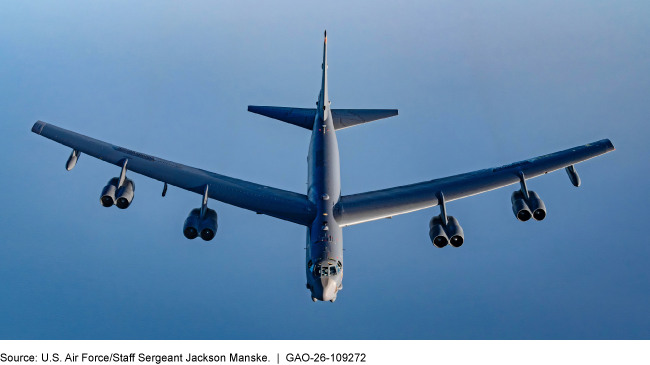
A B52 aircraft in flight
Highlights
What GAO Found
Ten of the 13 B-52 modernizations are experiencing cost, schedule, or performance challenges. The Air Force’s most expensive B-52 modernization effort, the Commercial Engine Replacement Program (CERP) will likely continue to face significant challenges as the Air Force plans to begin production with little to no developmental flight testing. While the Air Force analyzed and accepted increased risks from this approach in 2023, since then CERP costs increased by about $3 billion and initial operational capability was delayed more than 15 months. Department of Defense (DOD) policy states cost estimates should consider risk and include an analysis that identifies and evaluates alternative courses of action that may reduce cost and risk. Reassessing these risks would better inform decision-makers as they consider when to begin production.
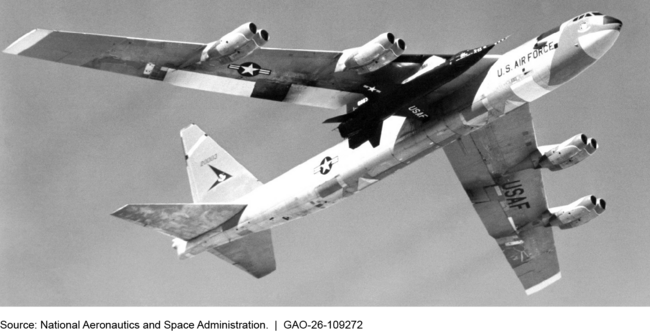
B-52 Transporting an X-15 Rocket Research Aircraft in 1959
In addition, as the Air Force develops its 13 modernizations, it is not consistently using digital engineering tools that provide decision-makers real-time data to assess overall performance allowing them to make timely and well-informed decisions. DOD issued guidance in 2023 stating programs in development should incorporate digital tools, such as digital twins, when it’s practical, beneficial, and affordable. The Air Force has not assessed the potential use of digital engineering on all B-52 modernizations. As a result, the Air Force may be missing opportunities to take advantage of efficiencies that digital engineering can provide, including avoiding future sustainment and supportability challenges.
The Air Force conducts planned maintenance on B-52s at a repair depot about every 4 years and has developed analyses to ensure it has sufficient capacity to perform planned modernization. However, the current maintenance plans assume that the Air Force will complete CERP and install new engines on time and do not account for risks from further schedule delays. B-52 maintenance is already struggling with finding sufficient parts for the current engines. Without planning for the possibility of engine delays from CERP, the Air Force risks falling behind on planned B-52 maintenance, which could impact readiness.
Why GAO Did This Study
The B-52 bomber is an aircraft capable of performing conventional and nuclear missions. The B-52 was originally introduced in 1955 with a projected lifespan of 20 years. The Air Force has since extended the aircraft’s lifespan through 2050. To maintain the B-52’s strategic edge, the Air Force is projected to spend an estimated $21 billion for modernizations including new engines, radar, and communications.
A Senate report included a provision for GAO to assess B-52 modernization. This report addresses, among other things, the extent to which (1) B-52 modernizations are meeting their cost, schedule, and performance goals, and (2) the Air Force has developed plans to ensure sufficient depot capacity for the modernizations. This is a public version of a sensitive report issued in July 2026. DOD deemed some schedule and mission capable information sensitive, and GAO omitted it from this report.
To conduct this review, GAO evaluated Air Force acquisition and sustainment documentation. GAO conducted site visits to the B-52 program office, depot, and logistics center. GAO also analyzed data and interviewed officials on depot performance, spare part and support equipment needs, and B-52 availability.
Recommendations
GAO is making six recommendations to the Air Force to improve planning and management for the B-52. These include recommending the Air Force delay the CERP production decision until the program office conducts an analysis to understand the associated risks; assess the benefits of using digital engineering; and update sustainment plans to account for potential delays. The Air Force partially concurred with GAO’s recommendation about the CERP production decision and fully concurred with the rest.
Recommendations for Executive Action
| Agency Affected | Recommendation | Status |
|---|---|---|
| Department of the Air Force | The Secretary of the Air Force should delay the CERP production decision until the program office conducts an analysis that accounts for recent cost growth and schedule delays to understand the risks and benefits associated with the timing of the CERP production decision. (Recommendation 1) |
When we confirm what actions the agency has taken in response to this recommendation, we will provide updated information.
|
| Department of the Air Force | The Secretary of the Air Force should ensure that the program office assesses the practicality, benefits, and affordability of implementing digital engineering in current modernization programs. (Recommendation 2) |
When we confirm what actions the agency has taken in response to this recommendation, we will provide updated information.
|
| Department of the Air Force | The Secretary of the Air Force should ensure that the B-52 Modernization Platform Integration Plan is updated to reflect the prioritization of all B-52 modernization programs. (Recommendation 3) |
When we confirm what actions the agency has taken in response to this recommendation, we will provide updated information.
|
| Department of the Air Force | The Secretary of the Air Force should ensure that the B-52 Modernization program updates the Platform Integration Plan to more clearly align program work to the Air Force's B-52 Modernization strategic goals, by identifying risk mitigations associated with maintaining multiple configurations. (Recommendation 4) |
When we confirm what actions the agency has taken in response to this recommendation, we will provide updated information.
|
| Department of the Air Force | The Secretary of the Air Force should ensure the B-52 program office updates the B-52 repair plans to account for potential delays in the modernizations. (Recommendation 5) |
When we confirm what actions the agency has taken in response to this recommendation, we will provide updated information.
|
| Department of the Air Force | The Secretary of the Air Force should issue guidance clarifying the roles and responsibilities for the life cycle management of B-52 specific support equipment. (Recommendation 6) |
When we confirm what actions the agency has taken in response to this recommendation, we will provide updated information.
|