
Commercial Aviation: Air Service to Small Communities Continues to Face Challenges
Fast Facts
We testified on the continued challenges small communities face in getting and keeping air service.
Our testimony, given before the House Transportation and Infrastructure Committee's Aviation Subcommittee, is based on our prior work:
Commercial Aviation: Trends in Air Service to Small Communities

U.S. Capitol Dome against a blue sky with overlaid words "GAO Testimony to Congress"
Highlights
What GAO Found
In general, small communities continue to face declining scheduled passenger air service, especially at nonhub airports—airports that have more than 10,000 annual commercial passenger boardings but less than 0.05 percent of the annual total of U.S. commercial passenger boardings. At these airports, the average number of daily departures per route in 2024 was 19 percent lower than the 2018 level. Over 70 percent of nonhub airports that were not receiving federal support from the Essential Air Service (EAS) program experienced a decline in average daily departures per route from 2018 to 2024.
Percentage Change from 2018 to 2024 in Average Daily Departures per Route for Nonhub Airports Not Receiving Subsidized Essential Air Service
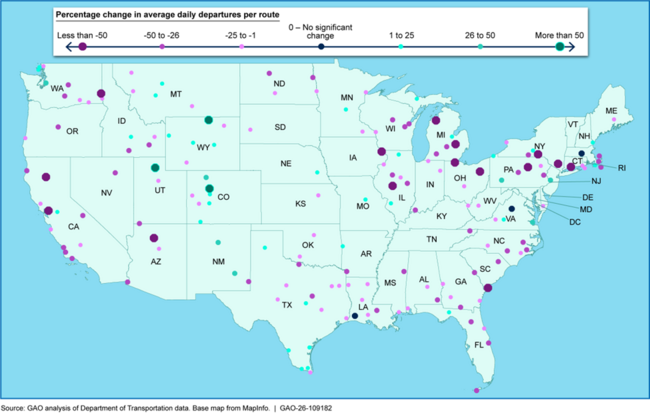
According to GAO’s prior work, stakeholders have cited pilot and maintenance workforce supply challenges, increased airline operating costs, and heightened airline expectations for revenue guarantees as among the market factors contributing to changes in air service to small communities in recent years. Some of these factors also contributed to higher EAS subsidy costs, which increased about 31 percent from 2018 to 2023. Higher airline operating costs also limited the effect of Small Community Air Service Development Program (SCASDP) grants that communities used to incentivize airlines to initiate air service.
As GAO has previously reported, selected stakeholders and recent studies have identified options to improve air service to small communities. These include increasing aviation workforce supply and supporting other transportation modes, such as bus service, or new technologies, such as electric aircraft, that could lower airline operating costs. Stakeholders also identified options to change EAS—such as focusing EAS assistance on more remote communities or expanding EAS to better ensure small airports do not lose air service—and to modify SCASDP in response to rising airline operating costs.
Why GAO Did This Study
Communities of all sizes seek access to air transportation services. However, the economics of the airline industry have traditionally made it difficult to establish or sustain viable air service in small communities.
Small communities are generally served by small airports, which for scheduled passenger air service typically include small hub, nonhub, and non-primary nonhub airports. The Department of Transportation administers federal programs that provide subsidies and grants to help eligible small communities retain a link to the national aviation system.
This testimony discusses (1) changes in scheduled passenger air service to small communities in recent years; (2) market factors affecting air service to small communities and related federal programs; and (3) options that aviation stakeholders and recent studies identified to improve air service to small communities. It draws from GAO’s September 2024 report on air service to small communities (GAO-24-106681), December 2025 report on nonhub airports (GAO-26-107751), and April 2026 report on regional airline pilots (GAO-26-107856). Details about the scope and methodology for each report are included in those reports.
Recommendations
In April 2026, GAO made two recommendations that could help strengthen pilot supply. Specifically, GAO recommended that FAA establish and publicly communicate timelines for finalizing two pilot training initiatives that were provided for in statute. DOT agreed with the recommendations.