
Commercial Aviation: Certain Nonhub Airports Face Significant Challenges in Securing and Maintaining Air Service
Fast Facts
Passenger air travel provides a vital connection between small communities and the wider world and is an important driver of an area's economic growth.
However, some smaller commercial airports described challenges in getting airlines to provide service or in keeping flights they already have.
The Department of Transportation does offer grants to eligible small communities to help jumpstart new airline service at their airports. But we found that demand for these grants continues to exceed available funds.
Moreover, representatives from smaller airports told us about difficulties maintaining service once this grant funding has been exhausted.
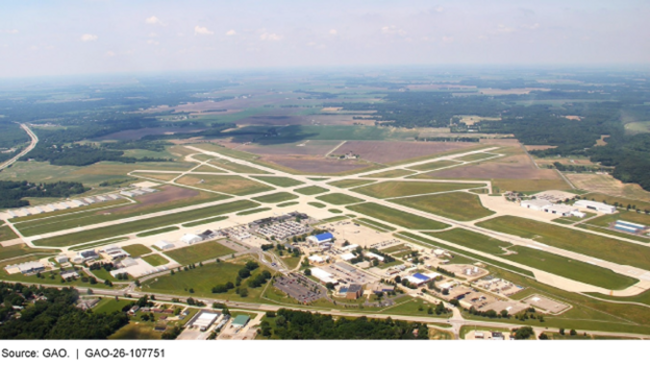
Abraham Lincoln Capital Airport in Springfield, Illinois
Highlights
What GAO Found
According to key metrics, air service at airports of all sizes dropped sharply in 2020 with the onset of the COVID-19 pandemic. While larger airports have rebounded to some extent, the recovery has lagged for smaller airports, including nonhub airports (i.e., airports that have less than 0.05 percent of annual U.S. commercial enplanements but have more than 10,000 annual enplanements). For example, the average number of daily departures per route for nonhub airports was 19 percent lower in 2024 than in 2018.
Average Daily Departures per Route for Nonhub Airports Before (2018), During (2020), and After (2024) the COVID-19 Pandemic (Calendar Years)
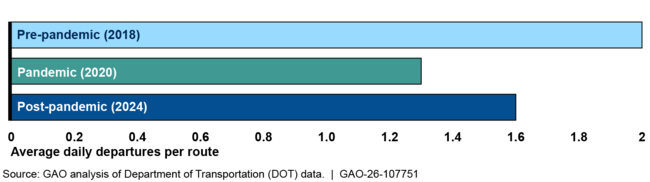
Note: Nonhub airports have less than 0.05 percent of annual U.S. commercial enplanements but have more than 10,000 annual enplanements.
The Department of Transportation (DOT) administers two federal programs that support air service to small communities. The Essential Air Service (EAS) program provides subsidies to airlines serving eligible communities to help support air service. The Small Community Air Service Development Program (SCASDP) provides grants to eligible communities not receiving EAS-subsidized service that can be used to jumpstart new air service. However, GAO found the demand for SCASDP grants has continued to exceed the support SCASDP offers. GAO also previously reported that SCASDP grants did not fully fund the revenue guarantees that reduce airlines’ financial risk to initiate new air service. Further, while SCASDP grants provide funding for revenue guarantees for up to 3 years, airport representatives and other stakeholders GAO interviewed identified ongoing funding as needed for maintaining service. The FAA Reauthorization Act of 2024 gave DOT some additional flexibilities to amend existing grants to small communities if circumstances change, and to consider grant applications for the same project from the community in a shorter time frame.
Certain nonhub airports that do not receive subsidized air service through EAS (non-EAS nonhub airports) have faced challenges securing and maintaining air service. For example, some of these airports reported an increased need to pay airlines for service, as airlines have shifted to using larger planes and scaled back service to some smaller communities to reduce their operating costs. Representatives of selected non-EAS nonhub airports told GAO they have leveraged various sources of funding to provide airlines revenue guarantees to help secure new air service. However, representatives of several selected airports stressed the difficulty of providing ongoing funding to maintain air service, particularly once any funding from SCASDP has been exhausted.
Why GAO Did This Study
Access to air service provides a vital connection to the national transportation system and can be an important driver of economic growth. However, smaller communities have experienced declining scheduled passenger air service for several decades. The smaller airports impacted by air service declines include certain nonhub airports that have not regained pre-pandemic service levels.
The FAA Reauthorization Act of 2024 includes a provision in statute for GAO to study challenges that certain nonhub airports face. This report describes (1) changes in key metrics for air service at nonhub airports from 2018 through 2024; (2) the extent to which SCASDP can help non-EAS nonhub airports secure and maintain air service; and (3) challenges selected non-EAS nonhub airports have identified, and how these airports have addressed the challenges.
GAO analyzed flight data reported to DOT for key metrics, including average daily departures per route, from calendar year 2018 through calendar year 2024.
GAO interviewed DOT officials and reviewed relevant statutes and grant documentation, including grant applications and awards for SCASDP from fiscal year 2018 through fiscal year 2023 (the most recent award cycle).
Finally, GAO selected seven non-EAS nonhub airports based on factors such as changes in air service. GAO interviewed representatives of these airports about challenges they have faced and their efforts to address those challenges, and GAO conducted site visits to four of the airports. GAO also interviewed state aviation officials in four states where selected airports are located as well as aviation stakeholders.
For more information, contact Derrick Collins at CollinsD@gao.gov.