
Aerial Refueling Tankers: Air Force Needs More Focused Metrics and a Risk-Based Mitigation Plan to Improve Sustainment
Fast Facts
The Air Force's aerial refueling tanker fleet can refuel aircraft while in flight during military operations. The critical fleet has consistently fallen below availability and capability standards in recent years.
But these standards don't tell the whole story. Tankers that can be used for aeromedical evacuations and cargo transport missions may be declared "mission capable" even if they can't do refueling.
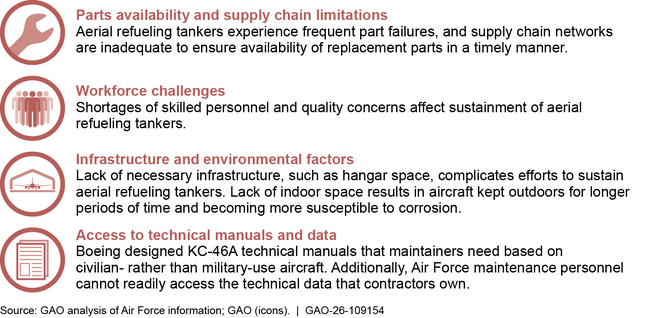
Also, Air Force officials found multiple risks to keeping the tankers in working order, such as frequent part failures and inadequate supply chains for timely replacements.
Our recommendations address these issues.
The Air Force's Aerial Refueling Tankers, KC-135 Stratotanker and KC-46A Pegasus, in Flight
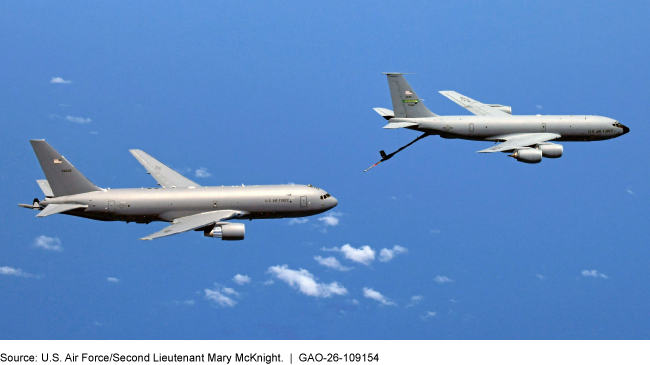
Two airplanes fly near each other in an almost cloudless blue sky. One has a tube for refueling sticking out near the tail.
Highlights
What GAO Found
The Air Force’s metrics for aircraft availability and mission capability do not provide a complete picture of the KC-135 and KC-46A tanker fleet’s ability to meet its primary refueling mission. The tanker fleet did not meet the Air Force’s availability and capability standards from fiscal year 2019 through fiscal year 2025, but these metrics do not specifically account for the aircraft’s ability to meet the primary refueling mission. The Air Force also calculates a “fully mission capable” (FMC) rate to measure the fleet’s ability to meet all its missions, which decreased substantially during that 7-year period. According to Air Force officials, while FMC is a clear indicator of an aircraft’s ability to meet its primary refueling mission, it excludes non-FMC aircraft that may be able to meet the refueling mission but not other missions. Without metrics and standards focused on the aerial refueling mission specifically, the Air Force risks not having a clear understanding of the fleet’s ability to meet key operational requirements.
Air Force officials identified sustainment risks for the KC-135 and KC-46A fleets, but the Air Force has not comprehensively assessed these risks or developed a plan to mitigate them. The sustainment risks included shortages of critical parts and skilled maintainers and infrastructure limitations. The Air Force has taken some actions to address these risks, including identifying alternative sources for parts and upgrading infrastructure. However, conducting a comprehensive assessment of risks associated with sustaining the fleet and developing a mitigation plan to address these risks based on their likelihood or impact would help the Air Force target scarce resources to areas of greatest risk and enhance the health of the aerial refueling tanker fleet.
Aerial Refueling Tanker Sustainment Risks
Why GAO Did This Study
The Air Force’s aerial refueling tanker fleet—capable of transferring fuel from airborne tankers to aircraft while in flight—is the largest in the world and plays a critical role in air mobility operations.
House Report 118-529, accompanying a bill for the National Defense Authorization Act for Fiscal Year 2025, included a provision for GAO to assess the Air Force’s refueling capabilities and sustainment of the aerial refueling fleet. Among other objectives, this GAO report addresses the extent to which the fleet meets the Air Force’s current and future needs, and the extent to which the Air Force has assessed risks and developed mitigation plans associated with sustaining the KC-135 and KC-46A aerial refueling aircraft.
GAO reviewed Air Force data on the composition and performance of the aerial refueling fleet, reviewed agency documentation, contacted 16 units across 11 bases, and interviewed relevant Department of Defense and Air Force officials. This is a public version of a sensitive report GAO issued in May 2026. This version omits information DOD deemed to be Controlled Unclassified Information.
Recommendations
GAO made four recommendations, including that the Air Force use metrics and standards that specifically assess the aerial refueling tanker fleet’s ability to meet its primary refueling mission; conduct a comprehensive assessment of sustainment risks associated with the aerial refueling tanker fleet; and develop a mitigation plan based on the results of that assessment. The Air Force concurred with GAO’s recommendations.
Recommendations for Executive Action
| Agency Affected | Recommendation | Status |
|---|---|---|
| Department of the Air Force | The Secretary of the Air Force should direct the use of metrics and standards that specifically assess the aerial refueling capability of its tanker fleet. (Recommendation 1) |
When we confirm what actions the agency has taken in response to this recommendation, we will provide updated information.
|
| Department of the Air Force | The Secretary of the Air Force should require the Air Mobility Command, in coordination with its subordinate organizations and relevant program offices, to regularly report on the metrics and standards adopted to assess the aerial refueling capability of its tanker fleet. (Recommendation 2) |
When we confirm what actions the agency has taken in response to this recommendation, we will provide updated information.
|
| Department of the Air Force | The Secretary of the Air Force should direct a service-wide comprehensive assessment of risks associated with sustainment of its aerial refueling tanker fleet, including their likelihood and impact. (Recommendation 3) |
When we confirm what actions the agency has taken in response to this recommendation, we will provide updated information.
|
| Department of the Air Force | The Secretary of the Air Force should direct the development of a mitigation plan based on the results of a risk assessment associated with sustainment of its aerial refueling tanker fleet. (Recommendation 4) |
When we confirm what actions the agency has taken in response to this recommendation, we will provide updated information.
|