
SBA Disaster Loans: Assistance for Businesses Affected by Low Snowfall or Warm Winters
Fast Facts
This Q&A looks at some of the federal help available to businesses near winter attractions that can suffer from low snowfall or warm winters.
While these winter conditions can harm ski areas and other hospitality businesses, they aren't in the federal definition of "natural disaster" that can be used to qualify for help.
Small Business Administration loans may be available in drought-stricken areas. But these winter conditions may not be linked to drought, so some affected businesses can't even apply.
We identified key factors for Congress to consider if it's deciding to expand access to SBA loans for small businesses under these conditions.
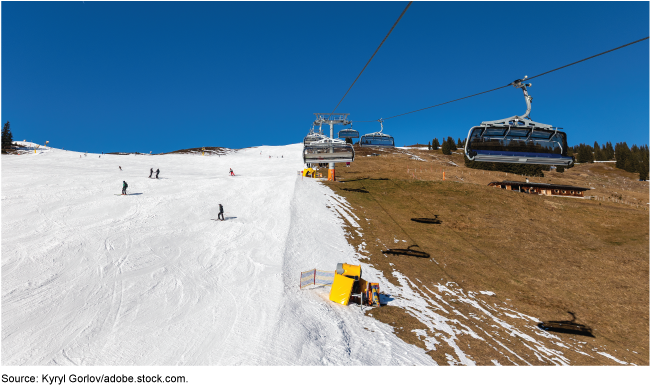
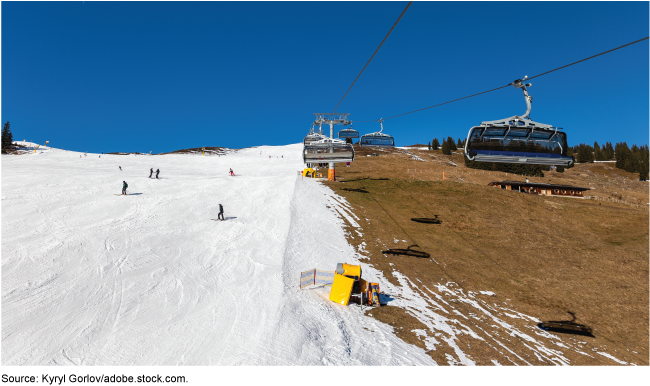
Chair lifts go up and down a steep hillside with brown grass below one side of the lift and groomed snow with skiers below the other.
Highlights
What GAO Found
The Small Business Administration’s (SBA) Economic Injury Disaster Loans (EIDL) provide necessary working capital to help small businesses affected by a disaster meet financial obligations until normal operations resume.
Relatively low snowfall and warm winters are not included in the statutory definition for “major disaster” contained in the Robert T. Stafford Disaster Relief and Emergency Assistance Act (Stafford Act) or the definition of “disaster” in the Small Business Act. The Stafford Act establishes the programs and processes through which the federal government, led by the Federal Emergency Management Agency, provides major disaster assistance, and the Small Business Act authorizes SBA’s disaster loan program. While both acts include examples of qualifying disasters, neither act explicitly includes relatively low snowfall or warm winters. Similarly, warm winters and low snow are not sudden events, nor do they create physical damage, which is the basis for requests for major disaster declarations under the Stafford Act. However, small businesses suffering substantial economic losses related to these weather events may be eligible for SBA assistance during a drought—a deficiency of precipitation compared with normal conditions, over an extended period of time, usually a season or more, resulting in a water shortage. Drought is listed as a disaster type under these acts, though usually declared by the Secretary of Agriculture.
Ski Resort with Limited Snowfall
Small businesses affected by relatively low snowfall or warm winters may qualify for EIDLs related to drought declarations made under certain authorities. The Small Business Act authorizes SBA to provide loans to alleviate substantial economic injury under five different types of disaster determinations, such as a presidential declaration of a major disaster or a drought declaration made by the Secretary of Agriculture. However, relatively low snow and warm winters may not be connected to a drought.
Should Congress consider expanding access to the EIDL program for small businesses affected by relatively low snowfall or warm winters, GAO identified important considerations. For example, Congress could add relatively low snowfall and warm winter as eligible disaster types to relevant statutory frameworks and establish criteria for determining when such conditions qualify for assistance. Implementing regulations would likely need to be amended to define how such events would qualify for federal disaster assistance. Providing economic support for small businesses affected by relatively low snowfall or warm winters could create a precedent to provide federal support, including EIDLs, for businesses adversely affected by other weather variations, such as extended heat waves that limit outdoor recreation activities. Over time, this support could increase federal exposure and put a strain on resources.
Why GAO Did This Study
U.S. ski areas experienced a 9 percent decrease in visits (about 9 million visits) from the prior 10-year average during the 2025–2026 season, according to preliminary data from the National Ski Areas Association. Industry representatives attributed the decrease to inconsistent snowfall and unusually warm conditions across western states, which can cause precipitation to fall as rain rather than snow.
Unlike many natural disasters, relatively low snowfall or warm winters cause more economic than physical harm. For example, ski resorts, ice fishing providers, or hospitality businesses that support those industries may experience revenue losses because they are unable to operate or have significantly fewer customers rather than because their facilities sustain physical damage.
The Joint Explanatory Statement accompanying the Financial Services and General Government Appropriations Act, 2026, includes a provision for GAO to review how small businesses affected by relatively low snowfall and warm winters can seek and receive federal relief. This report addresses the extent to which these businesses may be eligible for assistance under the EIDL program and policy considerations for Congress related to a potential expansion of the program.
GAO reviewed the Small Business Act, the Stafford Act, and their implementing regulations, as well as the Department of Agriculture’s documentation on its drought-declaration process. GAO also interviewed officials from SBA offices primarily responsible for the disaster loan program and Federal Emergency Management Agency officials who oversee the agency’s disaster response.
For more information, contact Courtney LaFountain at lafountainc@gao.gov.