
Open GAO Recommendations: Financial Benefits Could Be Between $132 Billion and $251 Billion
Fast Facts
In this Q&A report, we estimate that implementing our open recommendations could produce $132 to $251 billion in financial benefits to the federal government.
Typically, federal agencies implement over 75% of all GAO recommendations. Since 2002, this has produced $1.51 trillion in benefits. In 2025, GAO made over 1,800 new recommendations intended to save or raise money, help Congress, and improve government.
Because we make recommendations on an ongoing basis, there is always an inventory of open ones—which you can find in our recommendations database.

Piles of coins and American currency with stylized white arrows and dotted lines superimposed on top pointing upwards.
Highlights
What GAO Found
GAO estimates that implementation of its open recommendations to federal agencies and matters for congressional consideration could result in $132 billion to $251 billion of measurable future financial benefits. Because GAO makes new recommendations on an ongoing basis, including over 1,800 in fiscal year 2025, there is always an inventory of open recommendations. These span the federal government and include many agencies and activities. According to GAO’s simulation of potential financial benefits, a 10-percentage point increase in the share of recommendations implemented annually could increase financial benefits by billions of dollars in a typical year.
Potential Benefits of Open GAO Recommendations, as of October 2025
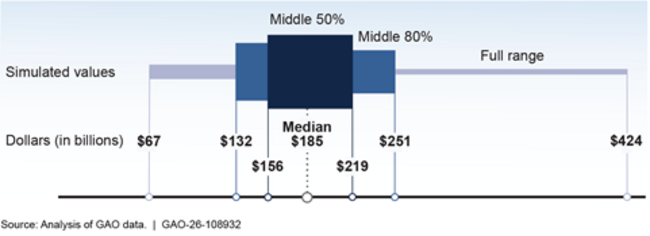
Note: To develop estimates of the potential financial benefits that could result from implementation of all its recommendations, GAO replicated the methodology used in GAO-24-107146.
In GAO’s annual report on duplication and cost savings, GAO identified 24 recommendations with potential financial benefits of $1 billion or more, many of which are described in that report (GAO-26-108505). For example
- Congress could equalize payment rates between physician offices and hospital outpatient departments for evaluation and management office visits and other services, which could save the Medicare program $156.9 billion over 10 years.
- Reauthorizing management of the broadband network for first responders and ensuring key statutory and contract responsibilities are addressed before current authorities sunset in 2027 could save $15 billion over 15 years.
- The Navy could save billions of dollars by improving its acquisition practices and ensuring that ships can be efficiently sustained.
While using different methods and serving different purposes, the simulation and the annual duplication and cost savings report arrive at essentially the same conclusion—one hundred billion dollars or more could be saved by implementing GAO recommendations. Furthermore, both approaches represent a subset of the full financial effect of GAO’s work. In addition, most open recommendations do not have individual benefit estimates, in many cases because the data needed to develop them are not available at this time. A large share of GAO’s recommendations produce valuable benefits that cannot be quantified credibly for this purpose, such as improved national security.
Why GAO Did This Study
Since 2002, GAO’s work has resulted in about $1.51 trillion in financial benefits and almost 30,800 program and operational benefits that helped change laws, improve public safety and other services, and promote better management throughout the government. In fiscal year 2025 alone, GAO’s work yielded $62.7 billion in financial benefits for the federal government.
The Senate report accompanying the Legislative Branch Appropriations Act, 2026, includes a provision for additional detail on the potential financial benefits associated with GAO’s open recommendations to federal agencies and matters to Congress.
This report updates GAO’s previous estimated ranges of potential financial benefits, which could result from implementation of all its open recommendations (GAO-24-107146). GAO developed models to estimate ranges of potential financial benefits using its historical data on recommendations and realized financial benefits. GAO identified and mitigated limitations related to using the historical data for the model by testing several alternatives. Actual financial benefits will depend on whether, how, and when recommendations are addressed.
For more information, contact Jessica Lucas-Judy at lucasjudyj@gao.gov or Michael Hoffman at hoffmanme@gao.gov.