We Found Billions in Potential Savings Possible if Federal Government Acts Now
Note: This post has been updated to include a video about how GAO does work on improving government efficiency to save taxpayers money.
Today, we released new analyses that paint a striking picture of both the progress and unrealized potential in federal government accountability. In our three new reports for Congress, we highlight how the federal government can reduce costs, boost revenues, and operate more efficiently. Our prior work in these areas has resulted in more than $774 billion in financial benefits since 2011.
We estimate that the government can save even more—between $132 billion and $251 billion in future savings—if Congress and agencies act on our remaining and new recommendations. Those funds could be redirected toward national priorities or to reduce the deficit.
Today’s WatchBlog post highlights some of the ways money could be saved based on our three new reports. Watch our video below to see how we do this work.
Billions on the table…
GAO has a long history of saving taxpayers’ money. Since 2002, our work has produced $1.51 trillion in financial benefits.
These savings were the result of Congress and federal agencies acting on our work and recommendations, which have led to financial and other benefits—including improving agencies’ coordination efforts, as well as reducing fraud, waste, abuse, and mismanagement.
But more can be done. Two of the three reports we released today assess progress on “open” recommendations for Congress and federal agencies. These are areas where action is still needed.
For example, notable recommendations with financial savings potential of $1 billion or more include:
- Medicare Payments by Place of Service: Congress should consider directing the Department of Health and Human Services to equalize payment rates between medical settings like physician offices and hospital outpatient departments for office visits. The potential associated savings? $156.9 billion over the course of 10 years to the Medicare program.
- Public-Safety Broadband Network: Congress should reauthorize the First Responder Network Authority before it expires in 2027. This would ensure the continuity of the public-safety broadband network. Potential revenues? $15 billion over 15 years.
- Disability Insurance Benefits: Congress should consider passing laws that require the Social Security Administration to offset Disability Insurance benefits for any Unemployment Insurance benefits received during the same period. Possible results? Saving $2.2 billion over 10 years.
- Navy Shipbuilding: The Navy should improve its acquisition practices and ensure that ships can be efficiently sustained. Potential cost savings? Billions of dollars.
Because information to develop these types of specific estimates is not always available, we also developed models that use historical data to estimate possible ranges. Acting on all of our open recommendations and matters would have the potential to produce between $132 billion and $251 billion of measurable, future financial benefits, according to those models.
Billions more could be saved by reducing duplication, overlap, and fragmentation in federal programs
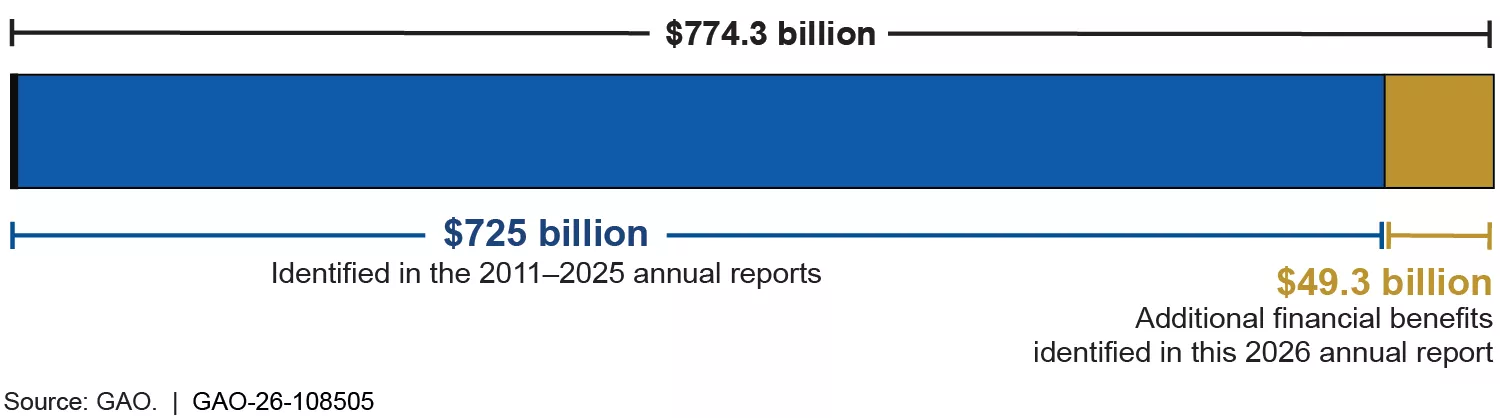
The third report we released today looks at ways the government can be more efficient and save taxpayers’ money. This is our 16th annual report on duplication, overlap, and fragmentation in federal government. We keep doing these reports because of how much money they show government can save. Since our first report in 2011, we’ve highlighted $774.3 billion in cost savings.
Total Financial Benefits: $774.3 Billion Identified from 2011 to 2026
Image
Specifically, this work calls attention to agencies and programs that:
- Work on similar or different parts of the same goal (fragmentation)
- Have similar goals or provide similar services (overlap)
- Work on the same activities or provide the same services (duplication)
In our latest report, we identified 97 new actions across the federal government. For example:
- VA and DOD Health Care Sharing Agreements. To better manage fragmented services, the Departments of Veterans Affairs and Defense should evaluate agreements to share health care resources and identify more opportunities to do so. The result? Improved patient access to care and potential savings of tens of millions of dollars annually.
- Nuclear Waste Classification. The Department of Energy should look at opportunities to manage certain waste as non-high-level radioactive waste. Why? It could help accelerate nuclear cleanup efforts, reduce environmental risks, and potentially save tens of billions of dollars.
- Government-wide Anti-Scam Strategy. The FBI should collaborate with other agencies on a strategy to combat consumer scams, which could be costing victims billions of dollars annually. A unified federal approach could help agencies better detect and prevent fraud and protect consumers.
You can learn more about these actions by checking out our Duplication & Cost Savings webpage.
- GAO’s fact-based, nonpartisan information helps Congress and federal agencies improve government. The WatchBlog lets us contextualize GAO’s work a little more for the public. Check out more of our posts at GAO.gov/blog.
- Got a comment, question? Email us at blog@gao.gov.
GAO Contacts
Image