
U.S. Ports of Entry: Update on CBP Public-Private Partnership Programs
Fast Facts
Over 1 million people and over 88,000 truck, rail, and sea containers entered the U.S. every day through 328 U.S. ports of entry in FY 2024.
U.S. Customs and Border Protection screens cargo and passengers at ports. To augment these services, CBP uses 2 public-private partnership programs. One allows partners, such as port authorities, to reimburse CBP for additional work outside regular hours. The other accepts donations for infrastructure improvements, which could speed up CBP's work.
Since our 2024 report, CBP added 241 reimbursement partnerships and 24 donation partnerships. This brings the total number of partnerships to 639 and 70, respectively, since FY 2013.
Tablets for Enhanced Passenger Screening Procured through a CBP Partnership, Minneapolis-St. Paul International Airport
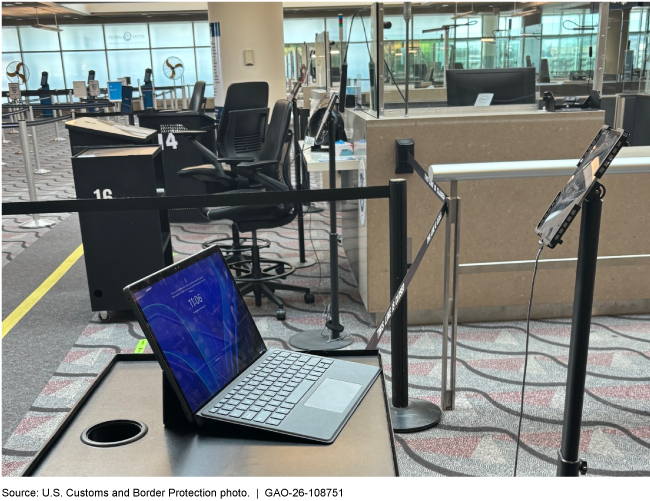
An airport passenger screening area with a laptop computer on a desk and a tablet on a stand behind it.
Highlights
What GAO Found
Since GAO's January 2024 report, U.S. Customs and Border Protection (CBP) continued to expand its public-private partnership programs—the Reimbursable Services Program (RSP) and the Donations Acceptance Program (DAP). The RSP ensures partners, such as port authorities or local municipalities that own or manage ports, reimburse CBP for providing services that exceed CBP's normal operations. For example, RSP partners pay overtime for CBP personnel that provide services at ports of entry outside regular business hours. The DAP enables partners to donate property or provide funding for ports of entry infrastructure improvements.
GAO found that CBP selected an additional 241 RSP applications for partnerships from October 2023 through December 2025, bringing the total of RSP selections to 639 since fiscal year 2013. CBP and its partners executed 798 memorandums of understanding for these 639 RSP partnerships. The memorandums outline how agreements are to be implemented at one or more ports of entry. Most (82 percent) of the memorandums cover agreements at air ports of entry. RSP partners reimbursed CBP a total of $302.8 million for overtime services for calendar years 2014 through 2025, according to CBP data.
Number of Applications U.S. Customs and Border Protection (CBP) Selected for Its Reimbursable Services Program (RSP), Fiscal Year 2013 Through December 2025
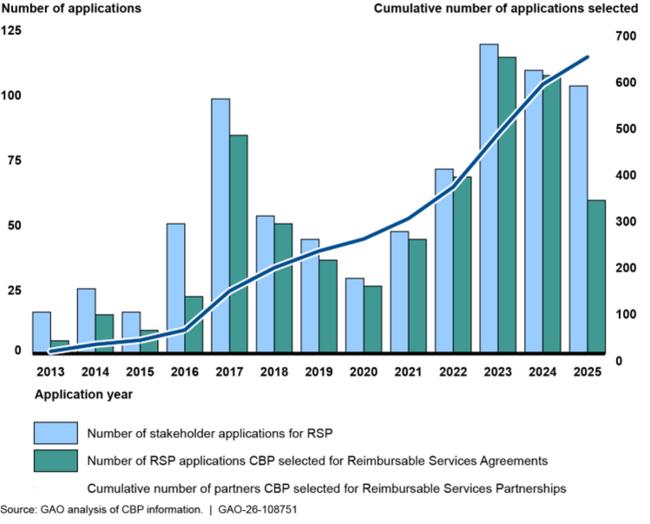
GAO previously reported that the number of requests for RSP services and the number of applications that CBP receives were increasing due to a post-COVID-19 rebound and CBP’s outreach, particularly to general aviation partners. Officials told GAO that CBP’s stakeholder outreach has included communicating application requirements and time frames and encouraging potential applicants to apply in advance of when they will need services.
CBP also entered into 24 new donation acceptance partnerships from October 2023 through December 2025, bringing the total number of agreements to 70 since fiscal year 2015. Partners span a variety of sectors such as state and local governments, private companies, and airline companies. Correspondingly, donations served a variety of purposes such as expanding inspection facility infrastructure (e.g., adding inspection lanes and booths), providing biometric detection services, and providing luggage for canine training. As of December 2025, 49 of the 70 projects were at land ports of entry. CBP officials estimated that the total value of all donations received from September 2015 through December 2025 was $277.3 million.
Why GAO Did This Study
On a daily basis in fiscal year 2024, over 1,150,000 passengers and pedestrians and over 88,500 truck, rail, and sea containers carrying goods worth approximately $9.2 billion entered the United States through 328 U.S. land, sea, and air ports of entry, according to CBP. To help meet demand for CBP inspection services, since 2013, CBP has entered into public-private partnerships under the RSP and DAP.
Congress asked GAO to review the agreements, along with the funds and donations that CBP has received under the RSP and DAP. This report is part of a body of work in response to a statute dating back to 2018. In this report, GAO updates key information from its January 2024 report by examining the status of CBP public-private partnership program agreements, including the purposes for which CBP used the funds and donations from these agreements in fiscal years 2024 and 2025.
GAO collected and analyzed information on any new RSP agreements, DAP agreements, and memorandums of understanding for both programs for fiscal years 2024 and 2025. GAO also analyzed data on the use of the programs and interviewed CBP officials to identify any significant changes to how the programs are administered.
For more information, contact Heather MacLeod at MacLeodH@gao.gov.