
Rideshare and Taxi Safety: Information on Assault Data, Safety Features, and Background Checks
Fast Facts
Rideshare and taxi services help many Americans safely travel to work, run errands, and get to medical appointments. But there's concern about assaults on drivers and passengers using these services.
Our report describes:
Data on assaults against drivers and passengers
Examples of states’ and localities’ background check requirements for drivers
New safety features offered by rideshare companies—including identity verification and offering the ability to request a female rider or driver
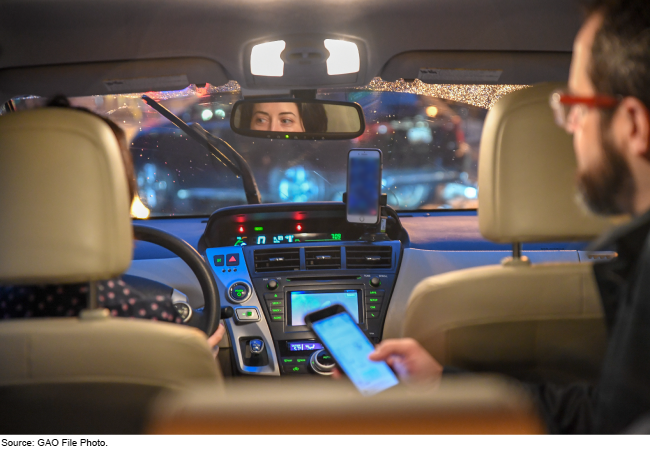
Car with two passengers driving in the rain.
Highlights
What GAO Found
Rideshare and taxi services help meet the transportation needs of people in the U.S, but stakeholders have raised questions about the services’ safety. Available data sources do not provide a full picture of the number of rideshare and taxi assaults against drivers and passengers from 2021 through 2025. There is no federal requirement to collect such data, but GAO identified some sources at the federal, local, and industry level. For example:
- Two federal databases provide some information. For example, the Bureau of Labor Statistics estimated 20 nonfatal injuries to taxi and rideshare drivers due to violent acts by other people from 2023 through 2024, not including self-employed drivers. Most rideshare and taxi drivers are self-employed (i.e., classified by companies as independent contractors).
- GAO analyzed police data in two cities and found 424 rideshare- and taxi-related assaults in Los Angeles from 2021 through 2023 and 109 in Chicago from 2023 through 2025. These assaults made up less than 1 percent of the overall number of reported assaults in each city during those time periods.
- Three ridesharing companies voluntarily report some assault data. For example, in 2021 and 2022, two companies publicly reported billions of rides, with a combined 52 fatal assaults and 4,469 of the five most serious types of sexual assault. One of these companies also reported 75,693 reported incidents of other types of sexual assault (e.g., attempted kissing and touching) and sexual misconduct (e.g., leering and explicit comments and gestures). As of June 2026, these companies have not reported the number of assaults for 2023 through 2025 or data on non-fatal physical assaults.
- Two taxi companies gave GAO non-public data on assaults. For example, one national taxi company identified that it had 17 verified reports of physical assault and three verified reports of sexual assault from 2021 through 2025.
Selected rideshare companies launched three new safety features, which add to features rideshare and taxi companies had in place.
New Rideshare Safety Features Since 2024
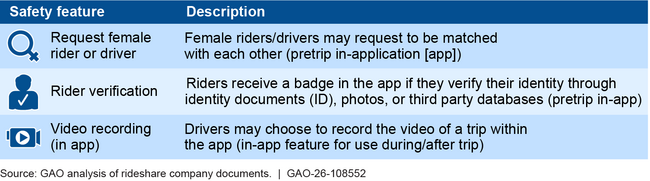
A driver advocacy group and some drivers GAO interviewed identified benefits of the new features. For example, drivers in four of five interviews GAO conducted appreciated the additional passenger verification features. However, they noted technical issues with certain video trip recordings. Representatives from one rideshare company said they have made improvements to the recording feature.
Why GAO Did This Study
Sami’s Law, enacted in 2023, provides for GAO to study and report every 2 years on the safety of rideshare and taxi drivers and passengers. GAO issued two reports in 2024 on this topic. Specifically, GAO reported on the lack of assault data in GAO-24-106742. In GAO-24-107093, GAO reported on the range of in-application and in-vehicle features that rideshare and taxi companies offer to help ensure safety.
This report describes (1) available data on the number of assaults on rideshare and taxi drivers and passengers from 2021 through 2025 and (2) safety features selected rideshare and taxi companies have implemented since 2024, among other topics.
To conduct this work, GAO collected and analyzed available data from two federal databases and two city databases that GAO previously identified as tracking rideshare and taxi assault data. GAO also reviewed documents and interviewed representatives from a nongeneralizable selection of four rideshare and four taxi companies. GAO selected companies to vary in size and location, among other factors. GAO analyzed data from three ridesharing companies’ public reports and websites. GAO requested additional non-public data from all eight companies to further understand the scope of assaults. Two taxi companies provided data; three rideshare companies declined to provide non-public data; and the other two taxi companies and one rideshare company do not maintain databases with which to track assault data. Therefore, this report uses publicly reported company data and attributes the information as appropriate throughout. GAO also conducted five nongeneralizable group interviews with nine self-identified rideshare drivers and individual interviews with 15 taxi drivers.
For more information, contact Elizabeth Repko at repkoe@gao.gov and Nathan Tranquilli at tranquillin@gao.gov.