
Rideshare and Taxi Assaults—What We Know About Safety and Efforts to Improve It
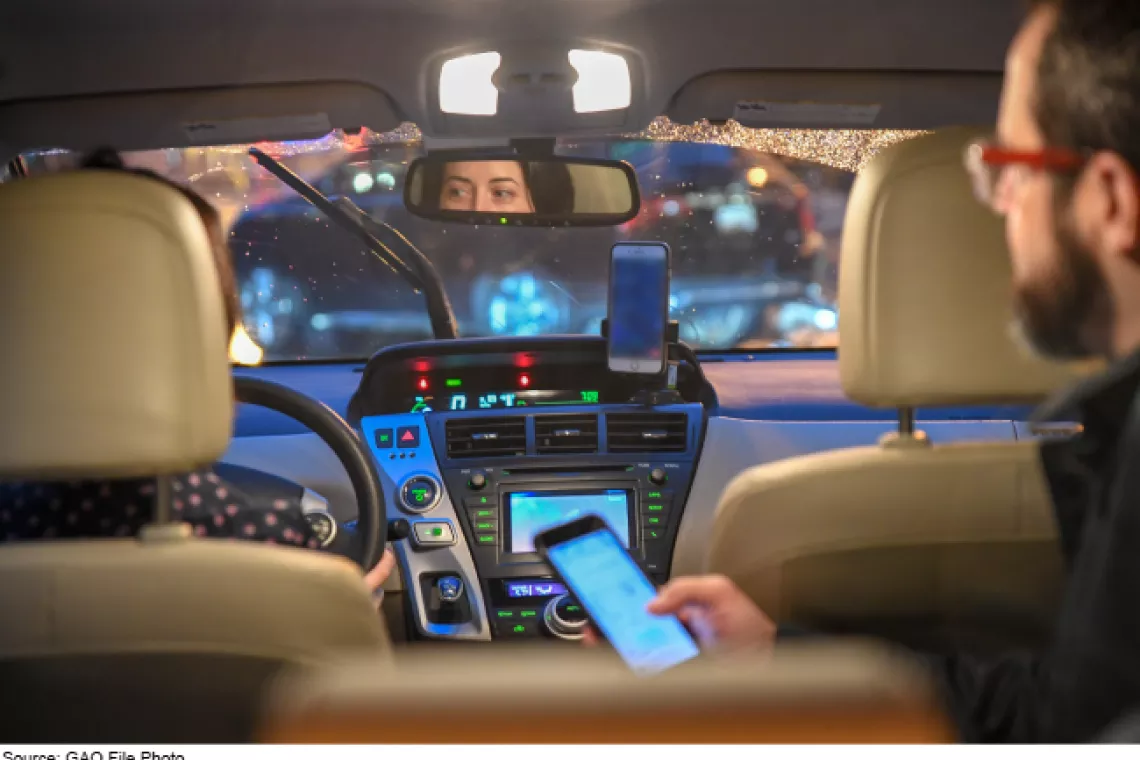
Millions of people use taxis or rideshare services every day. While reported incidents are rare, headlines about serious attacks on passengers or drivers themselves have raised concerns about safety.
Today’s WatchBlog post looks at our new report about efforts to improve rideshare and taxi safety.
Image

Why are there concerns about rideshare and taxi safety?
After college student Sami Josephson was murdered by someone impersonating a rideshare driver, Congress enacted Sami’s Law in 2023 to help improve rideshare and taxi safety. But passengers aren’t the only ones at risk of attacks. Violence against drivers—who often work at night and alone and interact with people under the influence—is a well-documented issue.
But how common are these attacks? It’s hard to say for sure, as there’s no single source that tallies these safety issues, and instances of sexual assault can go unreported. Here’s what we do know:
Local Data. The Los Angeles Police Department’s data shows 424 reported and verified incidents of rideshare- and taxi-related assaults from 2021 to 2023. This makes up about 0.2% of total reported and verified assaults in L.A. during that time.
The Chicago Police Department’s data shows 109 reported and verified incidents of rideshare- and taxi-related assaults from 2023 to 2025. This makes up about 0.3% of total assaults in Chicago during that time.
Industry Data. Major rideshare companies Uber and Lyft have reported publicly that a combined total of more than 4,400 serious sexual assaults and 52 fatalities in 2021 and 2022. This accounted for no more than 0.0002% of total rides in 2021 or 2022. This means these assaults occurred in no more than 1 in every 500,000 rides.
We also asked taxi companies if they collected data on reported assaults. One national company reported that it received 17 verified reports of physical assault and three verified reports of sexual assault from 2021 to 2025. Another regional taxi company reported 5 physical assaults and no sexual assaults from 2024 to 2025. Representatives from all taxi companies we spoke to said that, to their recollection, their drivers and passengers rarely experienced taxi assaults.
What is being done to make rides safer?
Many states and localities require criminal background checks for drivers. Depending on state or local laws, these checks may be fingerprint based and conducted by the FBI, or name based and conducted by private screening companies.
Outside of background checks, rideshare and taxi companies have long offered safety features, both in vehicles and through apps. “In-vehicle” features can include a partition between driver and passenger, a security camera, and vehicle markings. Some apps offer the driver’s name, photo, and vehicle information, which passengers can use to verify the ride. Other in-app features include location-sharing and the ability to report a safety issue.
But there are also several new in-app safety features introduced in the last couple of years for both riders and drivers.
- In-app video recording. Instead of drivers needing to provide a security camera for their car, drivers can now use in-app video recording on their phone to record their rides.
- Request female rider or driver. Female riders and drivers can request that they be matched with each other when they request a ride.
- Rider verification. Riders can receive a badge in apps if they verify their identity through ID documents, photos, or a third-party database.
Taxi drivers may or may not use apps to book rides, so they may not use in-app safety features. We asked taxi drivers about their opinions on in-vehicle safety features. One taxi driver said that, while a partition and camera would make him feel safer, these can be expensive. Some drivers also mentioned that they would feel safer with physical panic buttons that would alert police to emergencies. And several drivers told us that they feel safer now that credit card payments have increased and they carry less cash.
To learn more about rideshare and taxi safety, check out our new report.
- GAO’s fact-based, nonpartisan information helps Congress and federal agencies improve government. The WatchBlog lets us contextualize GAO’s work a little more for the public. Check out more of our posts at GAO.gov/blog.
- Got a comment, question? Email us at blog@gao.gov.
GAO Contacts
Image

Image



Related Products

GAO's mission is to provide Congress with fact-based, nonpartisan information that can help improve federal government performance and ensure accountability for the benefit of the American people. GAO launched its WatchBlog in January, 2014, as part of its continuing effort to reach its audiences—Congress and the American people—where they are currently looking for information.
The blog format allows GAO to provide a little more context about its work than it can offer on its other social media platforms. Posts will tie GAO work to current events and the news; show how GAO’s work is affecting agencies or legislation; highlight reports, testimonies, and issue areas where GAO does work; and provide information about GAO itself, among other things.
Please send any feedback on GAO's WatchBlog to blog@gao.gov.