
SUPPLEMENTAL MATERIAL FOR GAO-26-107049: Questionnaires for Survey of Service Academy Students
Fast Facts
This is a supplement to our report SERVICE ACADEMIES: Clarifying Guidance Would Enhance Effectiveness of Honor and Conduct Systems. In that report, we looked at the honor and conduct systems at U.S. service academies.
This supplement presents the questionnaires we used to survey students at the 5 academies: West Point, Naval, Air Force, Coast Guard, and Merchant Marine. It also presents survey results, with each academy's results presented in its own spreadsheet.
U.S. Military Academy at West Point students stand at attention at their graduation ceremony.
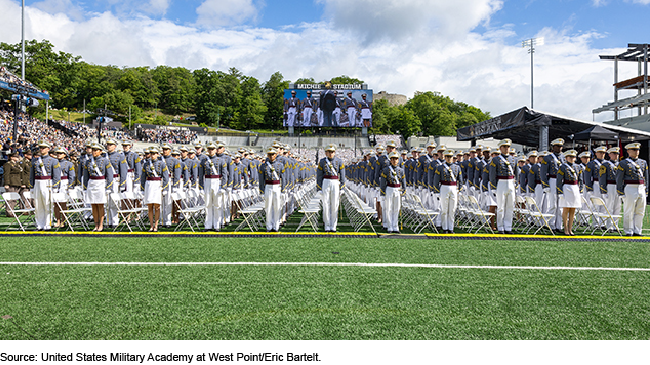
Orderly rows of West Point graduates standing at attention next to white folding chairs on a football field. They are wearing dress uniforms, with grey tops, brown belts and white sashes, white pants or skirts, and white hats with dark visors.
Highlights
This supplement is a companion to GAO’s report entitled, Service Academies: Clarifying Guidance Would Enhance Effectiveness of Honor and Conduct Systems (GAO-26-107049). The purpose of this supplement is to provide information from a survey of service academy students we used to obtain student perceptions, attitudes, and experiences with their academy’s honor and conduct systems.
Background
This supplemental material presents the questionnaires used to survey students at each of the five service academies (United States Military Academy (West Point); United States Naval Academy (Naval Academy); United States Air Force Academy (Air Force Academy); United States Coast Guard Academy (Coast Guard Academy); and United States Merchant Marine Academy (Merchant Marine Academy)). It also includes the results of our surveys, presented by Academy and each question.
To obtain student perceptions, attitudes, and experiences with their academy’s honor and conduct systems, we surveyed a census of 6,984 sophomore through senior students in the fall semester of academic year 2024-2025 at each academy. Each Academy population received the same questionnaire, but with question and response options tailored to each academy’s terminology and processes. We tracked responses with differing terminology by assigning a standardized code to comparable questions and response sets across academies, which helped to ensure the consistency of our analysis. At the end of our survey period, we received from:
- West Point – 972 complete responses (31 percent response rate)
- Naval Academy – 3,086 complete responses (94 percent response rate)
- Air Force Academy – 2,026 complete responses (68 percent response rate)
- Coast Guard Academy – 503 complete responses (61 percent response rate)
- Merchant Marine Academy – 397 complete responses (88 percent response rate)
For our analysis of survey responses, we performed a nonresponse bias analysis using the available student population data. We compared nonrespondents to respondents based on characteristics such as class year, gender, and race/ethnicity and identified differences for some race/ethnicity and gender groups, depending upon the academy. We applied weighting as appropriate to align survey respondents with the overall demographics of their respective academies. For the academies with lower response rates, non-response bias may exist due to unobservable characteristics, but any bias related to demographics included in the non-response model (race and ethnicity, gender, and class year) is mitigated. The survey results in our online supplemental materials are presented by Academy and each question, excluding those with open-ended responses, is presented with its weighted results including margins of error for each response. All survey results are generalizable to the population of their respective academies, unless otherwise noted. Further information on our methodology can be found in appendix I of the report (GAO-26-107049).
We are sending copies of this report to the appropriate congressional committees, the Secretary of Defense, the Secretary of the Army, the Secretary of the Navy, the Secretary of the Air Force, the Secretary of Homeland Security, and the Secretary of Transportation. In addition, this report is available at no charge on the GAO website at http://www.gao.gov.
We conducted the work upon which this supplement is based in accordance with generally accepted government auditing standards. Those standards require that we plan and perform the audit to obtain sufficient, appropriate evidence to provide a reasonable basis for our findings and conclusions based on our audit objectives. We believe that the evidence obtained provides a reasonable basis for our findings and conclusions based on our audit objective.
For more information, contact Kristy E. Williams at williamsk@gao.gov.