
Service Academies: Clarifying Guidance Would Enhance Effectiveness of Honor and Conduct Systems
Fast Facts
U.S. service academy graduates are expected to lead as military officers. The academies use honor and conduct systems to enforce ethical and moral standards among students.
Each academy offers due process protections so that students accused of an offense receive a fair hearing. But the guidance at some academies doesn't clearly specify certain protections. For example, 2 academies don't have clear guidance on students' right to access a complete record of the proceeding.
The honor and conduct data that academies collect could help improve these systems but data isn't always complete or easily accessible.
We recommended addressing these issues.
Students recite the oath of office during U.S. Air Force Academy Graduation
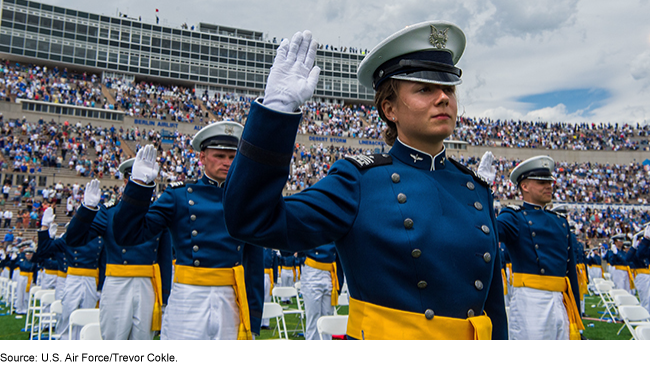
People in Air Force Academy dress uniforms, with blue jackets, gold belts, and white pants, gloves, and hats stand in front of their folding chairs in a packed football stadium and raise their right hands.
Highlights
What GAO Found
The service academies—West Point, Naval, Air Force, Coast Guard, and Merchant Marine—operate honor and conduct systems to help ensure students adhere to expected ethical and moral standards. Each academy has student-led honor systems to enforce honor codes that prohibit lying, cheating, and stealing; each also has officer-led conduct systems to maintain good order and discipline. However, key differences exist across the academies’ systems, such as the use of hearings and the right to appeal hearing findings or punishments.
West Point Cadet Honor Code

Typically, each academy offers procedural due process protections to help ensure that students accused of an honor or conduct offense receive a fair hearing. The academies offer most of the 12 common due process protections GAO reviewed, but some academies’ guidance does not clearly specify the availability of certain protections. For example, two academies do not provide clear guidance on students’ rights to access a complete record of their proceeding. By reviewing and revising honor and conduct system guidance to clearly articulate available protections, the academies can help ensure students are informed of their rights when engaging with processes that could impede their ability to graduate and serve as officers.
The honor and conduct offense data collected by the academies are not always complete or easily accessible. Specifically, some academies do not collect data on certain stages of their honor and conduct systems, such as investigations or appeals. Further, officials from four academies said they faced challenges in accessing relevant data. Addressing these challenges would improve the academies’ ability to manage their systems with quality information
Students GAO surveyed at the academies generally reported favorable opinions about their honor and conduct systems but raised some concerns about their fairness. Between about 25 to 45 percent of students, depending on the academy, said honor system findings were not applied fairly to all students, while about 40 to 55 percent said the same for conduct. Students also stated a reluctance to report honor offenses and minor conduct offenses. However, around 50 to 80 percent of students, depending on the academy, were willing to report major conduct offenses.
Why GAO Did This Study
The service academies seek to graduate military officers with high ethical and moral standards. Students who violate these standards may be disenrolled.
House Report 118-125 includes two provisions for GAO to review academies’ honor and conduct processes. This report assesses the extent to which (1) academy honor and conduct systems compare to one another and provide common procedural due process protections, and (2) academies collect honor and conduct data. It also describes (3) the perceptions of students toward their respective academies’ honor and conduct systems.
GAO reviewed academy policies and honor and conduct data for academic years 2018-2019 through 2023-2024. It also surveyed 6,984 students across the five academies. The survey results are generalizable to the sophomore through senior population at each respective academy. Complete survey results can be viewed at GAO-26-108179. GAO also interviewed academy officials and conducted site visits to each academy.
Recommendations
GAO is making 13 recommendations, including that the academies assess and update honor and conduct system guidance to ensure that due process protections are clearly articulated and include data collection requirements for all system stages. GAO also recommends the academies address challenges that limit timely access to data. The Departments of Defense, Homeland Security, and Transportation concurred with all recommendations.
Recommendations for Executive Action
| Agency Affected | Recommendation | Status |
|---|---|---|
| Department of the Army | The Secretary of the Army should ensure that the Superintendent of West Point assesses and updates the conduct system guidance to ensure that the intended range of due process protections available to students accused of conduct offenses are fully and clearly articulated. (Recommendation 1) |
The Department of Defense concurred with this recommendation. As of August 2026, we have not received any additional information related to this recommendation. We will update the status of this recommendation once we confirm what actions the Department has taken.
|
| Department of the Navy | The Secretary of the Navy should ensure that the Superintendent of the Naval Academy assesses and updates the honor and conduct system guidance to ensure that the intended range of due process protections available to students accused of honor and conduct offenses are fully and clearly articulated. (Recommendation 2) |
The Department of Defense concurred with this recommendation. As of August 2026, we have not received any additional information related to this recommendation. We will update the status of this recommendation once we confirm what actions the Department has taken.
|
| Department of the Air Force | The Secretary of the Air Force should ensure that the Superintendent of the Air Force Academy assesses and updates the honor and conduct system guidance to ensure that the intended range of due process protections available to students accused of honor and conduct offenses are fully and clearly articulated. (Recommendation 3) |
The Department of Defense concurred with this recommendation. As of August 2026, we have not received any additional information related to this recommendation. We will update the status of this recommendation once we confirm what actions the Department has taken.
|
| Department of Homeland Security | The Secretary of Homeland Security, in coordination with the Commandant of the Coast Guard, should ensure that the Superintendent of the Coast Guard Academy assesses and updates the honor and conduct system guidance to ensure that the intended range of due process protections available to students accused of honor and conduct offenses are fully and clearly articulated. (Recommendation 4) |
The Department of Homeland Security concurred with this recommendation. In June 2026, officials said that the Coast Guard Academy published the intended range of due process protections available to cadets accused of honor and conduct offenses within Sections D and E of SUPTINST 5215.3C, "Cadet Conduct and Discipline Manual," (dated Spring 2025). However, this Manual was the documentation that we reviewed and was the basis for our recommendation, as noted in our report. As of August 2026, we have not received any additional information related to this recommendation. We will update the status of this recommendation once we confirm what actions the Department has taken.
|
| Department of Transportation | The Secretary of Transportation, in coordination with the Assistant Secretary for Administration, should ensure that the Superintendent of the Merchant Marine Academy assesses and updates the honor and conduct system guidance to ensure that the intended range of due process protections available to students accused of honor and conduct offenses are fully and clearly articulated. (Recommendation 5) |
The Department of Transportation concurred with this recommendation. In response to our recommendation, officials said in April 2026 that the Superintendent of the United States Merchant Marine Academy initiated a comprehensive review of the Academy's Regimental Honor Program, including the Honor Code and the policies and procedures governing the investigation and adjudication of alleged honor and conduct violations. This review is anticipated to be complete by September 30, 2026 and is intended to assess and enhance, as appropriate, existing guidance to ensure that the full range of due process protections afforded to accused students is clearly articulated and consistently applied, according to officials. However, officials did not state what plans were in place to assess and update conduct system guidance, if any. As of August 2026, we have not received any additional information related to this recommendation. We will update the status of this recommendation once we confirm what actions the Department has taken.
|
| Department of the Army | The Secretary of the Army should ensure that the Superintendent of West Point identifies a comprehensive set of data collection requirements for all stages of the honor and conduct systems—including reporting, investigation, adjudication, discipline and appeal—and documents these requirements in guidance. (Recommendation 6) |
The Department of Defense concurred with this recommendation. As of August 2026, we have not received any additional information related to this recommendation. We will update the status of this recommendation once we confirm what actions the Department has taken.
|
| Department of the Navy | The Secretary of the Navy should ensure that the Superintendent of the Naval Academy identifies a comprehensive set of data collection requirements for all stages of the honor and conduct systems—including reporting, investigation, adjudication, discipline and appeal—and documents these requirements in guidance. (Recommendation 7) |
The Department of Defense concurred with this recommendation. As of August 2026, we have not received any additional information related to this recommendation. We will update the status of this recommendation once we confirm what actions the Department has taken.
|
| Department of the Air Force | The Secretary of the Air Force should ensure that the Superintendent of the Air Force Academy identifies a comprehensive set of data collection requirements for all stages of the honor and conduct systems—including reporting, investigation, adjudication, discipline and appeal—and documents these requirements in guidance. (Recommendation 8) |
The Department of Defense concurred with this recommendation. As of August 2026, we have not received any additional information related to this recommendation. We will update the status of this recommendation once we confirm what actions the Department has taken.
|
| Department of Homeland Security | The Secretary of Homeland Security, in coordination with the Commandant of the Coast Guard, should ensure that the Superintendent of the Coast Guard Academy identifies a comprehensive list of data collection requirements for all stages of the honor and conduct systems—including reporting, investigation, adjudication, discipline and appeal—and documents these requirements in guidance. (Recommendation 9) |
The Department of Homeland Security concurred with this recommendation. In June 2026, officials said the Coast Guard Academy will develop a comprehensive list of data collection requirements and processes for all stages of the honor and conduct systems, and that they would be documented in the next planned update to relevant guidance (SUPTINST 1531.10 (series), "Coast Guard Academy Core Values Remediation Program" (dated December 04, 2023); and (2) SUPTINST M5215.3C, "Cadet Conduct and Discipline Manual" (dated Spring 2025)). As of August 2026, we have not received any additional information related to this recommendation. We will update the status of this recommendation once we confirm what actions the Department has taken.
|
| Department of Transportation | The Secretary of Transportation, in coordination with the Assistant Secretary for Administration, should ensure that the Superintendent of the Merchant Marine Academy identifies a comprehensive set of data collection requirements for all stages of the honor and conduct systems—including reporting, investigation, adjudication, discipline and appeal—and documents these requirements in guidance. (Recommendation 10) |
The Department of Transportation concurred with this recommendation. In response to our recommendation, officials said in April 2026 that the United States Merchant Marine Academy will set requirements to collect relevant data systematically across all stages of both the honor and conduct systems. The requirements will be codified in an appendix to the revised Regimental Honor Program instruction manual. Officials said they expect this to be completed by September 30, 2026. However, they did not state how the conduct data requirements would be codified. As of August 2026, we have not received any additional information related to this recommendation. We will update the status of this recommendation once we confirm what actions the Department has taken.
|
| Department of the Air Force | The Secretary of the Air Force should ensure that the Superintendent of the Air Force Academy addresses challenges that limit timely access to honor and conduct data by officials responsible for managing and overseeing the systems, including identifying a viable solution for tracking the status of honor offenses and establishing time frames for addressing limitations with its current system. (Recommendation 11) |
The Department of Defense concurred with this recommendation. As of August 2026, we have not received any additional information related to this recommendation. We will update the status of this recommendation once we confirm what actions the Department has taken.
|
| Department of Homeland Security | The Secretary of Homeland Security, in coordination with the Commandant of the Coast Guard, should ensure that the Superintendent of the Coast Guard Academy addresses challenges that limit timely access to honor and conduct data by officials responsible for managing and overseeing the systems, including establishing time frames for addressing any planned solutions. (Recommendation 12) |
The Department of Homeland Security concurred with this recommendation. In June 2026, officials said the Coast Guard Academy will address challenges limiting timely access to honor and conduct data as part of their development of the comprehensive list of data collection requirements (in response to recommendation 9), and document it in planned updates to relevant guidance. Officials said they expect this will be completed by August 31, 2026. As of August 2026, we have not received any additional information related to this recommendation. We will update the status of this recommendation once we confirm what actions the Department has taken.
|
| Department of Transportation | The Secretary of Transportation, in coordination with the Assistant Secretary for Administration, should ensure that the Superintendent of the Merchant Marine Academy addresses challenges that limit timely access to honor and conduct data by officials responsible for managing and overseeing the systems, including establishing time frames for addressing any planned solutions. (Recommendation 13) |
The Department of Transportation concurred with this recommendation. In response to our recommendation, officials said in April 2026 that the United States Merchant Marine Academy is developing an enhanced Regimental Honor Program to capture honor offense data while ensuring strong internal controls. The upgraded system will provide authorized-officials timely access to honor and conduct case information needed for effective management and oversight, according to officials. The enhancements will support viewing and managing both honor and conduct case data. The Department plans to implement this functionality by September 30, 2026. As of August 2026, we have not received any additional information related to this recommendation. We will update the status of this recommendation once we confirm what actions the Department has taken.
|