
Federal Real Property: GSA Should Improve and Streamline Its Real Property Inventory
Fast Facts
The General Services Administration maintains an inventory of federal real property assets, including buildings. Data in the inventory is submitted to GSA by the agency responsible for the asset.
GSA has developed new guidance and tools to help agencies add accurate and complete data. But private sector and government stakeholders still limit their use of the inventory due to issues with the reliability, presentation, and timeliness of the data.
Lack of reliable data is one reason management of federal real property has been on our High Risk list for over 20 years. We made 3 recommendations to improve the inventory's accuracy and usefulness.

A light-colored stone building facade with a sculpture of an eagle above the words General Services Administration
Highlights
What GAO Found
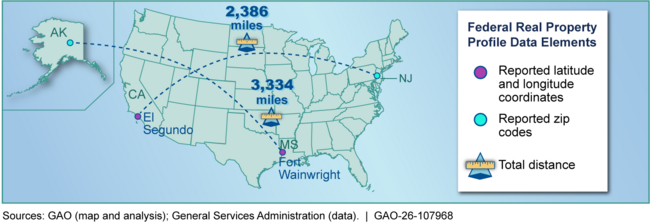
The General Services Administration (GSA) maintains an inventory of the federal government’s real property assets in a database called the Federal Real Property Profile (FRPP) Management System. Over time, data elements have been added to the FRPP for various reasons, including in response to laws. GSA has taken steps to improve FRPP data’s completeness and accuracy, such as updating guidance for agencies that submit data to FRPP. GAO assessed the accuracy of location data for fiscal year 2024 and found the data were generally accurate at the country and state level—data that GSA validates. However, the data were less accurate at a more granular level. In particular, about 20 percent of buildings listed in the FRPP had latitude and longitude coordinates that did not match their reported zip codes. As a result, FRPP’s building location data is less useful than it could be in providing accurate information on federal property.
Examples of Significant Mismatches Between the Federal Real Property Profile’s Latitude and Longitude Data and Zip Code Data for Two Buildings
Officials from all five selected agencies and all nine federal real property stakeholders GAO interviewed said they make limited use of the FRPP.
- Officials from three agencies said they use the data for illustrative purposes, such as making comparisons with other agencies. Officials from all five agencies said they relied on their agencies’ own more comprehensive systems to manage their real property.
- Real property stakeholders said they use other data to inform their decisions and cited concerns about FRPP’s data reliability, presentation, and timeliness. Six noted that the FRPP is difficult to use, with five tying this to the size and formatting of the FRPP.
GSA officials said they have not identified which of the FRPP’s more than 100 data fields are most useful to agencies and stakeholders because they typically add or remove elements in response to requirements from Congress or the administration. Internal control standards note the importance of communicating useful information and the need to develop a plan to respond to change (such as changes in user needs) within available resources. Developing a plan to streamline and improve the FRPP would help GSA provide a more useful and cost effective FRPP product that could better support the real property data needs of the administration, Congress, and other stakeholders.
Why GAO Did This Study
Congress and the administration have directed agencies to identify and dispose of underused real property, and reliable data can help inform efforts to more efficiently use federal space. GAO has previously identified problems with the reliability of FRPP location data, most recently in 2020. GAO was asked to study the reliability of FRPP data and its usefulness for different purposes and audiences. This report assesses (1) the steps GSA has taken to improve the accuracy and completeness of FRPP and the extent to which selected data elements for buildings are complete and accurate, and (2) the extent to which selected agencies and stakeholders use FRPP data.
GAO reviewed federal laws, documents, and data, including GSA’s FRPP data for fiscal years 2023 and 2024. GAO interviewed officials at GSA and from a non-generalizable sample of five federal agencies (military and civilian) selected based on their number of federal buildings. GAO also interviewed a non-generalizable sample of nine real property stakeholders selected based on GAO’s prior work, GAO’s research, and stakeholder recommendations. GAO also compared GSA’s efforts to provide FRPP data against OMB guidance and Standards for Internal Control in the Federal Government.
Recommendations
GAO is making three recommendations, including that GSA (1) improve the accuracy of FRPP building location data and (2) develop a plan to streamline and improve the FRPP in line with user needs. GSA concurred with our recommendations.
Recommendations for Executive Action
| Agency Affected | Recommendation | Status |
|---|---|---|
| General Services Administration | The GSA Administrator, in coordination with the Director of the OMB, the FRPC, and reporting agencies, should improve the accuracy of building location data in the FRPP. For example, GSA could revise its Validation and Verification process or tools to ensure that different location data points such as geocoordinates and zip codes are in alignment. (Recommendation 1) |
As of August 2026, GSA stated that it will review the accuracy of the FY 2025 FRPP data with a focus on building location data. This review will include an analysis of zip codes and a review of GSA's data validation processes. In addition, GSA plans to work with FRPC and OMB to develop recommendations to improve the accuracy of building location data. We will continue monitoring GSA's efforts to address this recommendation.
|
| General Services Administration |
Priority Rec.
The GSA Administrator should develop a plan that outlines the steps, resources, and any legislative changes needed to streamline and improve the FRPP as well as a proposal for any legislative changes needed. The plan should be based on user needs and include input on the data elements' usefulness from Congress, the FRPC, and other real property industry stakeholders. For example, GSA could solicit input on the usefulness of geocoordinates and street addresses. (Recommendation 2) |
As of August 2026, GSA said it will coordinate internally to conduct an analysis of the FRPP that includes interviews with agency users and other stakeholders regarding how to streamline the system to better meet their needs. GSA added that it will use that information to develop a plan for improving the FRPP. We will continue to monitor GSA's efforts to address the recommendation.
|
| General Services Administration | The GSA Administrator should implement this plan and communicate any changes to Congress, the FRPC, and real property industry stakeholders. As part of its communication, the agency should consult with Congress about any legislative changes needed to streamline and improve the FRPP. (Recommendation 3) |
As of August 2026, GSA said it will take actions to develop and implement a plan, including communicating with Congress and FRPC regarding any legislative changes and resources needed. We will continue to monitor GSA's efforts to address the recommendation.
|