
Community Project Funding/Congressionally Directed Spending: Most Fiscal Year 2022-2024 Funds Are Estimated to Be Obligated
Fast Facts
As part of congressional appropriations, Members of Congress could request to designate funds to particular recipients for specific projects in their communities.
Since 2022, Congress has designated about $39 billion for over 20,000 projects in education, health care, transportation, and more. We're tracking the funds to help ensure transparency.
We found that:
61% of this money was obligated by the end of FY 2024
60% of recipients reported challenges in implementing projects—such as managing timeframes
The agencies that monitor these funds encountered obstacles—such as a lack of staff—that affected their ability to conduct oversight

A close-up of the Capitol building on the back of a fifty-dollar bill.
Highlights
What GAO Found
GAO estimates that agencies recorded obligations for around 61 percent of the $39 billion in appropriated funds designated for Community Project Funding/Congressionally Directed Spending (CPF/CDS) projects in fiscal years (FY) 2022, 2023, and 2024, as of the end of FY 2024—the most recently completed fiscal year at the time that GAO started its review. GAO also estimates that around 16 percent of the funds have been outlayed as of the end of FY 2024. See figure below. GAO estimates that around 1 percent of FY 2022–2024 projects are not moving forward, for reasons such as recipients declining funds or not submitting required documentation.
Estimated Amount and Percent Obligated and Outlayed of Fiscal Year 2022-2024 Community Project Funding/Congressionally Directed Spending Funds, as of 9/30/24
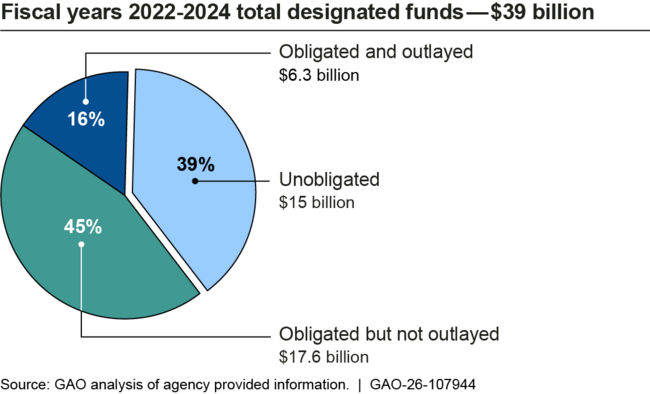
Note: For more details, including confidence intervals for the estimates, see figure 4 in GAO-26-107944. Dollar amounts do not sum to the total due to rounding.
GAO estimates that nearly all (between 98 and 100 percent) of the FY 2022 and 2023 projects moving forward had a purpose consistent with the purpose cited in the joint explanatory statement designating the funding and that around two-thirds of these projects were underway or complete. An estimated 60 percent of recipients reported experiencing at least one challenge in implementing their CPF/CDS project, such as managing time frames for completing the project.
The 19 agencies administering CPF/CDS funds conducted various oversight activities based on existing policies and guidance for monitoring federal awards, such as reviewing recipient spend plans, conducting site visits, and monitoring project time frames. Officials from most of the agencies (16 of 19) stated they incorporated lessons learned from oversight of the projects in previous fiscal years to improve the overall CPF/CDS process. Most agencies (16 of 19) reported challenges that affected their ability to conduct oversight activities, such as working with recipients receiving funds for the first time and agency staffing issues.
Why GAO Did This Study
As part of recent congressional appropriations processes, Members of Congress could request that funds be designated to a particular recipient—such as a local government or nonprofit organization in their community—for a specified project. These projects are called CPF in the House of Representatives and CDS in the Senate.
The joint explanatory statements accompanying the appropriations acts designating funds for these projects include provisions for GAO to review a sample of projects as part of Congress’s commitment to increased transparency for CPF/CDS funds.
For this report, GAO used generalizable samples to describe (1) the amount of CPF/CDS funds from FY 2022, 2023, and 2024 annual appropriations that have been obligated and outlayed as of the end of FY 2024, (2) the implementation status of FY 2022 and 2023 projects, and (3) how agencies are overseeing implementation for the FY 2022 and 2023 projects.
GAO reviewed data on obligations and outlays for a generalizable sample of 790 projects from the 19 agencies that administer CPF/CDS funds; interviewed a generalizable sample of 167 project recipients about their use of funds; conducted 36 in-person site visits; reviewed recipient spend plans, audit reports, and other documents from 30 randomly selected projects; and interviewed officials from the 19 agencies regarding oversight activities.
For more information, contact Jeff Arkin at arkinj@gao.gov.