
Transportation Demonstration Grants: DOT Should Develop and Implement a Lessons Learned Plan
Fast Facts
The Department of Transportation funds projects that demonstrate advanced technologies, such as:
- Smart traffic signals that can give transit and emergency vehicles priority at intersections
- Drones that can monitor traffic and help inspect bridges and roads
- Self-driving vehicles and automated driver assistance systems
Officials said these projects are intended to provide results that can be replicated and adopted by interested communities.
We recommended that DOT implement a plan to help identify and disseminate the results of these projects.
A traffic light at an intersection, green in one direction and red in the other.
Highlights
What GAO Found
The Department of Transportation (DOT) Strengthening Mobility and Revolutionizing Transportation (SMART) grants program funds demonstration projects that use advanced transportation technologies, such as autonomous vehicles and drones. In the first 3 years of the program, DOT received 1,073 applications from a variety of community sizes, entity types, and technology areas. As of September 2025, DOT has announced awards of around $289 million, which is 58 percent of the total authorized and appropriated funding for the program in the Infrastructure Investment and Jobs Act (IIJA), for 135 SMART projects.
While citing challenges that delayed the implementation of their projects, recipients GAO interviewed had generally positive views of the SMART program. Recipients reported challenges in procuring the necessary technology and equipment, which affected their project’s timeframes. As of September 2025, most SMART projects were not yet completed, but DOT officials expect many projects to be completed by the end of 2026. However, recipients also identified positive effects of the SMART program, including that the program allows them to test and demonstrate innovative technology solutions. Further, some recipients said the program allowed them to speed up the research or project timeframe compared with the timeline if they relied on local funding.
DOT has collected information about SMART projects but has not fully aligned its efforts with key practices for a lessons-learned process. The IIJA states that DOT should develop a lessons-learned process to identify technologies that can be successfully used in future deployments. In addition, GAO has identified key practices to building a comprehensive, documented lessons-learned process.
Key Practices for a Lessons-Learned Process
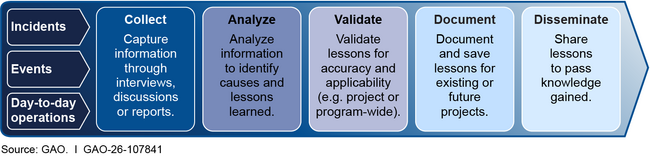
DOT’s current efforts do not fully align with these practices for lessons learned. For example, DOT has not analyzed information it collected from the SMART projects to identify lessons learned. DOT officials told GAO they have not developed a plan to align future activities with these practices because they were focused on awarding grants and not on planning for the analysis of program results. Developing and implementing a lessons-learned plan that incorporates key practices will help ensure that DOT can identify and share the results of the SMART program, particularly as projects are completed and recipients report their results to DOT. Without such a plan, DOT could miss opportunities to communicate lessons that could help improve the safety and reliability of transportation systems more broadly. Also, by better understanding lessons from the SMART program projects, communities can benefit from successes and may facilitate the adoption of advanced technologies.
Why GAO Did This Study
In 2021, the IIJA created the SMART program to fund demonstration projects that use advanced technologies and systems to improve transportation efficiency and safety. The SMART program provides discretionary grants that support projects across eight technology areas, and recipients include state, city, and tribal governments. The IIJA authorized and appropriated $500 million for the program between fiscal years 2022 and 2026. In February 2026, the Consolidated Appropriations Act, 2026 transferred $204.9 million in unobligated balances from the SMART grants program to support appropriations for other purposes.
The IIJA included a provision in statute for GAO to review the SMART program. This report addresses the characteristics of SMART program applicants and projects, perspectives of selected recipients on the program, and how DOT plans to identify lessons learned from the program. GAO reviewed DOT data on the applicants and projects selected for awards from fiscal years 2022 through 2024 and interviewed DOT officials on the SMART grant program. GAO also interviewed 17 selected grant recipients reflecting a range of community sizes and technology areas, on the program and their projects. In addition, GAO compared DOT efforts to identify lessons learned from the program with key practices GAO identified and federal guidance for developing lessons learned.
Recommendations
GAO is making a recommendation for DOT to develop and implement a lessons-learned plan that incorporates key practices for the SMART program.
DOT agreed with our recommendation.
Recommendations for Executive Action
| Agency Affected | Recommendation | Status |
|---|---|---|
| Department of Transportation | The Secretary of Transportation should direct the Assistant Secretary for Research and Technology to develop and implement a lessons-learned plan that incorporates key practices including analyzing, validating, documenting, and disseminating the lessons learned from the SMART program. (Recommendation 1) |
When we confirm what actions the agency has taken in response to this recommendation, we will provide updated information.
|