
Compacts of Free Association: Education and Health Remain Priorities, but Implementation and Oversight Are Delayed
Fast Facts
Micronesia, the Marshall Islands, and Palau are 3 countries in the Indo-Pacific that receive U.S. assistance under special agreements known as compacts of free association.
All 3 countries intend to use most funding from the compacts for education and health priorities, such as maintaining schools and medical facilities.
However, their use of funding has been slowed by various factors, such as construction labor shortages driven by population loss. In addition, the countries' and U.S. efforts to oversee the compact funding have been delayed.
Completed School Buildings in Kwajalein Atoll, Republic of the Marshall Islands—Built with Compact Funding from Prior Years
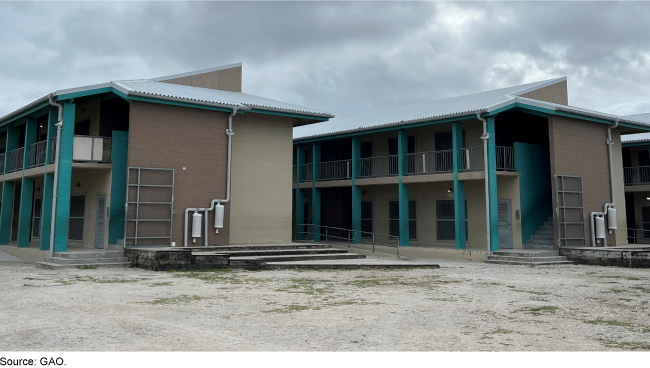
Multiple buildings with outdoor hallways.
Highlights
What GAO Found
Economic conditions in the Freely Associated States (FAS)—the Federated States of Micronesia (FSM), Republic of the Marshall Islands (RMI), and Republic of Palau—include population loss and economic decline. FSM’s population decreased by 26 percent between the 2010 and 2023 censuses, and RMI lost 20 percent of its population from 2011 to 2021. U.S. and FAS officials said high levels of out-migration have exacerbated skilled labor shortages and rising costs for government services. Though Palau’s population has remained relatively stable, a sharp drop in tourism during the COVID-19 pandemic drove a decline in its gross domestic product from 2019 through 2022.
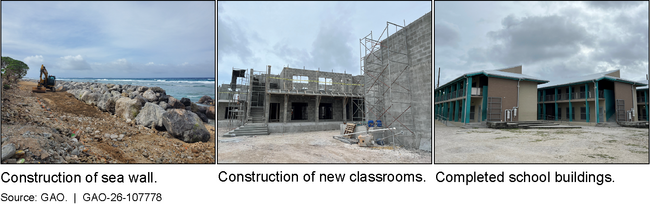
The three countries plan to use compact funding to prioritize education and health. Their allocations of compact grants for fiscal year (FY) 2025 largely support personnel salaries in the education and health sectors, and the countries plan to use compact infrastructure funds for projects that include schools and hospitals. However, FAS officials told GAO that project implementation has encountered obstacles such as delayed compact funds disbursement, rising construction costs, and labor shortages.
Examples of Compact-Funded Projects in the Marshall Islands, May 2025
The FAS have not yet met certain oversight requirements established by the amended compacts, while U.S. oversight efforts are underway with some delays. Most documents that FSM, RMI, and Palau are required to submit were not submitted on time, and some remain outstanding. For example, since FY 2019, all three countries’ required single audit reports—critical to U.S. compact oversight efforts—have been late. FAS officials said they are taking steps to improve the reports’ timeliness, such as by increasing financial accounting capacity. U.S. agencies have begun to implement oversight efforts. For example, the U.S.–FSM and U.S.–RMI joint management and accountability committees met in August 2025. However, delayed U.S. appointments to these committees affected members’ ability to discuss all planned issues. Also, the Interagency Group on the Freely Associated States submitted its FY 2024 report on its activities and recommendations for compact implementation to Congress 10 months late. State Department officials told GAO that plans to establish and staff a unit to support FAS relations and compact implementation by March 2029 had been paused due to the federal government’s hiring freeze and operational constraints.
Why GAO Did This Study
The U.S. has provided economic assistance through compacts of free association to FSM and RMI since 1986 and to Palau since 1994. This assistance—including grants overseen by the U.S. Department of the Interior as well as programs and services provided by various U.S. agencies—is intended to promote the economic advancement and self-sufficiency of the FAS. The compacts also provide the U.S. with military access in these strategically located countries in the Pacific.
In 2023, the U.S. signed amended compacts with FSM, RMI, and Palau, extending economic assistance for another 20 years. The compacts provide for, among other things, grant assistance and trust fund contributions for the FSM, RMI, and Palau that total to more than $6 billion collectively through 2043.
The Compact of Free Association Amendments Act of 2024 included a provision for GAO to review U.S. assistance provided under the amended 2023 compacts. This report (1) describes economic conditions and associated risks in each of the FAS, (2) describes funding provided under the amended compacts as well as planned uses of the funding, and (3) examines the extent to which the FAS and U.S. agencies have met selected oversight requirements established by the compacts. GAO reviewed relevant documents and data. GAO also observed projects funded by compact assistance and interviewed FAS and U.S. government officials in the three countries in 2025.
For more information, contact Latesha Love Grayer at lovegrayerl@gao.gov.