
Broadband Infrastructure: States’ Reported Progress Implementing Requirements to Facilitate Deployment Along Federal-Aid Highways
Fast Facts
Expanding broadband access requires adequate infrastructure. However, some parts of the country, especially rural areas, don’t have “middle mile” infrastructure connecting local internet providers to the global internet. Providers may install fiber optic cable, but excavations can be expensive.
To minimize excavations and save money, DOT requires states to take steps to facilitate 'digging once'—e.g., excavating highways and deploying broadband at the same time. We found most states made progress on DOT’s requirements, such as setting up electronic notifications to inform providers of planned transportation projects.
Example of Excavation to Install Fiber Optic Cables in Highway Right-of-Way
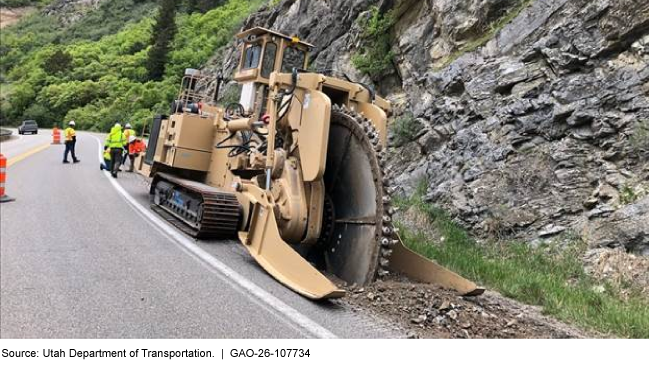
Several construction workers operate a larger trencher to excavate along the shoulder of a highway through a canyon.
Highlights
What GAO Found
In 2021, the Federal Highway Administration issued a final rule—the “dig once” rule—establishing new broadband infrastructure regulatory requirements for state departments of transportation that receive federal-aid highway program funding. These requirements included (1) identifying a broadband utility coordinator, (2) establishing certain processes to register and notify internet service providers and other entities, and (3) coordinating initiatives with state and local plans.
- Broadband utility coordinator. In GAO’s national survey, 46 of 52 respondents reported their state department of transportation had identified a coordinator.
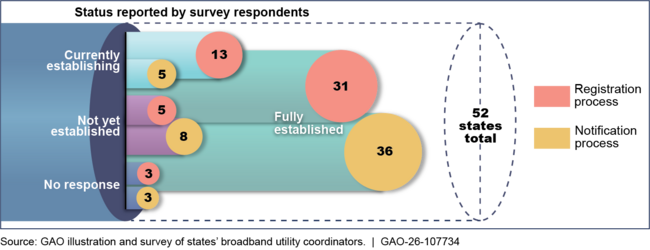
- Registration and notification. Over half of survey respondents reported their state had fully established processes to (1) register internet providers and other entities, and (2) electronically notify them of the state transportation improvement program. A few respondents noted barriers to implementing the processes, including limited availability of experienced staff, IT difficulties, and challenges engaging providers in the processes.
Survey Respondents’ Reported Progress Establishing Registration and Notification Processes Required by the Federal Highway Administration, as of May 2025
- Coordination. In responding to questions related to regulatory requirements for coordination,46 of 52 survey respondents reported coordinating broadly with federal, state, or local agencies to facilitate broadband infrastructure deployment in federal-aid highway rights-of-way. For example, one respondent reported that the broadband utility coordinator and a county utility committee exchanged details on planned highway and broadband projects at the utility’s monthly meeting.
Survey respondents and stakeholders GAO interviewed said the rule’s effects on broadband deployment were not well known. However, a few respondents, state officials, provider representatives, and other stakeholders cited the overall goals of “dig once” as reasons for optimism. Specifically, they were optimistic about the potential for benefits such as reduced excavation and traffic disruptions, lower project costs, and greater broadband access.
Why GAO Did This Study
Installing the infrastructure necessary to expand broadband access can be costly. “Dig once” policies encourage coordination between broadband projects and road projects, which can minimize excavations and save money.
GAO was asked to review the implementation status of the Federal Highway Administration’s 2021 “dig once” rule that established regulatory requirements to facilitate broadband infrastructure deployment, as required by statute.
This report describes states’ progress implementing certain “dig once” rule requirements and states’ views on the effects of the rule on broadband deployment.
To address these objectives, GAO surveyed all 52 broadband utility coordinators or other appropriate contacts (50 states, Puerto Rico, and Washington, D.C.). GAO reviewed applicable statutes, regulations, and Federal Highway Administration documentation. GAO also interviewed or obtained written responses from Federal Highway Administration and National Telecommunications and Information Administration officials, and representatives from four broadband industry and state government associations, which GAO selected to obtain a cross section of stakeholder interests.
For three selected states, GAO reviewed documents; interviewed state department of transportation and broadband office officials; and interviewed representatives of five internet service providers. GAO selected these states to reflect a range of factors, based on information including survey responses and experience with broadband deployment projects in federal-aid highway rights-of-way since the final rule took effect.
For more information, contact Andrew Von Ah at vonaha@gao.gov.