
Flight Simulators: FAA Should Take Steps to Ensure Oversight Efforts Address Increased Workload
Fast Facts
Airlines and flight schools use simulators to help train pilots to safely operate aircraft in a variety of situations. The Federal Aviation Administration evaluates and oversees simulators to make sure they accurately replicate aircraft.
FAA has several strategies to meet an increasing demand for simulator evaluations. For instance, FAA extends the time between evaluations from the standard 12 months up to 36 months for simulators that have consistent, high-quality performance. However, FAA hasn't communicated with stakeholders about its process for making such determinations.
We recommended that FAA address this and other issues.

Inside of the cockpit of a flight hydraulic simulator.
Highlights
What GAO Found
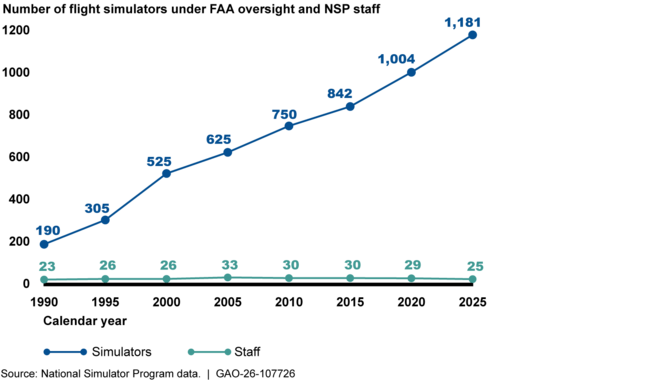
The Federal Aviation Administration (FAA) uses the National Simulator Program (NSP) to evaluate and oversee an increasing number of flight simulators. NSP’s oversight ensures that simulators accurately replicate the aircraft they simulate. From 1990 to 2025, the number of simulators increased by more than 500 percent, while the number of NSP staff remained steady. From 2019 through 2024, the number and type of simulator evaluations that NSP conducted remained relatively steady, as NSP implemented the Extended Evaluation Interval (EEI) program, among other strategies, to oversee the growing number of simulators. This program allows FAA to extend intervals between evaluations—from the standard 12 months up to 36 months—for simulators that demonstrate consistent, high-quality performance.
Trends in the Number of Simulators Under Federal Aviation Administration Oversight and National Simulator Program Staff, 1990–2025
However, GAO found that NSP has not communicated with simulator sponsors about its process for determining simulators’ eligibility for the EEI program and the intervals between evaluations of simulators in the program. Six of 10 selected sponsors raised concerns about communication, including insufficient opportunity to provide information that could help improve EEI determinations. For example, two sponsors cited potential safety issues that could result from extending the intervals between evaluations. Communicating with sponsors could help NSP make more informed decisions about eligibility and evaluation intervals, and identify and address risks associated with those determinations.
GAO found that NSP has identified staffing and skills gaps but has not addressed all mission-critical skills gaps, including in standards development. Developing and implementing a process to address all identified mission-critical skills gaps would help NSP ensure its staff has the requisite skills to keep pace with evolving technology while handling an increased oversight workload.
Why GAO Did This Study
NSP plays a critical role in aviation safety, as it oversees the flight simulators that airlines and flight schools use to train pilots to operate aircraft in a variety of situations.
The FAA Reauthorization Act of 2024 includes a provision for GAO to review FAA’s oversight of simulators. This report examines, among other objectives, how the number and type of simulator evaluations NSP conducts annually has changed in recent years, and how NSP has addressed increased demand; the extent to which NSP has communicated with sponsors in its process for making EEI program determinations; and the extent to which NSP has identified and addressed gaps in staffing levels and staff skill sets.
GAO reviewed FAA policies, guidance, and data, as well as relevant federal laws and regulations. GAO also interviewed FAA officials and simulator sponsors, such as major and regional airlines. For these interviews, GAO selected a nongeneralizable sample of 10 sponsors that own or operate over 62 percent of all flight simulators. In addition, GAO conducted two site visits to observe simulators managed by a flight simulator manufacturer and a flight training organization.
Recommendations
GAO recommends that FAA develop and implement a mechanism to communicate with and receive feedback from sponsors about its process for determining which simulators are eligible for inclusion in the EEI program, and develop and implement a process to address all identified mission-critical skills gaps. The Department of Transportation concurred with the recommendations.
Recommendations for Executive Action
| Agency Affected | Recommendation | Status |
|---|---|---|
| Federal Aviation Administration | The FAA Administrator should ensure that NSP develops and implements a mechanism to communicate with and receive feedback from sponsors about its process for determining which simulators are eligible for inclusion in its EEI program. (Recommendation 1) |
When we confirm what actions the agency has taken in response to this recommendation, we will provide updated information.
|
| Federal Aviation Administration | The FAA Administrator should ensure that NSP develops and implements a process to address all identified skills gaps that pose a risk to NSP's ability to meet its mission. (Recommendation 2). |
When we confirm what actions the agency has taken in response to this recommendation, we will provide updated information.
|