
Federal Statistics: Stakeholders Said Jobs Report Generally Meets Their Needs, but Opportunities Exist to Improve Data Quality
Fast Facts
FEDERAL STATISTICS: Stakeholders Said Jobs Report Generally Meets Their Needs, but Opportunities Exist to Improve Data Quality
The Bureau of Labor Statistics’ monthly Jobs Report provides key data about the U.S. economy. It is based on two surveys, one of individuals and one of employers.
Users of the report told us its data is generally accurate and meets their needs. But the quality of this data is at risk. For example, fewer people are responding to the surveys, which can affect data accuracy.
The bureau is taking steps to improve the data, but could do more. For example, it's working to add an online response option. But it may not be getting all the feedback it needs from Jobs Report users and technical experts.
Our recommendations address these issues and more.

A newspaper with the headline Job Market, with a silver pen and a pair of eyeglasses on top of the paper
Highlights
What GAO Found
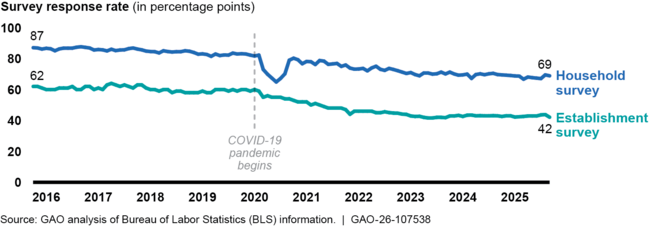
The Bureau of Labor Statistics’s (BLS) Employment Situation report (the Jobs Report) provides key information on the nation’s economy based on data from two surveys—one of households (the household survey) and one of employers (the establishment survey). Stakeholders with jobs data expertise said the report generally meets users’ needs. However, they said occasional large revisions can make the data less useful for informing timely decisions, and BLS faces risks to data quality due to lower survey response rates over time (see figure). BLS met its goals for the data’s precision and size of the revisions from fiscal years 2020 through 2025, but it relaxed one goal during the COVID-19 pandemic.
Response Rates to the Jobs Report Surveys, Oct 2015–Sept 2025
BLS obtains input from data users and technical experts through various means to inform improvements to the Jobs Report. However, it does not have a plan to address gaps in obtaining regular user and technical feedback since the Departments of Commerce and Labor eliminated three advisory committees in 2025. Having a plan would help ensure that changes to the Jobs Report meet users’ needs and address technical challenges while preserving data quality.
BLS and the Census Bureau—which conducts the household survey for BLS—have met federal requirements for assessing the effects of lower survey response rates on the Jobs Report’s accuracy but released limited information on their findings. Studies by agency staff found limited effects of lower response rates on the accuracy of the household survey data. However, BLS has not released its assessments of the establishment survey due to limitations, including challenges linking the survey data with more comprehensive sources. BLS has started a new establishment survey study designed to address earlier limitations. Releasing the results could help users maintain trust in the data’s accuracy.
Agency efforts and additional options identified by stakeholders aim to enhance the quality of the Jobs Report data. For example, BLS and Census are planning to add an online response method to the household survey in 2027 to try to increase response rates and lower data collection costs. However, BLS and Census officials said recent funding constraints may delay full implementation. Also, stakeholders, researchers, and BLS officials identified additional options to address survey challenges. For instance, some suggested incorporating administrative data from private and other government sources (such as unemployment insurance data) to help mitigate lower survey response rates.
Why GAO Did This Study
Economic policymakers, businesses, and others rely on the monthly Jobs Report for accurate and timely information on the health of the nation’s economy, such as the unemployment rate. However, in recent years, questions have been raised about the quality of the data in the report.
GAO was asked to review the quality of the data in the Jobs Report. GAO’s report addresses (1) the extent to which the Jobs Report data meet users’ needs for accurate, useful, and timely information, and challenges BLS faces in producing these data, (2) the extent to which BLS and Census have followed federal requirements for assessing survey response rates and communicating findings to data users, and (3) potential options to address survey challenges and associated considerations.
GAO reviewed data on BLS’s performance goals for the quality of the Jobs Report data. GAO also reviewed relevant government and academic studies and agency documentation. GAO interviewed agency officials and 14 stakeholders that were selected to provide a range of expert perspectives on the quality of the data for informing economic policy and business decisions and on options to address survey challenges. GAO compared BLS and Census processes to federal statistical policies and relevant federal standards for internal control.
Recommendations
GAO is making three recommendations, including that BLS develop a plan to address gaps in its ability to obtain external input on the Jobs Report data and publish an assessment on the effects of survey nonresponse on the establishment survey. BLS generally agreed with the recommendations.
Recommendations for Executive Action
| Agency Affected | Recommendation | Status |
|---|---|---|
| Department of Labor | The Secretary of Labor should ensure that the Commissioner of BLS, in consultation with the Director of the Census Bureau as appropriate, develops and implements a plan to address gaps in BLS's ability to obtain regular external input on changes to the Employment Situation report (Jobs Report) data. The plan should include timelines for implementation. (Recommendation 1) |
BLS did not disagree with this recommendation. In July 2026, BLS provided additional information about existing channels to obtain external input. However, BLS did not provide information on efforts to develop and implement a plan to address gaps in regular external input, as recommended. We will monitor BLS's implementation of this recommendation and close it once BLS provides evidence of such a plan.
|
| Department of Labor | The Secretary of Labor should ensure that the Commissioner of BLS updates the public documentation for the Current Employment Statistics program (establishment survey) to explain BLS's current methodology for assessing nonresponse bias and other sources of statistical error on key survey estimates, including any limitations in its methodology. (Recommendation 2) |
BLS agreed with this recommendation. In July 2026, BLS reaffirmed that it plans to draw on the outcomes of its new nonresponse bias study under contract to address this recommendation. The study is expected to be published by the end of 2026. BLS also said it will publish a paper on the BLS website that describes BLS's current methodology for assessing sources of statistical error and explains the current methodology's limitations. We will monitor the agency's progress on this effort.
|
| Department of Labor | The Secretary of Labor should ensure that the Commissioner of BLS publishes a summary assessment of nonresponse bias on the Current Employment Statistics program (establishment survey). The assessment should include the magnitude and direction of any bias on key survey estimates, such as total payroll employment growth. (Recommendation 3) |
BLS agreed with this recommendation. In July 2026, BLS reaffirmed that it plans to draw on the outcomes of its new nonresponse bias study under contract to address this recommendation. The study is expected to be published by the end of 2026. We will monitor the agency's progress on this effort.
|