
What You Should Know About the Jobs Report
Did the U.S. gain or lose jobs last month? What was the unemployment rate?
This Friday, the latest “Jobs Report” will be released, offering insights on employment growth or losses and unemployment. The Jobs Report, which is typically released the first Friday of each month, is viewed as an important economic indicator. It receives a lot of headlines and is used by businesses, financial institutions, and the government when making important decisions.
What all goes into making this report, and does it meet users’ needs? Today’s WatchBlog post looks at our new report on these questions and more you may have.
Image

The job of putting together the Jobs Report
The last Jobs Report was released on Friday, May 8. In it, the Bureau of Labor Statistics (BLS) reported that employment increased by 115,000 jobs and the unemployment rate, at 4.3%, did not change from the previous month.
How does BLS calculate these numbers? It uses data from two national surveys:
- The household survey provides the national unemployment rate. This is the estimated percentage of people in the U.S. labor force looking for employment. The Census Bureau collects the data for this survey, interviewing people in-person or by telephone.
- The establishment survey provides information from businesses and government agencies on the number of people they employ, as well as workers’ hours and earnings. For this survey, BLS interviews employers by phone and collects information from them through a web-based reporting system.
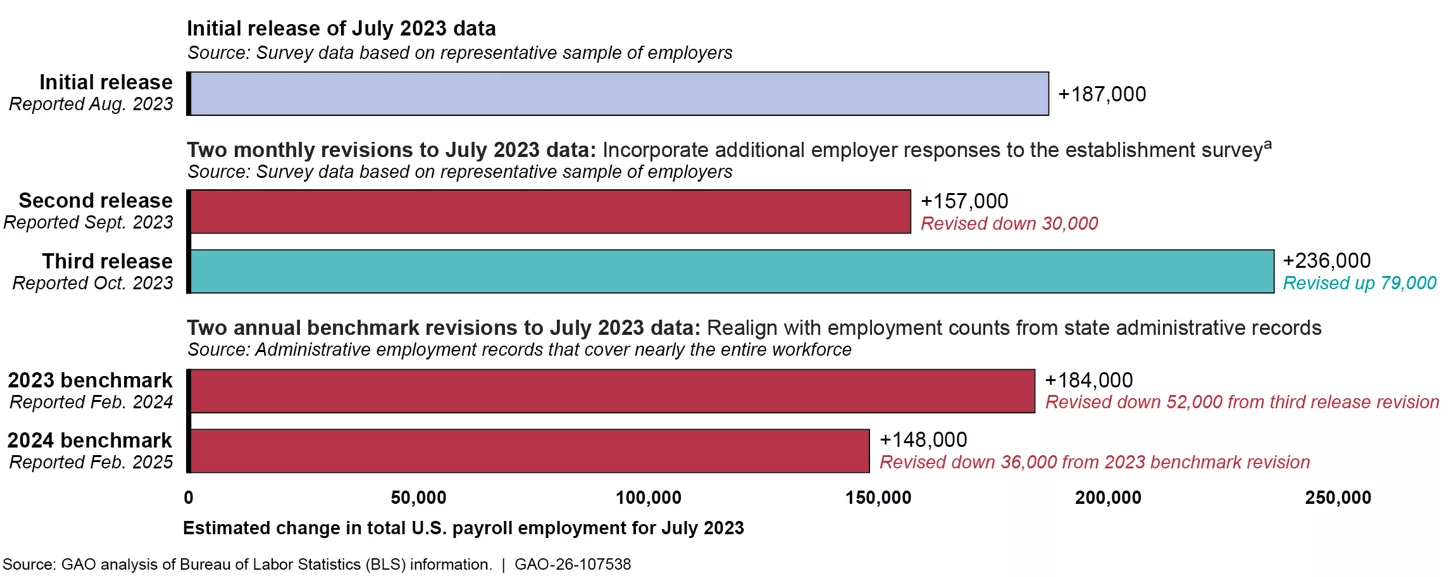
Revisions to the Jobs Report. Revisions are routine. BLS has a longstanding practice of making monthly and annual revisions to the numbers it reports from the establishment survey. Some employers don’t respond in time for their data to be included in the Jobs Report. So BLS gives them additional time to respond, and later Jobs Reports include revisions based on the additional employer data. BLS also conducts an annual revision of its establishment survey numbers after it receives more complete employment data from state unemployment insurance programs.
The revision process is intended to provide the public with more accurate estimates over time. But sometimes, revisions can be larger than usual. And for those who rely on the Jobs Report, large revisions can make it less useful.
Example of Monthly and Annual Revisions to Employment Data in the Jobs Report, Based on Data for July 2023
Image
Revisions and other challenges with the Jobs Report
The monthly Jobs Report is important to a wide range of users. For example, the Federal Reserve closely monitors unemployment and employment growth to help determine interest rates and manage inflation. Businesses use the numbers to help inform their own workforce and investment decisions—such as hiring more workers or expanding operations.
What do experts think of the Jobs Report? We interviewed users and other stakeholders who had expertise about the Jobs Report. This included folks from government entities like the Congressional Budget Office and Federal Reserve Board, as well as private sector financial institutions like Vanguard, JPMorgan Chase, and Goldman Sachs. They told us that the Jobs Report generally meets their needs for accurate, timely, and useful information. But they also raised concerns about two things:
- The occasional large revisions that can diminish the usefulness of the Jobs Report for making timely decisions
- Lower survey response rates that could reduce the accuracy of information reported
Large revisions. During the last 5 fiscal years, BLS has met its goals for the size of its revisions. But occasionally, there have been larger revisions to the establishment survey data (of employers). For example, larger monthly revisions were common during COVID-19 after the pandemic impacted data collection.
One expert we interviewed said large revisions cause uncertainty about the quality of the numbers in the Jobs Report and can delay decision-making. BLS is aware of these kinds of concerns. As a result, BLS adjusted its methods for calculating employment growth in February with the goal of making the report more accurate. It is also working on other changes that could help reduce the size of the revisions.
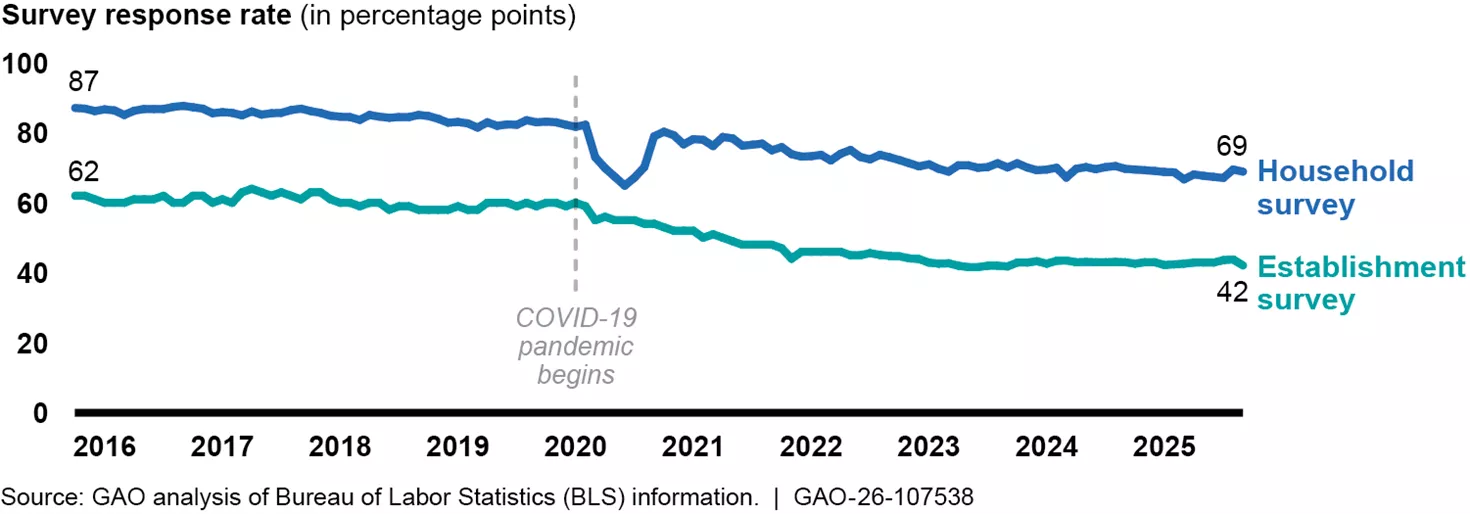
Lower response rates. Response rates for both the household and establishment surveys have fallen substantially since COVID-19. Lower response rates have made it harder to measure some numbers, such as the unemployment rate, as precisely as before.
Response Rates to the Jobs Report Surveys, October 2015 to September 2025
Image
BLS is taking steps to address lower response rates. For example, it is planning to add an online option for the household survey in 2027. This could increase response rates and lower the cost of running the survey. But this effort might be delayed by recent funding constraints. Some experts suggested additional options that could improve the data, such as incorporating alternative data from the private sector or other government sources (for example, data from private payroll companies or tax records).
In our report, we suggested other actions to ensure the Jobs Report remains a trusted resource for measuring the health of the economy. Learn more by reading our full report.
- GAO’s fact-based, nonpartisan information helps Congress and federal agencies improve government. The WatchBlog lets us contextualize GAO’s work a little more for the public. Check out more of our posts at GAO.gov/blog.
- Got a comment, question? Email us at blog@gao.gov.
GAO Contacts
Image

Image

Related Products

GAO's mission is to provide Congress with fact-based, nonpartisan information that can help improve federal government performance and ensure accountability for the benefit of the American people. GAO launched its WatchBlog in January, 2014, as part of its continuing effort to reach its audiences—Congress and the American people—where they are currently looking for information.
The blog format allows GAO to provide a little more context about its work than it can offer on its other social media platforms. Posts will tie GAO work to current events and the news; show how GAO’s work is affecting agencies or legislation; highlight reports, testimonies, and issue areas where GAO does work; and provide information about GAO itself, among other things.
Please send any feedback on GAO's WatchBlog to blog@gao.gov.