
Students With Disabilities: Assistive Technology Challenges and Resources in Selected School Districts and Schools
Fast Facts
Assistive technology—e.g., modified scissors or apps that read computer screens aloud—can help students with disabilities participate at school.
However, staff in the 8 school districts we visited said they face challenges providing it. For example, staff may not be aware of the range of available technology or be trained to use it.
Staff in the districts told us about strategies that helped address these challenges, including:
Forming "assistive technology teams" that provide services like training to schools
Using resources from outside their district like lending libraries, where they can borrow assistive technology for students to try

Portrait of preteen girl using headphones and a digital tablet in a classroom
Highlights
What GAO Found
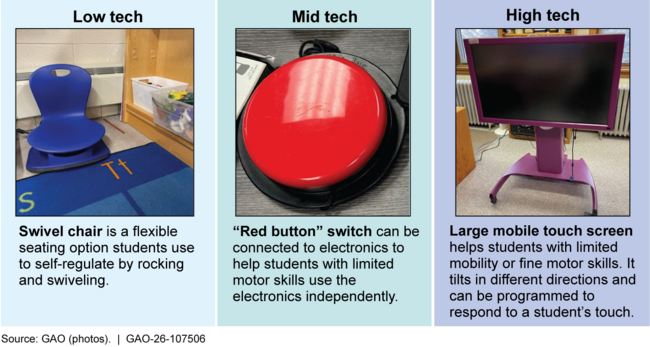
Assistive technology—such as pencil grips, calculators, and screen readers—can help students with disabilities more fully participate at school. Staff from the eight school districts that GAO visited provided examples of assistive technology that students use in the classroom (see figure). Limited knowledge about assistive technology was a key challenge, according to staff from all eight school districts GAO visited. For example, staff in many school districts said that teachers often only think of high-tech devices and may not consider simpler low-tech devices that could meet students’ individual needs. In addition, rapidly changing technology can make it difficult for school district and school staff to keep abreast of current assistive technology options. School district staff also described how broad challenges pertaining to public education adversely affected their ability to provide assistive technology to students with disabilities. These included insufficient time and opportunities for training, staffing issues (e.g., shortages and high turnover), technology issues, and funding constraints.
Examples of Assistive Technology Used in School Districts GAO Visited
The eight school districts GAO visited sometimes formed assistive technology teams and used external resources, which helped mitigate some of the challenges described above. Specifically, four districts had assistive technology teams that helped improve coordination and increase staff knowledge about assistive technology, according to school district officials. The teams—generally comprised of district special education staff—help school staff develop standardized processes to identify the best assistive technology for students’ needs, document assistive technology use in students’ individualized education programs, and acquire assistive technology. In addition, district officials in all eight school districts said that they used federal, state, or regional resources to train school staff or provide assistive technology to students. These included external training, expert consultations, libraries that loan assistive technology, and guidance such as Education’s 2024 Myths and Facts Surrounding Assistive Technology Devices and Services.
Why GAO Did This Study
The Individuals with Disabilities Education Act (IDEA) requires that all children with disabilities receive a free appropriate public education. Under IDEA, assistive technology must be considered for students receiving special education services. Little is known about how this requirement is implemented locally.
GAO was asked to review how schools make decisions about providing assistive technology to students with disabilities. This report describes (1) the assistive technology selected school districts provide to students and the challenges they face doing so, and (2) strategies and resources selected school districts use to provide assistive technology to students and mitigate challenges.
GAO visited four states—Minnesota, Pennsylvania, Texas, and Wyoming— selected for variation in factors such as percentage of students with disabilities and presence of state-level assistive technology initiatives. GAO interviewed staff from state and regional education agencies, eight school districts, and eight schools. GAO selected districts for variation in factors such as urbanicity and assistive technology initiatives. In addition, GAO interviewed officials and reviewed documents from the U.S. Department of Education (Education), the U.S. Department of Health and Human Services (HHS), and both departments’ relevant technical assistance centers. GAO also conducted a web-based survey of all 93 Parent Centers—family technical assistance centers funded by Education—and received a response rate of 88 percent. We provided a draft of this report to Education and HHS for review and comment. Education provided technical comments, which we incorporated as appropriate. HHS did not provide any comments on the report.
For more information, contact Jacqueline M. Nowicki at nowickij@gao.gov.