
Consumer Protection: Actions Needed to Improve Complaint Reporting, Consumer Education, and Federal Coordination to Counter Scams
Fast Facts
Scammers manipulate victims into sending them money. These scams may be costing Americans billions of dollars annually.
For example, based on banking data filed in 2021, Treasury estimated $200 billion in impersonation-related suspicious activity. That's when a scammer impersonates someone else—like a potential romantic partner or employer, or a customer service representative—to get money.
There is no government-wide estimate of the money lost to scams, no common definition of scams, and no national strategy for combating them. Having these could help federal agencies protect consumers.
We recommended addressing this and more.
Highlights
What GAO Found
Scams occur in a variety of forms, have evolved with technology, and are a growing risk to consumers. Commonly, scams involve a scammer contacting the victim, engaging the victim with a particular type of scam, and requesting a payment for a false purpose.
Examples of a Scam Execution Process
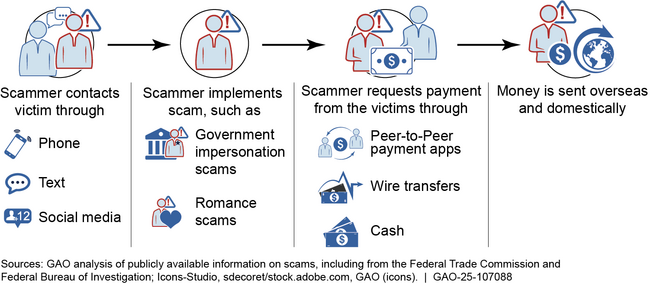
Note: Other types of contact methods, scams, and payment methods exist.
The 13 federal agencies GAO spoke with engage in a range of efforts to counter scams. However, none were aware of a government-wide strategy to guide those efforts. Existing strategies did not focus on countering scams and did not apply across agencies. The Federal Bureau of Investigation (FBI) is developing a cyber-enabled fraud strategy. The overlap in issues relating to scams and cyber-enabled fraud could provide FBI with the expertise to develop a government-wide strategy. Developing a government-wide strategy would better position agencies to coordinate and strategically target their efforts to counter scams.
The Consumer Financial Protection Bureau (CFPB), FBI, and Federal Trade Commission (FTC) receive, compile, and report on consumer complaints pertaining to issues including internet-related crime and scams. Data limitations, such as issues with how data are collected, do not allow agencies to calculate the exact number of scam complaints, but each agency can estimate the number it receives. For example, the FBI estimated that in 2023 it received approximately 589,400 scam-related complaints, resulting in losses of $10.55 billion. In addition, no government-wide estimate of the total number of scams and dollar losses exists. Improved data collection and estimates would better support federal efforts to understand the extent of this type of crime and develop ways to counter it.
CFPB, FBI, and FTC provide a variety of education resources for consumers. However, they do not measure the effectiveness of their education efforts on the consumers that receive them. Doing so would help the agencies understand how their education efforts are affecting consumers' ability to recognize and protect themselves from scams and how the agencies might adjust their education materials to best help consumers.
Why GAO Did This Study
Scams, a method of committing fraud, involve the use of deception or manipulation intended to achieve financial gain. Scams often cause individual victims to lose large sums—in some cases their entire life savings.
GAO was asked to review federal agencies' and businesses' efforts to counter scams. This report examines, among other things, the extent to which (1) a comprehensive, government-wide strategy guides agency efforts; (2) selected federal agencies compile scam-related complaint data and agencies' ability to estimate the total number of scams and related dollar losses; and (3) selected agencies measure the effectiveness of consumer education activities.
GAO analyzed publicly available information, agency documents, and agency consumer complaint data. GAO interviewed agency officials and representatives of relevant industries and advocacy groups.
Recommendations
GAO is making 16 recommendations to various agencies to develop a government-wide strategy to counter scams, a national scam estimate, a common definition of scams, and evaluate the outcomes of consumer education efforts. The FBI disagreed with three recommendations related to the development of a national estimate, a definition of scams, and evaluating the outcomes of its consumer education efforts. GAO maintains the recommendations are valid, as discussed in the report. FTC neither agreed nor disagreed with the five recommendations made to it.
Recommendations for Executive Action
| Agency Affected | Recommendation | Status |
|---|---|---|
| Federal Bureau of Investigation |
Priority Rec.
The Director of FBI should lead a U.S. government effort to develop and implement a government-wide strategy to counter scams and coordinate related activities. This effort should be done in collaboration with the Director of CFPB, the Chair of FTC, the Secretary of the Treasury, and other agencies, as appropriate (through their designees). This effort should address issues such as a common definition for scams; consumer complaint reporting; related types/granularity/aggregation of data, risks, and responses; a government-wide estimate of this type of crime; and coordination of federal and business activities. As appropriate, and consistent with desired characteristics, a strategy should also define agency roles, responsibilities, and authorities; identify necessary resources; and identify any legislative, regulatory, or administrative changes needed to enable a comprehensive, coordinated response. (Recommendation 1) |
In comments on our April 2025 report, the FBI stated that it is fully committed to this mission and leading this effort in partnership with the Chair of FTC, the Secretary of Treasury, and key agencies to develop and implement a unified strategy to combat scams and coordinate related activities. In October 2025, the FBI stated that is prepared to lead this critical effort in partnership with the Chair of the Federal Trade Commission, and Secretary of the Treasury, and other relevant agencies. Adding, the FBI has identified the strategic framework necessary to drive this effort forward. Specifically, the FBI stated that the development and implementation of a government-wide strategy will involve: (1) a multi-agency working group, (2) legislative updates and regulatory reform, (3) collaboration with private sector organizations and others, and (4) additional funding. In May 2026, the FBI told us that the federal government's approach to combating cyber-enabled fraud has evolved significantly since we issued our report. For example, in March 6, 2026, Executive Order (14390), "Combating Cybercrime, Fraud, and Predatory Schemes Against American Citizens" directed federal agencies to enact several initiatives addressing cyber-enabled crime. This included creating an operational cell within the National Coordination Center (NCC) to coordinate federal efforts to combat cyber-enabled criminal activity. In June 2026, the FBI told us that they are participating in NCC. The FBI added that the executive order directs FBI to develop an action plan by July 2026. According to the FBI, it has paused its efforts to implement this recommendation to respond to the executive order. While addressing cyber-enabled crime is important, that does not negate the need we identified for a comprehensive governmentwide-strategy to counter scams. Related strategies exist, but they are either agency-specific plans or do not focus on scams. The absence of a comprehensive, government-wide strategy poses risk for fragmentation of effort and overlap of activities, which can reduce their impact on consumer protection. A government-wide strategy should address issues such as a common definition for scams; consumer complaint reporting; data, risks, and responses; a government-wide estimate of this type of crime; and coordination of federal and business activities. We will continue to monitor the FBI's actions to develop and implement a government-wide strategy to counter scams.
|
| Federal Trade Commission | The Chair of FTC should, in collaboration with CFPB, FBI, and other major contributors, explore ways to harmonize data collection and contributions to Sentinel to better identify scams, such as consistently collecting data on scam type, dollar loss amount, payment method, and other data fields, as appropriate. (Recommendation 2) |
In November 2025, FTC stated that harmonizing the data can be difficult but noted that it is important to provide better information to law enforcement users and better analysis to the public. The FTC explained that it will continue to review its intake mapping and will also explore ways to improve the harmonization, including the data mapping for its major contributors. We will continue to monitor FTC's progress in this area. As of July 2026, FTC has provided no additional information on its implementation of our recommendation.
|
| Consumer Financial Protection Bureau | The Director of CFPB should, in collaboration with FTC, explore ways to harmonize data collection to better identify scams, such as consistently collecting data on scam type, dollar loss amount, payment method, and other data fields, as appropriate. (Recommendation 3) |
In an October 2025 update, CFPB did not specifically discuss actions it is taking to address the recommendations we made. However, CFPB stated that it recognizes the scale and impact of scams on consumers and shares our perspective that federal efforts must be as effective as possible. CFPB stated that for several reasons, such as implementation of the government-wide strategy to counter scams, it believes it is prudent to closely monitor the actions of the FBI, FTC, and other stakeholders before determining whether any further CFPB action is warranted. Further, for the recommendation to adopt the definition of scams developed by the Federal Reserve or work with the FBI, FTC, and other agencies to develop a common definition of scams and related scam types, CFPB stated that agreed-upon definitions and standards are necessary for the agency to address the GAO's recommendations in whole or in part. We will continue to monitor CFPB's progress in this area. As of July 2026, CFPB has provided no additional information on its implementation of our recommendation.
|
| Federal Bureau of Investigation | The Director of FBI should, in collaboration with FTC, explore ways to harmonize data collection to better identify scams, such as consistently collecting data on scam type. (Recommendation 4) |
In October 2025, the FBI explained that it will work with FTC and other partners to explore opportunities for alignment, such as shared scam-type classification, which would improve coordination in defining and tracking scams. The FBI added that it supports collaborative efforts to improve data consistency where alignment is feasible and mutually beneficial. In May 2026, FBI informed us that it continues to support efforts to improve consistency in scam-related data collection across agencies, recognizing that aligned definitions, taxonomies, and data fields can enhance trend analysis and coordination. In June 2026, the FBI told us it is waiting to move forward due to proposed legislation that would create a centralized repository for victim complaints. We will continue to monitor FBI's progress in this area.
|
| Consumer Financial Protection Bureau | The Director of CFPB should use the agency's data collection and analysis to produce and report an estimate of the number of complaints it receives and the associated financial losses resulting from scams. (Recommendation 5) |
In an October 2025 update, CFPB did not specifically discuss actions it is taking to address the recommendations we made. However, CFPB stated that it recognizes the scale and impact of scams on consumers and shares our perspective that federal efforts must be as effective as possible. CFPB stated that for several reasons, such as implementation of the government-wide strategy to counter scams, it believes it is prudent to closely monitor the actions of the FBI, FTC, and other stakeholders before determining whether any further CFPB action is warranted. Further, for the recommendation to adopt the definition of scams developed by the Federal Reserve or work with the FBI, FTC, and other agencies to develop a common definition of scams and related scam types, CFPB stated that agreed-upon definitions and standards are necessary for the agency to address the GAO's recommendations in whole or in part. We will continue to monitor CFPB's progress in this area. As of July 2026, CFPB has provided no additional information on its implementation of our recommendation.
|
| Federal Bureau of Investigation | The Director of FBI should use the agency's data collection and analysis to produce and report an estimate of the number of complaints it receives and the associated financial losses resulting from scams. (Recommendation 6) |
In May 2026, the FBI told us that starting in 2025, the IC3 Annual Report included information on cyber-enabled fraud. Our recommendation asked that the FBI produce and report an estimate of the number of complaints it receives and the associated financial losses resulting from scams. The new IC3 format adds valuable information to the report but does not provide an estimate of complaints or losses related to scams. We will continue to monitor FBI's progress in this area.
|
| Federal Trade Commission | The Chair of FTC should use the agency's data collection and analysis to produce and report an estimate of the number of complaints it receives and the associated financial losses resulting from scams. (Recommendation 7) |
In November 2025, FTC stated it will review its "fraud" and "other" topic categories in its Sentinel database to determine if there should be any adjustments to those Sentinel categories. While we appreciate FTC's effort to review its categories, this action does not address the recommendation to report an estimate of the number of complaints it receives and the associated financial losses resulting from scams. We understand that FTC already reports on fraud complaints; however, this category is broad. In our April 2025 report, we recommended FTC estimate and report the number of complaints it receives and the associated financial losses resulting from scams. We will continue to monitor FTC's progress in this area. As of July 2026, FTC has provided no additional information on its implementation of our recommendation.
|
| Consumer Financial Protection Bureau | The Director of CFPB should, in collaboration with FBI, FTC, and other agencies, as appropriate, develop and report a single, government-wide estimate of the number of consumers affected by, and dollar losses resulting from, scams, factoring in an estimate of incidents not reported. (Recommendation 8) |
In an October 2025 update, CFPB did not specifically discuss actions it is taking to address the recommendations we made. However, CFPB stated that it recognizes the scale and impact of scams on consumers and shares our perspective that federal efforts must be as effective as possible. CFPB stated that for several reasons, such as implementation of the government-wide strategy to counter scams, it believes it is prudent to closely monitor the actions of the FBI, FTC, and other stakeholders before determining whether any further CFPB action is warranted. Further, for the recommendation to adopt the definition of scams developed by the Federal Reserve or work with the FBI, FTC, and other agencies to develop a common definition of scams and related scam types, CFPB stated that agreed-upon definitions and standards are necessary for the agency to address the GAO's recommendations in whole or in part. We will continue to monitor CFPB's progress in this area. As of July 2026, CFPB has provided no additional information on its implementation of our recommendation.
|
| Federal Bureau of Investigation | The Director of FBI should, in collaboration with CFPB, FTC, and other agencies, as appropriate, develop and report a single, government-wide estimate of the number of consumers affected by, and dollar losses resulting from, scams, factoring in an estimate of incidents not reported. (Recommendation 9) |
In October 2025, the FBI informed us that it cannot address the recommendation to collaborate with other agencies to develop and report a single, government-wide estimate of the number of consumers affected by, and dollar losses resulting from, scams, factoring in an estimate of incidents not reported, as framed. However, the FBI told us it supports continued coordination across agencies and will do its part to contribute meaningful data and analysis to inform the government's collective fraud prevention efforts. Specifically, the FBI explained that it does not believe diverting law enforcement resources to develop independent estimates would be a wise or effective use of taxpayer funds since its focus remains on disrupting criminal networks, protecting the public, and preventing future scams. The FBI added that agencies, such as FTC, with statistical or consumer protection mandates are better positioned to lead such work. Our recommendation directs agencies to collaborate on developing a single government-wide estimate of scams and scam losses. We did not recommend that the FBI develop the government-wide estimate independently. As we explained in our April 2025 report, fraud estimates, including those specifically addressing scams, can demonstrate the scope of the problem, help improve oversight prioritization, and help determine the return on investment from activities to mitigate fraud. In May 2026, the FBI stated that IC3 already collects and publicly reports substantial data on cyber-enabled crime, including scam-related losses. According to the FBI, it provides aggregated statistics, which can inform broader government-wide analysis, including estimates of unreported harm. In July 2026, the FBI stated that FTC and other agencies have access to IC3 information, and it is willing to assist law enforcement partners with questions on IC3 data or methodologies. While the FBI reports data on cyber-enabled crimes, this is not a single government-wide estimate. The FBI's efforts are not consistent with the spirit and intent of our recommendation, which calls for the FBI, in collaboration with CFPB, FTC, and other agencies, as appropriate, to develop and report a single, government-side estimate. As we discuss in our April 2025 report, fraud estimates can demonstrate the scope of the problem, help improve oversight prioritization, and help determine the return on investment from activities to mitigate fraud. We will continue to monitor FBI's progress in this area.
|
| Federal Trade Commission | The Chair of FTC should, in collaboration with CFPB, FBI, and other agencies, as appropriate, develop and report a single, government-wide estimate of the number of consumers affected by, and dollar losses resulting from, scams, factoring in an estimate of incidents not reported. (Recommendation 10) |
In November 2025, FTC stated that it already makes efforts to report its fraud-related data and estimates of consumer impact, which include reports from many other government agencies, such as the FBI. According to FTC, its 2023 report to Congress, Protecting Older Consumers, estimated $158.3 billion in consumer fraud losses in 2023, with an estimated $61.5 billion lost by older adults. However, this estimate is not a single, governmentwide estimate of losses resulting from scams. As we stated in our April 2025 report, we understand that each agency has its own mandate and authority. We continue to believe, however, that a single, government-wide measure and a common definition of scams will best support a multiagency approach and response to scams. We will continue to monitor FTC's progress in this area. As of July 2026, FTC has provided no additional information on its implementation of our recommendation.
|
| Consumer Financial Protection Bureau | The Director of CFPB, prior to developing a single estimate of the number of consumers affected by, and dollar losses resulting from, scams, should adopt the definition of scams developed by the Federal Reserve or work with FBI and FTC and other affected agencies to develop and adopt a common definition of scams and related scam types. (Recommendation 11) |
In an October 2025 update, CFPB did not specifically discuss actions it is taking to address the recommendations we made. However, CFPB stated that it recognizes the scale and impact of scams on consumers and shares our perspective that federal efforts must be as effective as possible. CFPB stated that for several reasons, such as implementation of the government-wide strategy to counter scams, it believes it is prudent to closely monitor the actions of the FBI, FTC, and other stakeholders before determining whether any further CFPB action is warranted. Further, for the recommendation to adopt the definition of scams developed by the Federal Reserve or work with the FBI, FTC, and other agencies to develop a common definition of scams and related scam types, CFPB stated that agreed-upon definitions and standards are necessary for the agency to address the GAO's recommendations in whole or in part. We will continue to monitor CFPB's progress in this area. As of July 2026, CFPB has provided no additional information on its implementation of our recommendation.
|
| Federal Bureau of Investigation | The Director of FBI, prior to developing a single estimate of the number of consumers affected by, and dollar losses resulting from, scams, should adopt the definition of scams developed by the Federal Reserve or work with CFPB and FTC and other affected agencies to develop a common definition of scams and related scam types. (Recommendation 12) |
In May 2026, the FBI informed us that it continues to support efforts to improve definitional alignment across agencies, recognizing that greater consistency can enhance data comparability, public understanding, and coordination. At the same time, the FBI explained that any effort to develop a common definition of "scams" must account for the distinct statutory authorities, missions, and enforcement responsibilities of participating agencies. However, the FBI believes that recently proposed legislation related to scams will influence both the structure of data collection and the framework for defining and categorizing scam-related activity across agencies. In June 2026, though it did not cite specific examples of such legislation, the FBI reiterated to us that it is waiting for scam-related legislation to move forward before implementing this recommendation. Our recommendation calls for agencies to collaborate with each other in developing a scam definition, which can be done in absence of legislation. It is important to define terms and use definitions consistently, including using common definitions when measuring the volume and impact of scams over time. As we explained in our April 2025 report, using a common definition for this type of crime would improve the ability of agencies to compare and aggregate data across agencies, assess trends, and show progress in fraud prevention. We will continue to monitor FBI's progress in this area.
|
| Federal Trade Commission | The Chair of FTC, prior to developing a single estimate of the number of consumers affected by, and dollar losses resulting from, scams, should adopt the definition of scams developed by the Federal Reserve or work with CFPB and FBI and other affected agencies to develop a common definition of scams and related scam types. (Recommendation 13) |
In November 2025, FTC expressed concerns about the uniform adoption of the Federal Reserve's definition of "scams." FTC officials stated that they have used the terms "scam" and "fraud" interchangeably for many decades, and they have established methods for tracking consumer report data. Further, the FTC explained that the Federal Reserve's definition of scam does not align with its statutory responsibilities related to prohibiting a wide range of conduct. FTC agreed that additional collaboration with CFPB, the FBI, and other agencies is needed to fight scams and fraud. Our recommendation gives FTC an option to adopt the definition of scams developed by the Federal Reserve or work with CFPB and the FBI and other affected agencies to develop a common definition of scams and related types. While we understand there may be limitations with agencies' authority and the Federal Reserve scam definition, we continue to believe that the agencies should work together to adopt a definition of scams. We will continue to monitor FTC's progress in this area. As of July 2026, FTC has provided no additional information on its implementation of our recommendation.
|
| Consumer Financial Protection Bureau | The Director of CFPB should establish metrics and a plan to measure the effectiveness of its antiscam training on the stakeholder organizations and consumers that receive it through in-person events or webinars. This could include understanding the training's effect on consumers' ability to recognize and protect themselves from scams. (Recommendation 14) |
In an October 2025 update, CFPB did not specifically discuss actions it is taking to address the recommendations we made. However, CFPB stated that it recognizes the scale and impact of scams on consumers and shares our perspective that federal efforts must be as effective as possible. CFPB stated that for several reasons, it believes it is prudent to closely monitor the actions of the FBI, FTC, and other stakeholders before determining whether any further CFPB action is warranted. We will continue to monitor CFPB's progress in this area. As of July 2026, CFPB has provided no additional information on its implementation of our recommendation.
|
| Federal Bureau of Investigation | The Director of FBI should establish metrics and a plan to measure the effectiveness of its antiscam training on the consumers that receive it through in-person events or webinars. This could include understanding the training's effect on consumers' ability to recognize and protect themselves from scams. (Recommendation 15) |
In May 2026, the FBI acknowledged the benefits of measuring the effectiveness of anti-scam training and noted that it remains committed to outreach and prevention efforts. The FBI emphasized that effectively combatting scams requires a comprehensive, government-wide strategy focused on disruption, coordination, and addressing underlying drivers of victimization. In June 2026, the FBI stated that it has a very robust training and outreach effort throughout all field offices and at the headquarters level. The FBI has an estimate of the number of outreach events it has conducted and the number of attendees for these events. These events include webinars, podcasts, national media, and print media. The FBI does not believe there is a method to calculate the effectiveness of individual outreach events. Attendees could find training effective, but they could still fall victim to scams. The FBI stated it cannot trace an increase or decrease in scams reported to outreach it has conducted, but this does not mean the outreach was not worthwhile. The FBI added it does not have resources to conduct longitudinal studies over time to track training effectiveness. The FBI believes there needs to be a government-wide strategy to combat scams rather than increased outreach effort. While we acknowledge the FBI's concerns, we continue to maintain that our recommendation is warranted. As stated in our April 2025 report, it is important for agencies to ensure that their training efforts incorporate performance measures that can be used to demonstrate contributions that training makes to improving results. In addition, such information would allow agencies to identify aspects of their training program that need improvement. We will continue to monitor FBI's progress in this area.
|
| Federal Trade Commission | The Chair of FTC should establish metrics and a plan to measure the effectiveness of its antiscam training on the consumers that receive it through in-person events or webinars. This could include understanding the training's effect on consumers' ability to recognize and protect themselves from scams. (Recommendation 16) |
In November 2025, FTC informed us that it had developed and deployed a method for gathering performance engagement metrics from organizational audiences. According to the FTC, in May 2025 it launched a pilot program to survey organizational participants in virtual training and webinars. As of November 2025, the FTC had captured over 200 survey responses evaluating seventeen training events. According to FTC, the initial survey results confirm high satisfaction and engagement rates with FTC training. We will continue to monitor FTC's progress in this area. As of July 2026, FTC has provided no additional information on its implementation of our recommendation.
|