
Nuclear Weapons: Actions Needed to Improve Management of NNSA's Lithium Activities
Fast Facts
The National Nuclear Security Administration has facilities to process lithium—a key material in nuclear weapons. However, these facilities have deteriorated and NNSA has proposed a new facility to meet the demand for lithium.
We found that NNSA's cost and schedule estimates for this new facility grew by as much as $1 billion and 6 years between 2015 and 2019. It also plans to use a new technology to process lithium that may not be ready when construction begins—which could lead to delays.
We recommended management tools that can help NNSA maintain its lithium supply using deteriorated facilities until the new facility is ready in the 2030s.
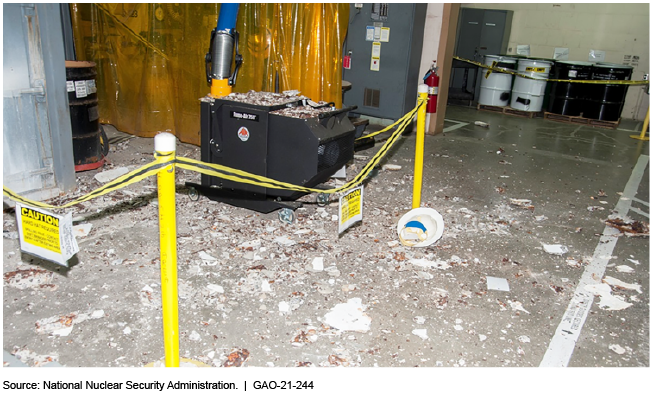
In 2014, a 300-pound slab of concrete fell from the ceiling of a building used to process lithium in Oak Ridge, Tennessee.
Highlights
What GAO Found
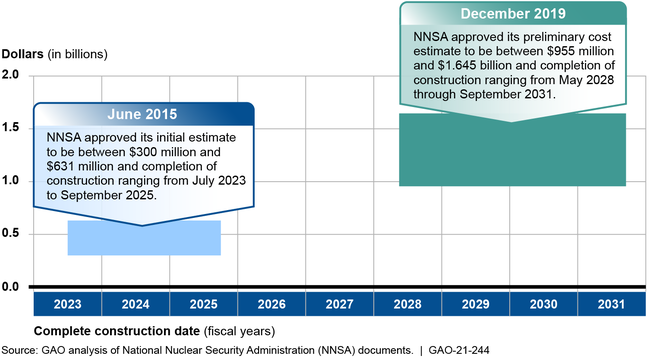
In December 2019, the National Nuclear Security Administration (NNSA) preliminarily estimated construction would cost between $955 million and $1.645 billion for a new lithium processing facility (LPF) at the Y-12 National Security Complex (Y-12) in Tennessee and would be completed between May 2028 and September 2031. This is a substantial increase in cost and schedule; in 2015, NNSA initially estimated that a new facility would cost between $300 and $631 million and could be completed between 2023 and 2025. One reason for the cost and schedule changes is increased facility size, as reflected in a more mature design. GAO's evaluation of the LPF's preliminary cost estimate found it to be substantially comprehensive. NNSA also plans to include a new technology in the facility design based on its most recent technology assessment. In this assessment, NNSA did not collect certain data needed to fully evaluate the lithium produced with the technology. GAO best practices recommend agencies ensure all necessary evidence is collected when assessing the maturity of a new technology. Otherwise, NNSA faces some risks to ensuring the technology is ready to start construction in 2024 and could face future delays to the LPF if testing reveals unexpected problems with lithium produced with this technology.
Preliminary Cost and Schedule Estimates for NNSA's New Lithium Processing Facility Increased Over Timea
aNNSA's estimates are reported as actual dollars and were not adjusted for inflation.
Important program management tools that NNSA could use to help ensure that the agency meets lithium demand are under development and are not consistent with best practices. For example, the lithium program's current schedule and scope of work—as expressed in a work breakdown structure—do not track the same program activities. According to GAO best practices, a program's schedule should be aligned with its work breakdown structure to ensure that activities are completed on time. By aligning these management tools, NNSA could help ensure that the comprehensive scope of work for the program is reflected in the schedule and that NNSA is accomplishing all program activities on time.
Why GAO Did This Study
Since the 1940s, the nation's supply of lithium used in some nuclear weapons components has been processed at NNSA's Y-12 site. However, due to deteriorating facilities and equipment and the need to reestablish dormant processing capabilities, NNSA faces risks in meeting future lithium demand. To address these challenges, NNSA has developed a strategy to meet lithium demand until the 2030s, by which time it expects the new LPF will be fully operational.
The Senate committee report accompanying the National Defense Authorization Act for Fiscal Year 2020 includes a provision for GAO to examine NNSA's lithium programs and projects. GAO's report examines, among other things, (1) the status of current cost and schedule estimates and design activities for NNSA's LPF project and (2) the extent to which NNSA has developed management tools for the lithium program that are consistent with best practices.
GAO reviewed NNSA and contractor documentation, compared NNSA's efforts against agency requirements and best practices, and interviewed NNSA officials and Y-12 contractor representatives.
Recommendations
GAO is making seven recommendations, including that NNSA should ensure important data are collected for future technology assessments and align the program schedule with the scope of work. NNSA agreed with five and agreed in principle with two recommendations, noting actions taken. GAO believes NNSA needs to take additional actions, as discussed in the report.
Recommendations for Executive Action
| Agency Affected | Recommendation | Status |
|---|---|---|
| National Nuclear Security Administration | The Lithium Modernization Program Manager and the Federal Project Director for the LPF project should ensure that a TRA plan is documented, including a comprehensive assessment that ensures all key information is obtained by the TRA team to conduct future TRA assessments. (Recommendation 1) |
After several years of delays, NNSA completed this TRA in May 2025. NNSA's independent Office of Cost Estimating and Program Evaluation (CEPE) performed a comprehensive evaluation of the TRA plan and execution in September 2025. CEPE concluded that the 2025 Lithium Homogenization TRA was performed in compliance with NNSA's NAP 413.4, Technology Readiness Assessments and found the report comprehensive and complete. CEPE's report also found that the TRA substantially followed 26 of the 30 TRA best practices that GAO identified, including a documented plan. CEPE's report found that the TRA partially met four others, but CEPE deemed these to be minor issues in terms of project risk. We reviewed the TRA plan and CEPE's comprehensive evaluation and believe NNSA's actions address this recommendation, including documenting a TRA plan that should include the key information needed for future TRA assessments.
|
| National Nuclear Security Administration | The Lithium Modernization Program Manager and the Federal Project Director for the LPF project should take steps to ensure that all key data are collected and assessed before completing future TRA assessments and achieving key project milestones. (Recommendation 2) |
After several years of delays, NNSA completed this TRA in May 2025. NNSA's independent Office of Cost Estimating and Program Evaluation (CEPE) performed a comprehensive evaluation of the TRA plan and execution in September 2025. CEPE concluded that the 2025 Lithium Homogenization TRA was performed in compliance with NNSA's NAP 413.4, Technology Readiness Assessments and found the report comprehensive and complete. CEPE's report also found that the TRA substantially followed 26 of the 30 TRA best practices that GAO identified, including a documented plan. CEPE's report found that the TRA partially met four others, but CEPE deemed these to be minor issues in terms of project risk. We reviewed the TRA plan and CEPE's comprehensive evaluation and believe NNSA's actions address this recommendation, including that the LPF project should have steps in place to include key data are collected and assessed before completing future TRA assessments and milestones.
|
| National Nuclear Security Administration | The Lithium Modernization Program Manager and the Federal Project Director for the LPF project should complete and document management reviews of the TRA process following the completion of future TRAs. (Recommendation 3) |
After several years of delays, NNSA completed this TRA in May 2025. NNSA's independent Office of Cost Estimating and Program Evaluation (CEPE) performed a comprehensive evaluation of the TRA plan and execution in September 2025. CEPE concluded that the 2025 Lithium Homogenization TRA was performed in compliance with NNSA's NAP 413.4, Technology Readiness Assessments and found the report comprehensive and complete. CEPE's report also found that the TRA substantially followed 26 of the 30 TRA best practices that GAO identified, including a documented plan. CEPE's report found that the TRA partially met four others, but CEPE deemed these to be minor issues in terms of project risk. Overall, the NNSA planned and executed the Lithium homogenization TRA successfully and allowed the technology to advance from TRL-6 to TRL-7. We reviewed the TRA plan and CEPE's comprehensive evaluation and believe NNSA's actions address this recommendation, including that the LPF project should have a process to complete and document management reviews of the TRA process for future TRAs.
|
| National Nuclear Security Administration | The Lithium Modernization Program Manager should ensure that the lithium modernization work breakdown structure captures the complete scope of work of lithium activities and should update the work breakdown structure in the event of future changes in scope. (Recommendation 4) |
In their response to our recommendation, NNSA stated their work breakdown structure only includes the scope of work that is funded by the Lithium program. We disagree that the lithium work breakdown structure (WBS) captures the complete scope of work for the Lithium Modernization Program. NNSA provided us a copy of its updated WBS on August 16, 2023. The WBS continues to reflect only the activities of the Lithium program. GAO suggested that the Secondary Program Office might be at the right level to integrate and coordinate the WBSs of the Enriched Uranium, Depleted Uranium, and Lithium programs. well as their integrated master schedules. NNSA, however, told us it has no plans to do so and maintains that stance.
|
| National Nuclear Security Administration | The Associate Administrator for Defense Programs should update its Defense Programs Program Execution Instruction to include the requirement that programs' work breakdown structures use the NNSA-wide common work breakdown structure. (Recommendation 5) |
In September 2021, NNSA updated its Defense Program's Program Execution Instruction to include the requirement that programs' work breakdown structures use the NNSA-wide common work breakdown structure.
|
| National Nuclear Security Administration | The Lithium Modernization Program Manager should align the program's integrated master schedule and work breakdown structure and do so continuously, following best practices for managing and integrating program scope, schedule, and cost. (Recommendation 6) |
In their response to our recommendation, NNSA stated they plan to continue to update their integrated master schedule (IMS). However, the current IMS and WBS (both dating to August 2023) do not match as there are items in the schedule that are not captured in the WBS. In January 2025, NNSA provided further documentation of WBS and IMS documentation. This documentation does not appear to be responsive to our recommendation. We will continue to track it through recommendation follow-up and future Li work.
|
| National Nuclear Security Administration | The Lithium Modernization Program Manager should develop a life-cycle cost estimate that aligns with the work breakdown structure and integrated master schedule, following best practices for managing and integrating program scope, schedule, and cost. (Recommendation 7) |
In their response to our recommendation, NNSA stated they plan to develop a life-cycle cost estimate after the lithium processing facility (LPF) project reaches its next critical project milestone (CD-2), an event then anticipated to occur until May 2026. On August 16, 2023, NNSA reaffirmed this position, arguing that Design Approval (CD-2) needs to be reached before life cycle costs are determined. In January 2025 NNSA again reaffirmed this position, but in May 2025 announced that it was re-assessing LPF because of cost growth beyond its CD-1 estimate. Because a cost range is developed at Preliminary Design CD-1, we continue to believe NNSA has sufficient data to begin to estimate the life cycle costs of the program. Best practices call for the early development of cost estimates that are refined over time.
|