
Inside the IRS's Use of Artificial Intelligence
It’s that time of year, again—tax season! As you’re trying to fill out forms and submit your annual tax return this season—you may need help with a question or other assistance. The IRS is embracing Artificial Intelligence as a tool for improving taxpayers’ experience. AI is also being used to help select tax returns for audits, root out tax fraud, and generally improve operations.
In a new report, we looked at how IRS uses AI and what it might mean for you. Today’s WatchBlog post looks at our report.
Image

How is IRS using Artificial Intelligence?
The IRS has used AI for many years. But recently, there’s been an increase in AI tools that taxpayers may interact with—such as voicebots that answer taxpayers’ questions over the phone.
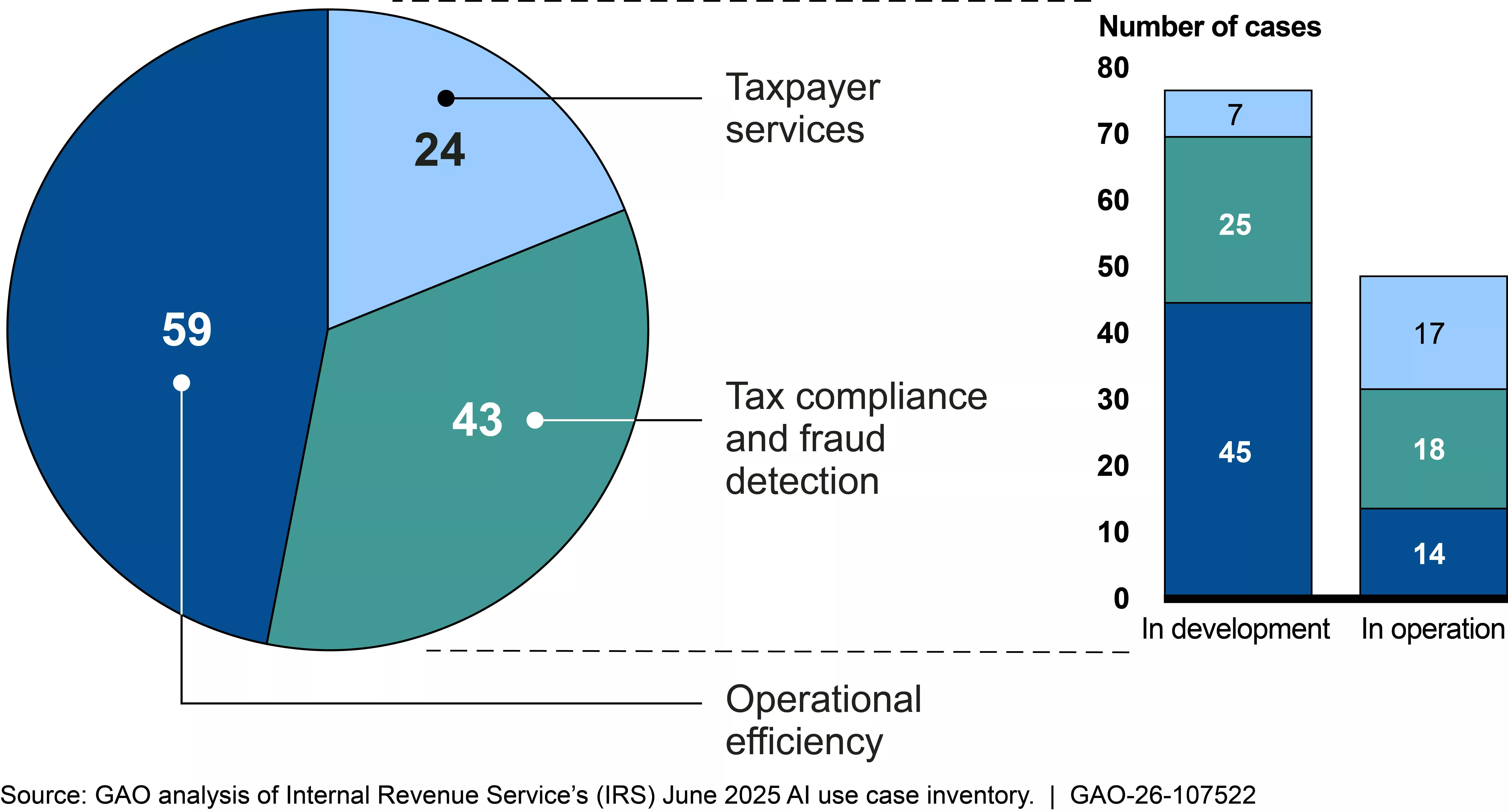
As of last summer, IRS had 126 active AI use cases, meaning applications of AI for particular business or operational needs. Each use case falls primarily into one of three buckets—taxpayer services (like the chatbots), operational efficiency (like automatic meeting summaries), or tax compliance and fraud detection (like helping audit selection). Most of these applications were still in development, as of last summer. But some were in operation.
IRS Artificial Intelligence Use by Category and Status (in development or in operation)
Image
How is AI improving IRS’s operations and taxpayers’ experiences? As with any new technology, AI use comes with concerns—including those about privacy and oversight. We have several reports about how the federal government is balancing AI advancements with these concerns. But today, we’re focused on how IRS is aiming to use AI to move more quickly, and, in some cases, reduce staff workload. For example,
- Answering common taxpayer questions more quickly. Voicebots and chatbots allow taxpayers to get information about their accounts, status of refunds, balances due, payment plans, and other routine questions. This could free up staff to answer more complicated questions that taxpayers have.
- IT modernization. IRS has some very old IT systems, including one system that uses a 60-year-old coding language. Several AI tools aim to help IRS understand that old code and rewrite it in modern coding languages. IRS said this will help it modernize IT systems much sooner than without AI.
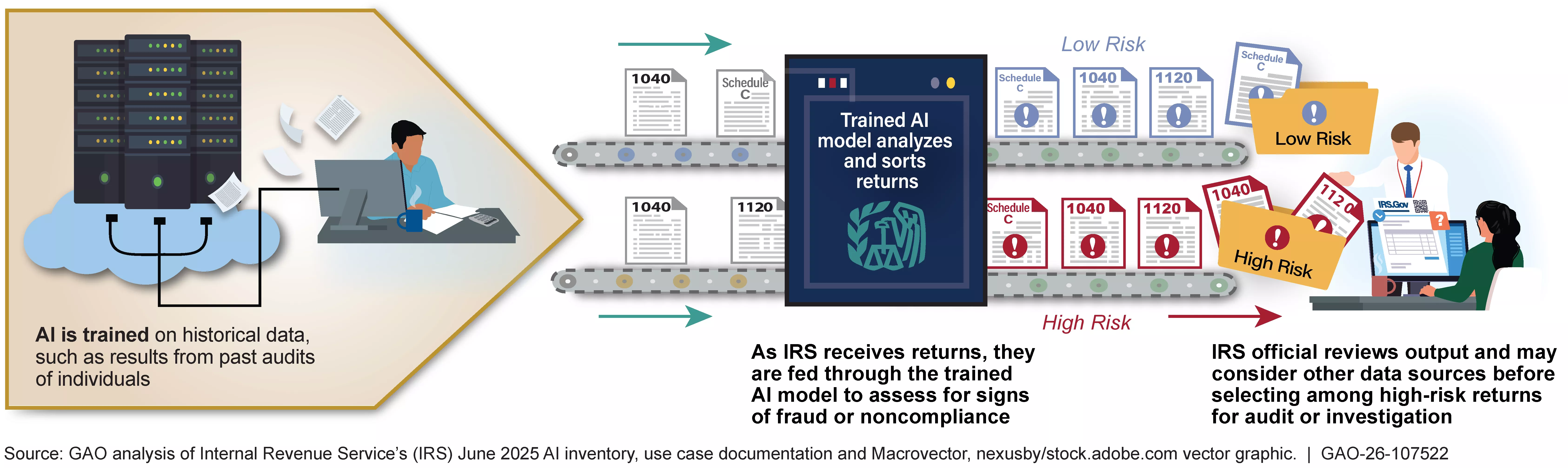
- Workload prioritization. AI is being used to review large volumes of tax and other data to assist staff in identifying which tasks to prioritize. AI is also helping to identify which returns are at highest risk for noncompliance with tax law and may need immediate attention.
Example of How AI Can Help With Tax Compliance and Fraud Detection
Image
What’s the future of IRS’s AI use?
IRS officials say they plan to continue using and expanding the use of AI to find new ways to improve the taxpayer experience and agency operations. But recent changes in funding and staffing may impede these efforts.
Funding changes. In 2022, IRS received $79.4 billion to help modernize its operations—including with AI. Subsequent laws have rescinded or prevented IRS from spending more than half of that amount, reducing it to $25.9 billion. As a result, IRS will need to assess which AI tools provide the greatest return on investment for the agency.
Staffing changes. In 2025, IRS lost approximately 20% of its staff. These major staff reductions could greatly affect IRS’s ability to develop and use AI. For example, officials in IRS’s Research, Applied Analytics and Statistics group (which supports AI development, oversight, and use) said they lost 63 employees, who had been working full or part-time on AI.
As IRS works to overcome these challenges, there are steps it could take to help improve its AI efforts. First, IRS could improve the quality of information in its inventory of AI uses. For example, we found that, in more than 25% of use cases, IRS didn’t say how AI was expected to benefit the agency. We also found several AI tools that officials said were being used to help build criminal cases against tax cheats. But these tools weren’t in IRS’s inventory.
Similarly, IRS needs to look at its overall oversight of AI. This includes how AI investments are being managed across the agency and ensuring AI use contributes to agency-wide goals. We made recommendations to IRS about steps it could take to address these and other issues.
To learn more about IRS’s use of AI, check out our full report.
- GAO’s fact-based, nonpartisan information helps Congress and federal agencies improve government. The WatchBlog lets us contextualize GAO’s work a little more for the public. Check out more of our posts at GAO.gov/blog.
- Got a question or comment? Email us at blog@gao.gov.
GAO Contacts
Image



Related Products

GAO's mission is to provide Congress with fact-based, nonpartisan information that can help improve federal government performance and ensure accountability for the benefit of the American people. GAO launched its WatchBlog in January, 2014, as part of its continuing effort to reach its audiences—Congress and the American people—where they are currently looking for information.
The blog format allows GAO to provide a little more context about its work than it can offer on its other social media platforms. Posts will tie GAO work to current events and the news; show how GAO’s work is affecting agencies or legislation; highlight reports, testimonies, and issue areas where GAO does work; and provide information about GAO itself, among other things.
Please send any feedback on GAO's WatchBlog to blog@gao.gov.